


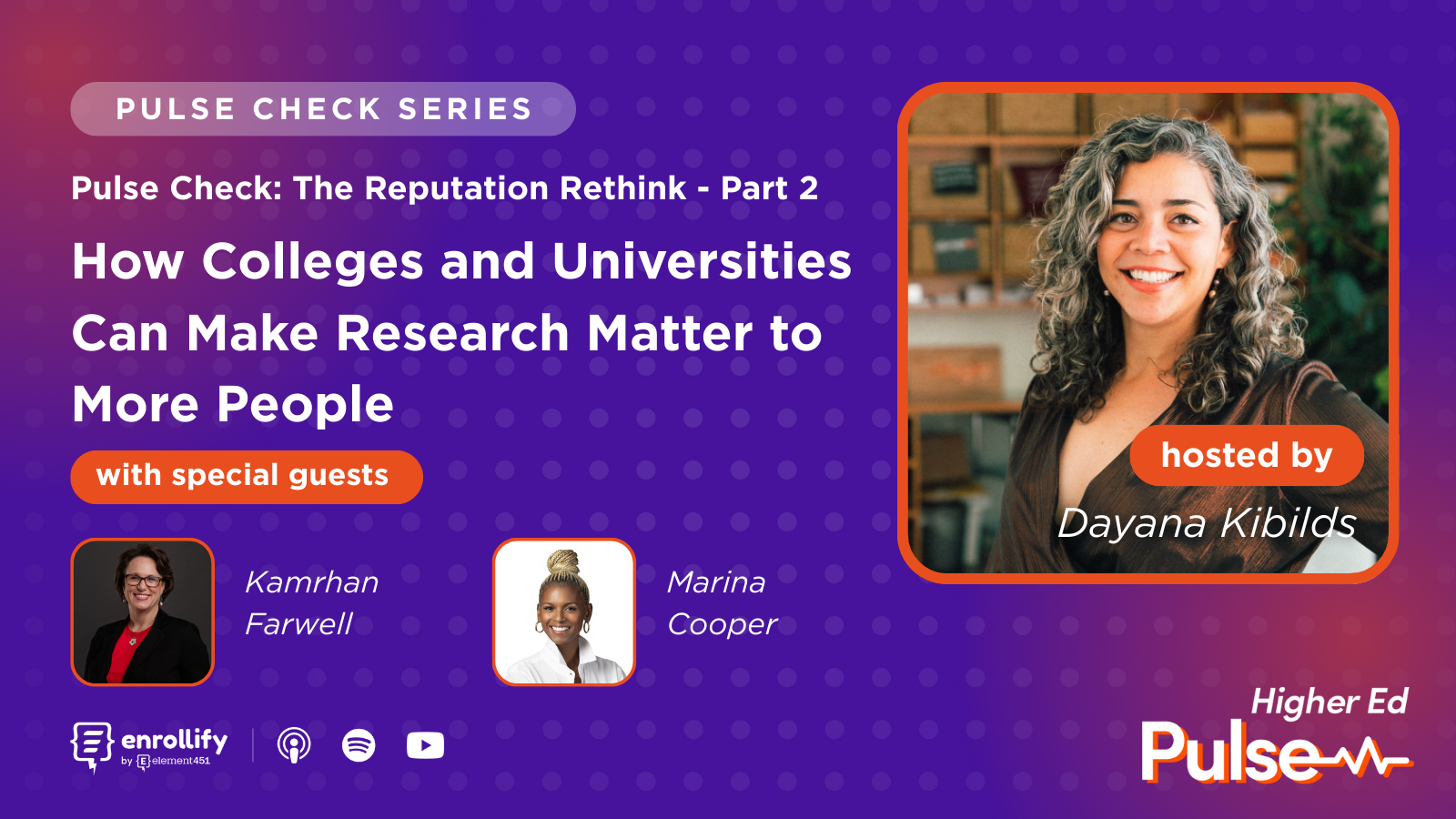




About the Episode
About The Episode:
People believe research matters. What they don’t always see is how it shows up in their lives.
In this episode of Pulse Check: The Reputation Rethink, host Dayana Kibilds digs into one of the clearest findings from Ologie’s national study: across politics, geography, and education level, the public overwhelmingly agrees that research — especially in STEM and medicine — is higher education’s most important contribution beyond teaching.
And yet, only about two-thirds of people believe colleges and universities are actually making an impact through research.
So what closes that gap? Clearer storytelling.
Day is joined by two higher ed communications leaders who have built national campaigns around that exact idea:
- Marina Cooper, Senior Associate Vice President for Integrated Marketing and Brand at Johns Hopkins University, behind the Research Saves Lives campaign
- Kamrhan Farwell, Senior Vice President of University Relations at Boston University, behind the You Are Why campaign
Together, they unpack how research storytelling can:
- Make complex work feel real and relevant
- Build public trust without politicizing the message
- Mobilize partners across campus, government, and advancement
- Energize internal communities as much as external audiences
Episode’s Main Topics
Why is Research Is Higher Ed’s Strongest Shared Value?
Day opens the episode with a key insight from The Reputation Rethink: research is the area where the public most strongly agrees on higher education’s value — across political, geographic, and demographic lines.
The Research Agreement vs. the Research Gap
While 90% of respondents say research is higher ed’s most important contribution beyond teaching, only about two-thirds believe universities are actually making an impact. The group unpacks why that disconnect exists.
04:45 – Why the Public Asked for Stories, Not More Studies
When asked what would change their perception of research impact, people didn’t ask for more data. They asked to better understand what already exists — through stories that connect research to real outcomes.
Why Does the Public Ask for Stories, Not More Studies?
When asked what would change their perception of research impact, people didn’t ask for more data. They asked to better understand what already exists — through stories that connect research to real outcomes.
Inside Boston University’s “You Are Why” Campaign
Kamrhan explains how BU reframed research storytelling by pairing researchers with the people they help, creating short, emotional videos that highlight motivation, humanity, and impact.
Johns Hopkins’ “Research Saves Lives” Framework
Marina shares how Hopkins built a flexible, open-source campaign that empowers researchers and communicators to tell their own stories — making research feel tangible and urgent without oversimplifying it.
How Can One Story Travel Across Audiences?
Both guests break down how the same core story can be adapted for government relations, alumni, advancement, social media, campus pride, and public audiences.
Balancing Global Reach With Local Impact
The conversation explores how global research institutions can still demonstrate deep local value — through jobs, partnerships, economic impact, and visible community engagement.
How do you Build a Repeatable Research Story Pipeline?
From BU’s The Brink magazine to Hopkins’ internal content hackathons, the guests share how they systematically surface the right stories instead of relying on ad hoc ideas.
What Actually Makes a Research Story Work
Clear impact, passionate communicators, human stakes, and the discipline to tell the story simply — sometimes in just 30 seconds.
What Changed After These Campaigns Launched?
The campaigns didn’t just drive views and reach. They boosted internal pride, trustee engagement, fundraising alignment, and a shared sense of purpose across campus.
Final Advice for Research Communicators
Quality over quantity. Find the stories people can feel. Tell them clearly. Repeat them relentlessly. And get them out into the world while they’re relevant.
Resources Mentioned in This Episode
The Reputation Rethink (Ologie Research Report)
Download the full report and explore the findings and recommendations.
Day’s Blog about the Report
Read more commentary and thoughts from Day about the research findings from The Reputation Rethink.
John Hopkins’ Research Saves Lives Campaign
Boston University’s You Are Why Campaign
The Brink (Boston University’s research magazine)
The Brink is a university publication that delivers the latest news from Boston University research. The Brink explores topics such as capturing the first-ever image of a black hole, making leaps in our understanding of why CTE hits some people harder than others, or finding new links between human activities and our changing environment. Our faculty and students are on the cutting edge of new discoveries. Read The Brink.
Enrollify is produced by Element451 — the next-generation AI student engagement platform helping institutions create meaningful and personalized interactions with students. Learn more at element451.com.


.svg)
.svg)
