






About the Episode
About the Episode:
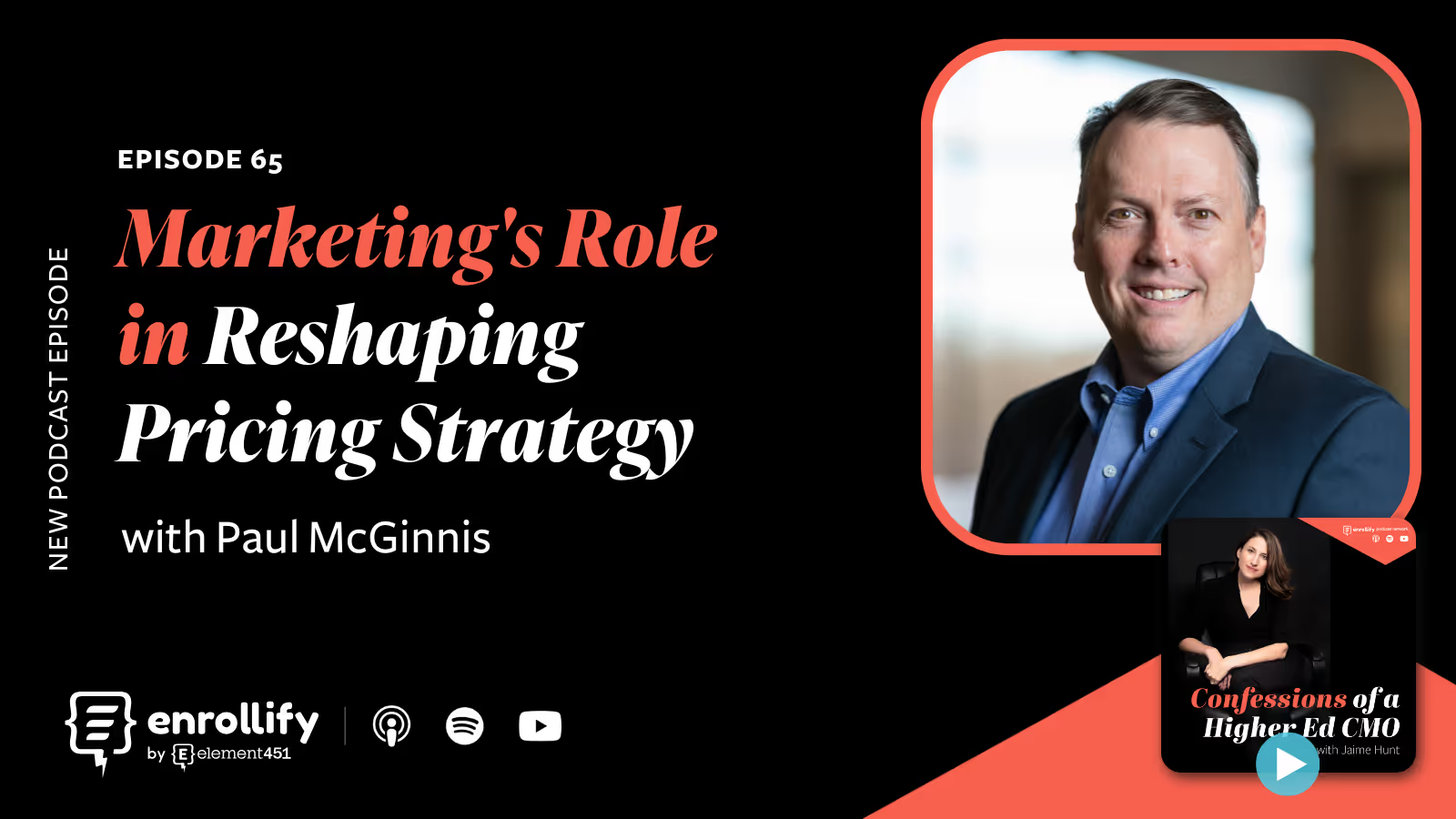
Every marketer knows the four Ps–Product, Price, Place and Promotion–but it is the rare higher ed marketing leader who gets to have a voice in anything beyond just Promotion. In this episode, Jaime sits down with Paul McGinnis, vice president for marketing and enrollment at Bethel University, to talk about how he led the charge to completely transform Bethel’s pricing strategy with a tuition reset.
Takeaways for this episode include insights into:
- why Bethel felt it was important to move toward tuition transparency
- why marketing led the charge – and how they tackled this massive undertaking
- how they communicated the change both internally and externally
- how a tuition reset could help struggling colleges make important changes that impact their trajectory
- why Jaime and Paul think that tuition transparency is an issue every higher ed leader needs to be considering
Why Did Bethel University Decide to Reset Its Tuition?
Bethel University’s tuition reset, reducing the sticker price from $44,000 to $26,000, aims to simplify the decision-making process for prospective students and families. Paul McGinnis explains that the traditional high-price, high-discount model was particularly confusing and daunting for first-generation and underrepresented students who might not understand financial aid mechanisms. Paul shares how the pandemic stalled early efforts but eventually catalyzed discussions on aligning tuition with Bethel’s mission and delivering on promises of transparency.
How Did Bethel Evaluate Value vs. Cost?
Paul emphasizes that this tuition repositioning wasn't driven solely by enrollment goals but was part of Bethel’s mission to support students’ access to quality education without financial misrepresentation. To evaluate their pricing strategy, Bethel’s marketing team, with Paul at the helm, facilitated a “positioning exercise” involving faculty and administration to honestly assess where the institution stands in relation to competitors. This exercise confirmed that Bethel’s sticker price had outpaced its perceived value, creating barriers to enrollment. Through collective insights, the team realized that the institution’s value proposition had to align with what families were willing to pay.
How Did Mission and Transparency Influence Bethel’s Approach?
At the heart of this initiative is Bethel’s mission to serve students who are looking to grow academically and spiritually. Recognizing that high costs could deter mission-aligned students, Bethel opted for transparent pricing, adopting “clear, simple, and transparent” as the campaign message rather than focusing on affordability alone. This intentional choice underscores that while college remains an investment, Bethel’s pricing approach reflects a commitment to clear communication and access. McGinnis shares how this decision aligns with Bethel’s broader mission, prioritizing access to a faith-based education while fostering a welcoming environment for students from diverse backgrounds.
How Was the Tuition Reset Received?
The announcement received overwhelmingly positive feedback, with parents and faculty expressing gratitude for Bethel’s decision to drop the “used car” pricing model. Many prospective families, previously deterred by the high sticker price, found new hope in the simplified, transparent pricing structure. McGinnis shares several stories, including one of a prospective student who applied immediately upon learning of the tuition reset. Faculty and staff at Bethel also rallied behind the change, embracing it as a step in the right direction for the institution.
What Were Key Strategies in Communicating this Change?
Bethel undertook significant internal and external communications efforts to ensure consistency and transparency. Paul emphasizes the importance of engaging influential faculty members early on to secure buy-in and facilitate positive messaging within the community. By having faculty, board members, and marketing leaders on board, Bethel’s administration was able to communicate the new pricing model clearly. Internally, Bethel held multiple sessions for faculty and staff to explain the “why” behind the change, empowering them to discuss the reset confidently with families and students.
What Challenges and Opportunities Does this Shift Create for Higher Education?
Paul believes that Bethel’s approach to transparent tuition could serve as a model for other institutions, especially those with high discount rates and diminishing enrollment. In a landscape where the “college value” conversation is paramount, Bethel’s tuition reset offers a way forward for institutions struggling to reconcile costs with value perception. Paul also points out the regulatory risks of the current pricing model, suggesting that, if higher education doesn’t adapt to more transparent practices, external bodies may eventually mandate these changes.
To hear this interview and many more like it, subscribe on Apple Podcasts, Spotify, or our website, or search for Confessions of a Higher Ed CMO in your favorite podcast player.
Connect With Our Host:
Jaime Hunt
https://twitter.com/JaimeHuntIMC
About The Enrollify Podcast Network:
Confessions of a Higher Ed CMO is a part of the Enrollify Podcast Network. If you like this podcast, chances are you’ll like other Enrollify shows too!
Some of our favorites include Talking Tactics and Higher Ed Pulse.
Enrollify is produced by Element451 — the next-generation AI student engagement platform helping institutions create meaningful and personalized interactions with students. Learn more at element451.com.
Attend the 2025 Engage Summit!
The Engage Summit is the premier conference for forward-thinking leaders and practitioners dedicated to exploring the transformative power of AI in education.
Explore the strategies and tools to step into the next generation of student engagement, supercharged by AI. You'll leave ready to deliver the most personalized digital engagement experience every step of the way.
👉🏻 Register now to secure your spot in Charlotte, NC, on June 24-25, 2025! Early bird registration ends February 1st.






.svg)
.svg)
