


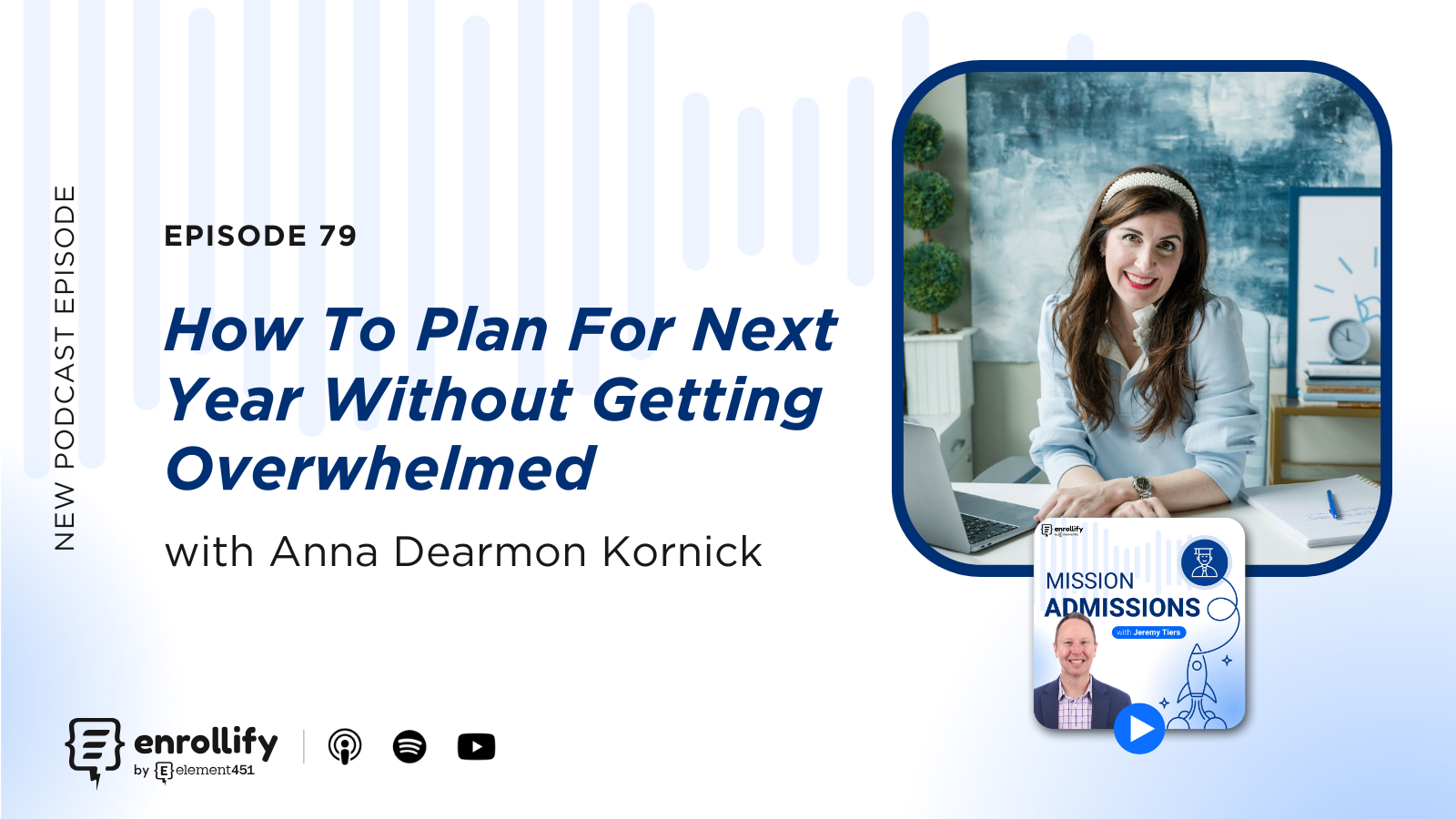




About the Episode
Got a story to tell? An innovative idea to share? Fill out our guest nomination form and let's chat!
About the Episode:
Jeremy Tiers wraps up Season 5 with returning guest Anna Dearmon Kornick, a time management coach and host of the It’s About Time podcast. This timely episode explores how higher ed professionals can use reflection, goal setting, and intentional planning to start 2026 strong—without burning out by February. Anna shares a simple three-part framework for sustainable success and actionable strategies to build habits that actually stick.
Key Takeaways
- Reflection is the first step to meaningful goal setting — avoid jumping straight into resolutions without understanding what worked (and didn’t) last year.
- Quarterly planning > annual only — regular check-ins reduce overwhelm and allow for goal flexibility throughout the year.
- Use the Clarity Compass — separate must-dos from should-dos, want-tos, and could-dos to focus on goals that actually matter.
- Accountability increases goal achievement by 95% — having a coach, colleague, or accountability partner is a non-negotiable.
- Habits that lack immediate reward are harder to stick to — build in small celebrations or wins to sustain momentum.
- Your subconscious shapes your success — writing down your roles (e.g., mom, advisor, leader) helps clarify priorities and plant mental seeds for action.
- Fewer goals = deeper results — diluted focus leads to diluted results. Aim for 3-5 meaningful goals, not 20+ that stretch you too thin.
- Time management must evolve with life seasons — different rhythms for summer, fall, and winter mean you need adaptable plans.
Episode Summary: Your Goal-Setting Questions, Answered
Why isn’t once-a-year planning enough in higher ed?
Because time management isn’t a “set it and forget it” crockpot. Anna emphasizes that our roles, responsibilities, and seasons of life shift constantly. What worked for you in July likely won’t fit in December. Intentional, consistent check-ins (quarterly or even monthly) allow you to adjust before burnout or disengagement creep in.
Why is it so hard to start new habits like weekly planning or reflection?
Simple: there’s usually no immediate payoff. Brushing your teeth feels good right away. Sitting down to plan next quarter? Not so much. That lack of instant gratification derails people quickly. Anna advises creating mini rewards or milestones that offer emotional return early and often.
What are the key life areas to reflect on before setting goals?
Forget the 7-category goal wheels. Keep it simple with Anna’s “Four Fs”: Personal, Professional, Financial, and Fun. Ask these four questions in each area:
- What went well?
- What didn’t go well?
- What did I learn?
- What am I celebrating?
How do I know which goals are worth pursuing?
Enter the Clarity Compass, Anna’s mental model that helps you separate:
- Must-Dos – Critical actions with serious consequences if neglected.
- Should-Dos – External expectations that may not align with your values.
- Want-Tos – Passion-driven goals, often delayed but deeply meaningful.
- Could-Dos – Nice-to-haves with minimal urgency or impact.
How many goals should I actually set?
Anna recommends aiming for 3–5 high-impact goals. More than that can dilute focus and hinder results. Use the rest of your ideas as “someday/maybe” items that can plug into different parts of your year as bandwidth allows.
How often should I be revisiting my goals?
Here’s Anna’s cadence:
- Annual Planning (3 hours): Set your big-picture goals.
- Quarterly Review (1 hour): Adjust based on what’s working.
- Monthly Check-In (30 minutes): Prioritize tasks and timelines.
- Weekly Planning (15-20 minutes): Translate big goals into daily actions.
What role does courage play in goal execution?
According to Anna, courage is what helps you say “no” to overcommitting, admit when something isn’t working, and stay accountable. Failure and trying again build courage far more than getting it right on the first try.
What kind of accountability works best?
There are four types of accountability:
- Self – Intrinsic motivation
- Structural – Apps, alarms, calendars
- Social – Peers or partners who check in regularly
- Supportive – Coaches or mentors who guide progress
Having just one accountability partner can make you 95% more likely to hit your goals.
Connect With Our Host:
Jeremy Tiers
https://twitter.com/CoachTiers
About The Enrollify Podcast Network: The Higher Ed Pulse is a part of the Enrollify Podcast Network. If you like this podcast, chances are you’ll like other Enrollify shows too!
Some of our favorites include Generation AI and Confessions of a Higher Education Social Media Manager.
Enrollify is produced by Element451 — the next-generation AI student engagement platform helping institutions create meaningful and personalized interactions with students. Learn more at element451.com.





.svg)
.svg)
