






About the Episode
Got a story to tell? An innovative idea to share? Fill out our guest nomination form and let's chat!
About the Episode:
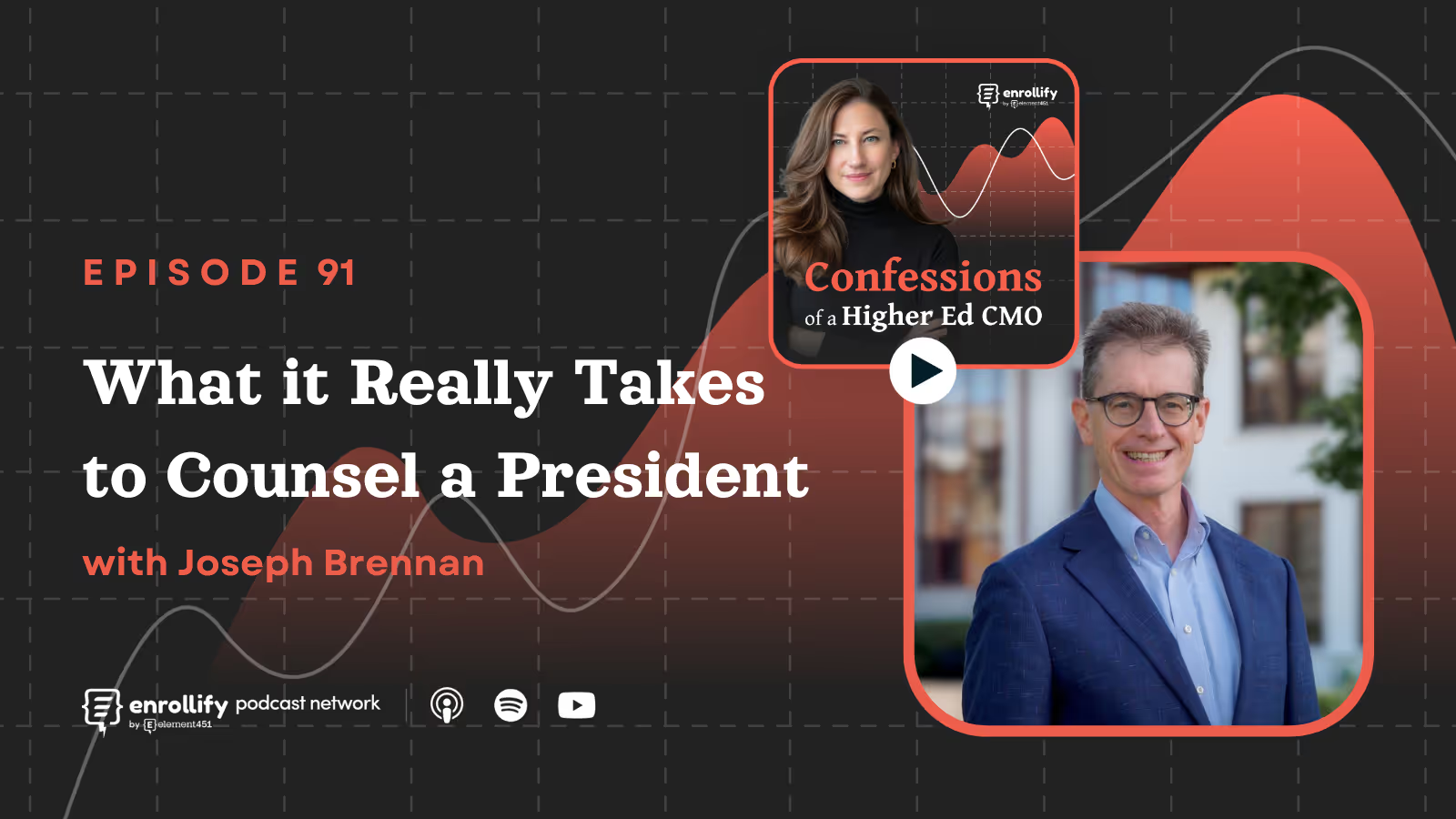
Jaime Hunt sits down with Joseph Brennan, Vice President for Communications and Marketing at Montclair State University, for a raw and riveting conversation on what it really means to counsel a university president. With over three decades in higher ed and experience advising 13 university presidents, Brennan shares how the role of CMO has evolved from tactician to trusted strategic advisor—and why communication professionals must develop executive presence, business fluency, and emotional intelligence to lead in today’s high-pressure environment.
Key Takeaways
- The role of the higher ed CMO has transformed—it now demands strategic leadership, business acumen, and deep understanding of organizational dynamics.
- CMOs must counsel presidents with clarity and confidence, bringing insights grounded in research, risk analysis, and broad institutional awareness.
- Executive presence is not optional—learn to own the room, present concisely, and build trust during moments of crisis and change.
- Emotional intelligence is mission-critical, especially in high-stakes situations where calm, grounded leadership can influence institutional direction.
- Crisis moments are opportunities to show the true value of strategic communications and earn a permanent seat at the leadership table.
- A trauma-informed mindset and leadership coaching can help communicators lead with compassion while staying resilient and effective.
The Evolution of the CMO: From Press Releases to Presidential Strategy
Once upon a time, university CMOs were tasked with viewbooks, press releases, and perhaps managing a fax machine. Today, as Joseph Brennan puts it, "we've gone from postal mail to strategic counsel." The communications leader is now expected to influence business outcomes, advise the president on everything from crises to reputation management, and oversee omnichannel campaigns that stretch across paid, earned, owned, and social media.
Brennan reflects on how the role has evolved alongside higher ed’s transformation—from an environment of abundance to one of hyper-competition. Declining demographics, rising costs, and polarized politics mean that communications professionals are not just storytellers—they’re strategic differentiators. They must tell the university’s story in a way that is human, emotionally resonant, and strategically sound.
This shift calls for a deeper understanding of university operations. Effective CMOs, Brennan argues, know how every department functions and how to influence cross-functional collaboration. They understand how to market not just to prospective students, but to alumni, donors, faculty, staff, and community stakeholders.
The Art of Counseling Presidents in High-Stakes Moments
One of the most valuable sections of the episode is Brennan’s step-by-step framework for offering presidential counsel. In high-stakes moments, leaders need guidance that’s clear, strategic, and brief. His five-step framework includes:
- Size up the situation – Quickly assess what’s at stake and what’s known or unknown.
- Present options and consequences – Offer two to three viable paths, including doing nothing, with associated risks and benefits.
- Think institutionally, not just reputationally – Counsel in terms of institutional outcomes, not just public perception.
- Acknowledge decision ownership – The final call lies with the president; your job is to inform, not insist.
- Pause for reflection – After presenting, stop talking. Give the leader time to think and respond.
Brennan emphasizes that presidential trust isn't given—it’s earned through consistent value and presence during critical moments. CMOs must cultivate the ability to stay grounded, offer sound advice without ego, and hold space for decision-making—even amidst uncertainty and pressure.
Executive Presence and Emotional Intelligence: The Power Combo
Counseling a president—or contributing meaningfully at any executive level—requires more than insight. It demands presence.
Brennan encourages CMOs to invest in developing executive presence: posture, calm tone, eye contact, and confidence. This isn’t about bravado; it’s about composure, clarity, and intentionality. Your ability to hold the room in a crisis speaks louder than any talking point.
Paired with this is emotional intelligence, or as Brennan calls it, the ability to “respond, not react.” This means grounding yourself, understanding your own triggers, and leading from a centered place—especially when others are spiraling. Host Jaime Hunt shares a personal strategy: channeling her “inner T-Rex” before difficult conversations to embody unshakable confidence and clarity.
Together, these traits enable communicators to manage their own responses, hold space for others, and maintain credibility even in chaos. When practiced intentionally, this combo is what separates tactical communicators from true strategic leaders.
Surviving the Spotlight: Managing Trauma and Finding Your Center
Another compelling section of the episode addresses what happens after the storm. Communicators often act as emotional first responders during campus crises. But when the adrenaline fades, the impact lingers. Brennan warns of the dangers of vicarious trauma and encourages higher ed professionals to seek support, decompress, and process.
Both Hunt and Brennan agree: suppressing your emotional response isn’t strength—it’s a recipe for burnout. Whether it’s through therapy, coaching, or simply a quiet moment of reflection, CMOs need practices to stay healthy and resilient.
Brennan advocates for a trauma-informed approach to leadership—acknowledging that everyone is carrying unseen weight. Communicators should lead with empathy, listen with open hearts, and avoid minimizing or comparing others’ struggles. Sometimes, just holding space is more powerful than trying to fix the problem.
Rewriting the Job Description of a CMO
In closing, Hunt poses a powerful question: If you could rewrite the job description of a university chief communications officer, what would it say?
Brennan’s answer:
“Strategic thinker and collaborator with executive presence—able to hold their ground and lead with clarity.”
He underscores the importance of curiosity, too. Hunt adds that intellectual curiosity should be a must-have trait in any modern CMO. In an industry constantly evolving, the best leaders are those who seek to understand, question assumptions, and adapt with intention.
Communicators are no longer optional players in institutional strategy—they are central to how universities survive and thrive in an era of uncertainty. This episode makes it clear: the next generation of higher ed CMOs must be coaches, connectors, counselors, and change agents.
Connect With Our Host:
Jaime Hunt
https://twitter.com/JaimeHuntIMC
About The Enrollify Podcast Network:
Confessions of a Higher Ed CMO is a part of the Enrollify Podcast Network. If you like this podcast, chances are you’ll like other Enrollify shows too!
Some of our favorites include Talking Tactics and Higher Ed Pulse.
Enrollify is produced by Element451 — the next-generation AI student engagement platform helping institutions create meaningful and personalized interactions with students. Learn more at element451.com.






.svg)
.svg)
