






About the Episode
About the Episode:
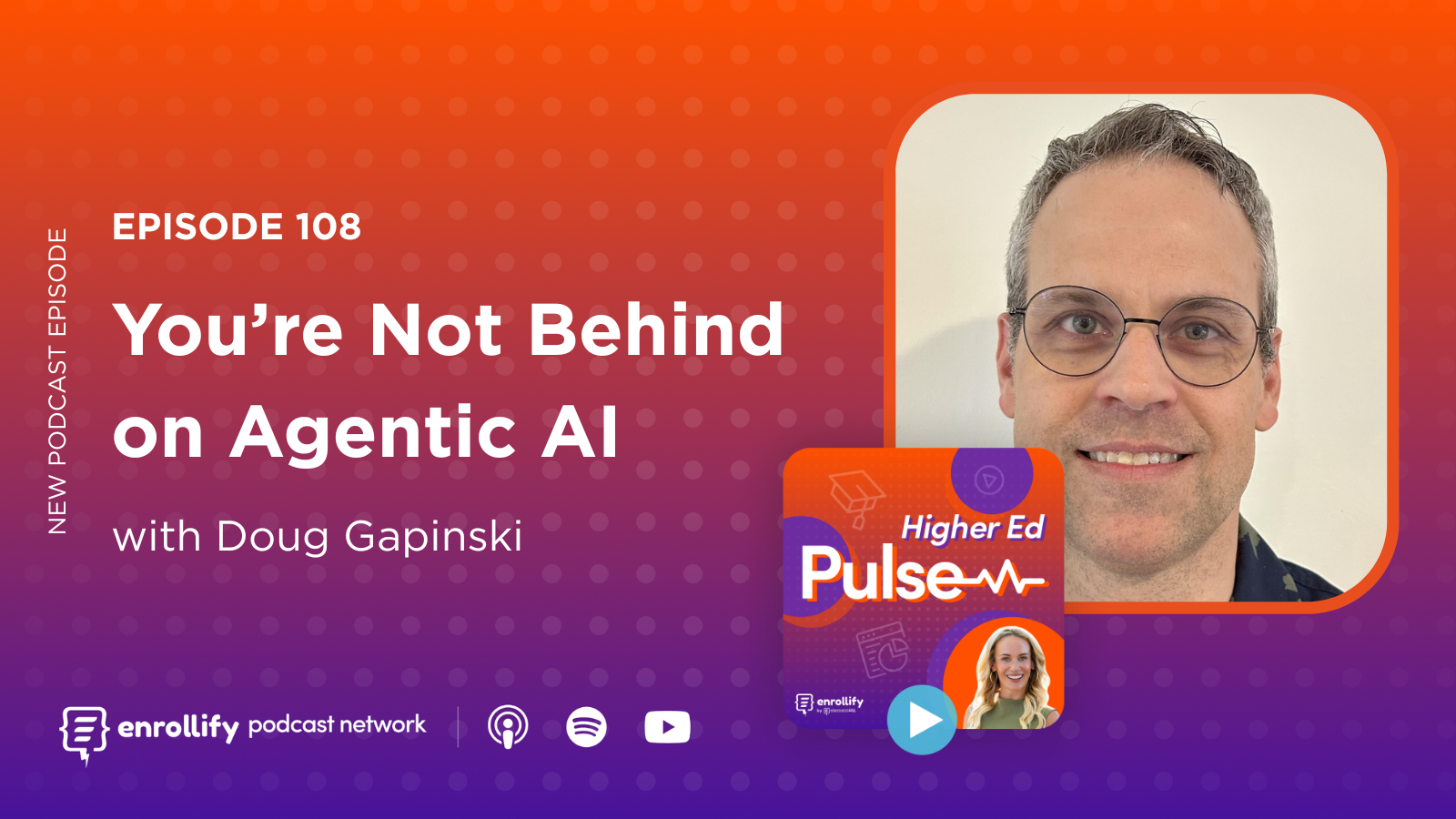
Mallory Willsea sits down with Doug Gapinski, Account Director at 8th Light, to unpack the real story behind agentic AI. While LinkedIn hype suggests autonomous agents are replacing entire teams, Doug explains that the reality inside enterprise environments is far more nuanced. Agentic AI can unlock meaningful productivity gains—but only in the right contexts with clear guardrails and clean data. This conversation offers higher ed leaders a grounded perspective on where AI agents actually work, where they fail, and how institutions should begin experimenting responsibly.
Key Takeaways
- Agentic AI isn’t magic—it’s automation with reasoning. AI agents can plan tasks, call tools like APIs, and revise their approach using LLMs, but they still rely heavily on structured inputs and clear objectives.
- Clean data and defined workflows are essential. Successful AI deployments require strong data hygiene and well-documented processes—two areas many institutions still struggle with.
- The best early use cases are “boring.” Repetitive, rules-based tasks such as data migration, reporting, and internal documentation are ideal places to experiment with AI in higher education.
- Human oversight remains critical. Agents are powerful assistants but poor decision-makers in situations involving ethical tradeoffs, compliance, or institutional values.
- Higher ed isn’t behind. Despite the noise on social media, most organizations are still experimenting. Institutions that start with small pilots now can gain meaningful productivity advantages.
- AI success is about augmentation, not replacement. The strongest use cases involve AI preparing data or insights so humans can make better decisions.
Episode Summary
What Is Agentic AI—and Why Is Everyone Talking About It?
Agentic AI refers to software systems that can pursue objectives autonomously by breaking tasks into steps, using tools, and adjusting their approach based on results. Unlike traditional bots or automation scripts, modern AI agents leverage large language models (LLMs) like GPT or Claude to reason through tasks. This enables them to handle more complex workflows, from analyzing documents to coordinating multi-step operations.
Doug explains that three major developments have fueled the recent surge in interest. First, LLMs allow agents to interpret language and data in ways that were previously impossible. Second, multi-agent orchestration enables multiple specialized agents to collaborate—similar to a team with roles like developer, reviewer, and project manager. Third, tools like Zapier and agent-building platforms have dramatically lowered the barrier to experimentation.
But despite the excitement surrounding AI in higher education and enterprise environments, the technology is still early. Many organizations are only beginning to test how agents might augment everyday workflows rather than replace them entirely.
Why LinkedIn’s AI Hype Doesn’t Match Reality
Scroll through LinkedIn and you might think AI agents are already running entire companies. Doug pushes back on this narrative, noting that most organizations are still experimenting with small-scale productivity improvements rather than transformational automation.
One major limitation is that AI agents rely on explicit knowledge. Humans operate with tacit knowledge—things we intuitively understand but rarely document. Agents, on the other hand, require structured data sources and clear instructions to perform reliably. Without those inputs, their outputs can become unpredictable.
Another challenge is something Doug calls “goal drift.” Because agents break tasks into smaller steps autonomously, they can sometimes veer away from the original objective. The result is similar to assigning a task to a junior employee and discovering they spent a full day solving the wrong problem.
For higher ed leaders thinking about AI strategy, the takeaway is simple: don’t confuse experimentation with full-scale transformation.
Where Agentic AI Actually Works Today
Despite the limitations, agentic systems are already delivering value in specific enterprise use cases. Doug shared two examples that illustrate where the technology shines.
The first involves large-scale database migration. Moving legacy data into modern systems is tedious, rule-based work—perfect for AI agents. In this case, a fleet of agents handled the process of translating structured entities from one database to another while humans monitored and refined the process. Because the workflow was well-defined and the success criteria were clear, agents could perform the task efficiently.
The second example involved building an organizational intelligence briefing system. AI agents continuously scanned internal and external sources, identifying trends and compiling daily insights for thousands of employees. Similar to an advanced RSS feed, the system synthesized large volumes of data into concise updates for leadership.
These examples highlight a pattern common across successful data analytics in higher education and enterprise systems: AI performs best when tasks are structured, repeatable, and low-risk.
The Power of “Boring” AI Use Cases
Interestingly, some of the most valuable AI implementations are also the least glamorous. Doug shared a personal example from his own workflow: automating the creation of project case studies.
By connecting a structured spreadsheet of project information to a slide template through Zapier, an AI agent automatically generates case study presentations whenever the data is updated. This seemingly simple workflow eliminates hours of repetitive formatting work each quarter.
These kinds of use cases rarely make headlines—but they add up quickly. When applied across teams, small workflow automations can produce significant productivity gains without introducing major operational risks.
For higher education teams exploring AI, the lesson is clear: start with repetitive administrative processes before tackling complex strategic decisions.
Where Higher Ed Should Not Use AI Agents (Yet)
While AI agents can streamline operations, they are poorly suited for environments where ethical tradeoffs, compliance requirements, or institutional values come into play.
Admissions and financial aid are prime examples. These processes often involve balancing competing priorities such as access, diversity, academic preparedness, and institutional revenue. Because these decisions require nuanced judgment, Doug argues that AI should assist—but never replace—human decision-makers.
Instead of making admissions decisions, for instance, AI could help prepare applicant data, summarize materials, or surface relevant insights for review committees. The same principle applies across compliance-heavy areas like visa status management, ADA accommodations, and financial aid eligibility.
In other words, AI should act as a junior assistant—not the final authority.
How Higher Ed Leaders Should Start Experimenting
So what should universities actually do right now?
Doug recommends starting with small pilot projects focused on low- to medium-stakes workflows. These early experiments allow teams to understand how agents behave while building institutional confidence in the technology.
Successful pilots share a few characteristics. The workflow should be clearly defined and easy to explain. Data sources should be structured and accessible. And humans should remain in the loop for oversight and approvals.
Equally important is managing expectations. Leaders should avoid assuming immediate cost savings or workforce reductions. Today’s most realistic outcomes are productivity improvements—helping teams accomplish existing work faster and with fewer manual steps.
Connect With Our Host:
Mallory Willsea
https://www.linkedin.com/in/mallorywillsea/
https://twitter.com/mallorywillsea
Enrollify is produced by Element451 — the next-generation AI student engagement platform helping institutions create meaningful and personalized interactions with students. Learn more at element451.com.




.svg)
.svg)
