






About the Episode
About the Episode:
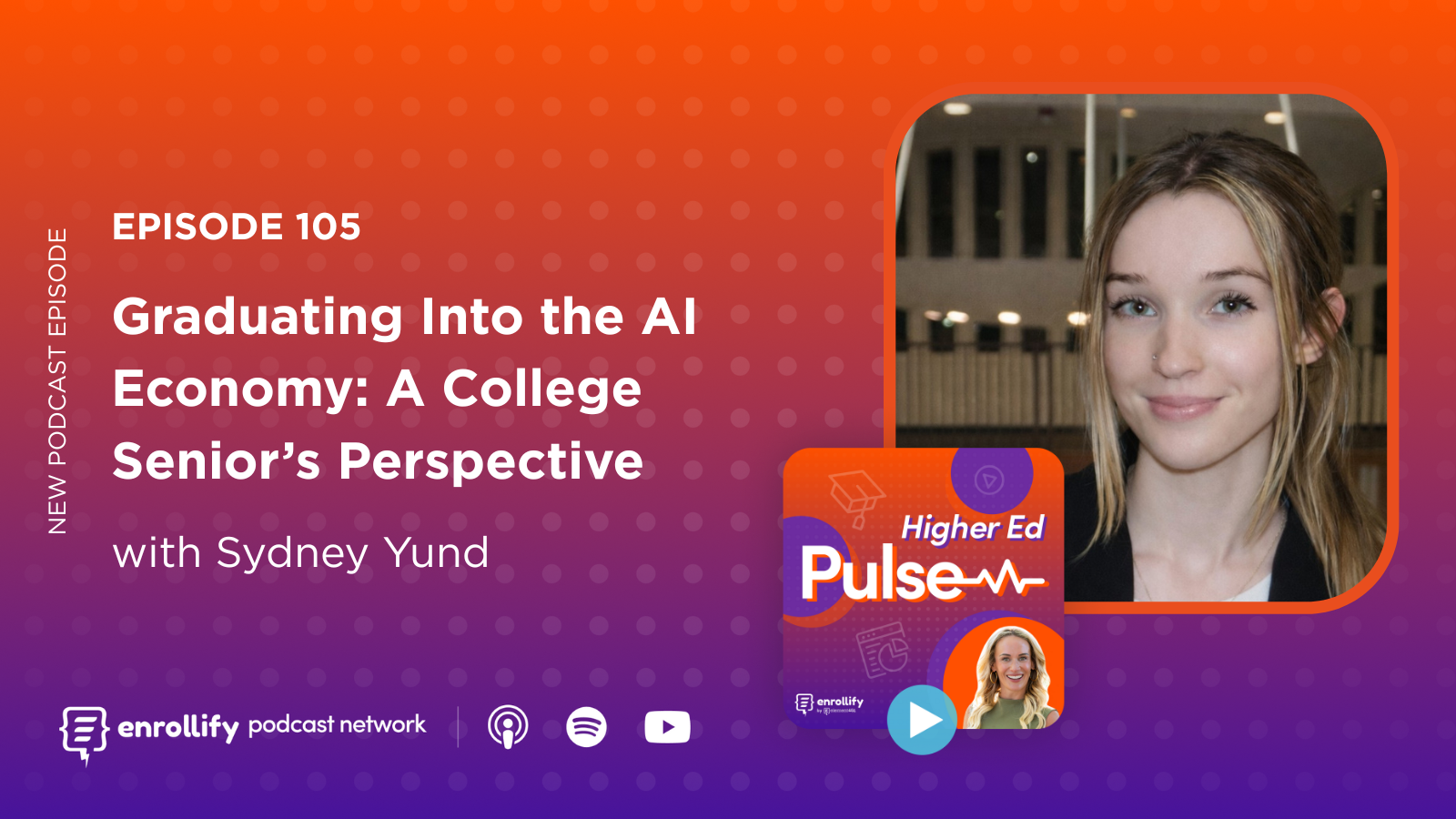
In this episode of Higher Ed Pulse, hosted by Mallory Willsea, listeners hear directly from a senior marketing major navigating AI in higher education in real time. Mallory sits down with Sydney Yund, a University at Albany student, to unpack what it means to prepare for entry-level roles in an AI-powered workforce.
From prompt engineering assignments to AI screening job applications, this conversation explores how today’s students are using generative AI tools like ChatGPT and Claude in both the classroom and internship settings. If you’re wondering whether higher ed is truly preparing students for the future of work, this episode offers a refreshingly candid—and energizing—student perspective.
Key Takeaways
- AI in higher education is no longer optional — in some marketing courses, students are penalized for not using generative AI tools.
- Prompt engineering is becoming a core marketing skill, requiring foundational marketing knowledge to guide AI outputs effectively.
- AI is reshaping entry-level roles, especially in research, content drafting, and analysis within enrollment marketing and broader business functions.
- Students are being trained to evaluate AI outputs critically, recognizing hallucinations and the risks of unchecked automation.
- AI is already embedded in hiring workflows, with HR teams using AI agents to screen resumes and cover letters.
- The future of work favors AI fluency, and students who can strategically leverage AI tools may outperform more senior professionals who resist adoption.
- Higher education institutions must rethink career readiness, aligning curriculum with evolving trends in higher education marketing and workplace expectations.
Episode Summary
How Is AI in Higher Education Changing the Classroom Experience?
Sydney makes one thing clear: AI in higher education has evolved rapidly in just a few short years. Early in her college career, professors discouraged generative AI use, labeling it as academic dishonesty. Fast forward to today, and she’s enrolled in an “AI Operators Lab” where failing to use AI can result in a failing grade. That shift signals something bigger—AI literacy is becoming foundational, not optional.
In her marketing coursework, Sydney is learning advanced prompt engineering techniques. That means assigning roles, tone, audience context, and even structured marketing frameworks (like PAS or BAB) within prompts. Rather than replacing learning, these exercises require deeper subject-matter knowledge. Students must understand traditional marketing strategy in order to guide AI effectively.
This reframes the conversation around academic integrity. The focus is no longer “Should students use AI?” but “Do students know how to use AI responsibly and strategically?” In this sense, higher education is beginning to align curriculum with the realities of modern marketing workflows.
What Does AI Mean for Entry-Level Marketing Jobs?
The viral essay referenced in the episode argues that white-collar, cognitive roles—especially entry-level ones—may shrink as AI tools take over routine drafting, research, and analysis. For a senior marketing major preparing to enter the workforce, that message initially sparked fear. If AI can draft, summarize, and analyze faster than humans, where does that leave early-career professionals?
Sydney points to marketing research and content drafting as areas with significant overlap between human skills and AI capability. Synthetic data, competitor analysis, and content ideation are increasingly AI-assisted. However, she emphasizes that AI still requires human oversight, particularly because hallucinations and fabricated insights remain common risks.
This creates a paradox: AI may compress entry-level roles, but it also levels the playing field. Junior marketers who understand AI deeply can produce output comparable to—or even surpassing—more senior professionals who resist the technology. In that sense, AI in higher education may be equipping students with a competitive advantage.
How Are Students Using Generative AI Strategically (Not Lazily)?
One of the most compelling insights from this episode is Sydney’s emphasis on nuance. She rejects the idea that AI automatically makes students lazy. Instead, she describes structured workflows: chain-of-command prompting, iterative refinement, AI self-critique, and voice-lock techniques to replicate brand tone.
These methods demand intentionality. Students must engineer prompts step by step, ensuring AI completes tasks sequentially and adheres to strategic frameworks. In other words, AI becomes a collaborator—not a crutch. The human still defines objectives, evaluates results, and applies judgment.
Sydney also highlights accessibility as a major benefit. AI tools provide broad access to knowledge, helping students brainstorm, refine, and accelerate research. If used responsibly, AI expands learning opportunities rather than diminishing them.
Is Higher Ed Truly Preparing Students for the Future of Work?
Higher education continues to promise career readiness—but what does that mean in an AI-powered economy? According to Sydney, the institutions that encourage experimentation with AI are better positioning students for modern workplaces. Companies are already embedding AI into marketing strategy, analytics, and HR workflows.
She also raises a critical point about hiring processes. AI agents are reviewing resumes and applications, meaning students must understand not only how to use AI—but how to navigate AI-driven recruitment systems. This adds another layer to student success strategies and professional preparation.
Perhaps most provocatively, Sydney suggests that organizations resistant to AI adoption may risk falling behind—just as brands like Kodak struggled during the digital revolution. For higher ed leaders and enrollment marketers, this episode serves as a wake-up call: adaptation isn’t optional.
Connect With Our Host:
Mallory Willsea
https://www.linkedin.com/in/mallorywillsea/
https://twitter.com/mallorywillsea
Enrollify is produced by Element451 — the next-generation AI student engagement platform helping institutions create meaningful and personalized interactions with students. Learn more at element451.com.





.svg)
.svg)
