






About the Episode
About the Episode:
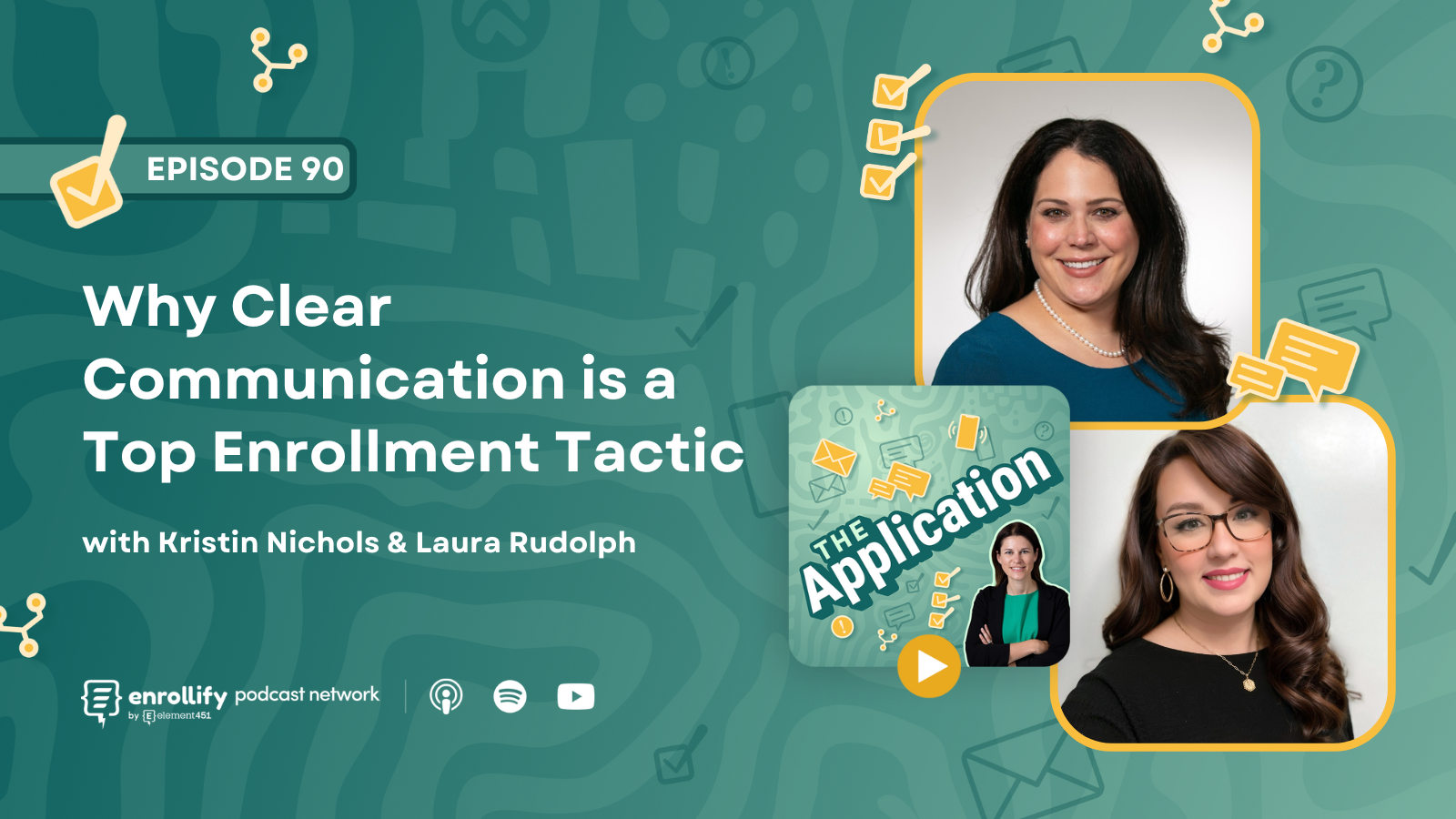
Allison is joined by Laura Rudolph, Founder and CEO of Square One Consulting, and Kristin Nichols, CMO at Massachusetts College of Liberal Arts, to unpack the “secret language” of higher education. They argue that clarity is not just a best practice, but an act of equity, leveling the playing field for all audiences. From decoding terms like “matriculate” and “bursar” to realizing “graduate” can confuse a high school senior , they show how jargon creates friction and erodes student trust. The conversation explores practical methods, including using AI at a sixth-grade reading level paired with human review, to audit and rewrite communications. They emphasize that small, free changes can lead to huge gains, like the reduction in melt-related phone calls and improved conversion rates.
Join us as we discuss:
- [2:18] Common words or phrases in higher ed that trip up prospective students
- [11:18] How to ensure your language is clear for your intended audiences
- [20:15] Finding the balance between conveying your intended message and meeting your audience where they are
To hear this interview and many more like it, subscribe on Apple Podcasts, Spotify, or our website, or search for “The Application with Allison Turcio” in your favorite podcast player.
Why Is Higher Ed Jargon Hurting Your Enrollment Marketing?
Higher education content marketing often defaults to institutional language—terms like “matriculate,” “cohort,” “registrar verification,” or even “undergraduate” and “graduate.” But as Laura points out, what feels normal inside our industry can feel like a foreign language to students and families. In one example, high school seniors selected the “graduate” application because they had already graduated high school. Logical? Absolutely. Costly? Also yes.
For institutions like MCLA, where 43% of students are first generation, clarity becomes even more critical. Kristin emphasizes that many families have never navigated the college process before. When we rely on academic, “flowery” language, we risk creating confusion—and worse, self-doubt.
This isn’t just about semantics. It’s about belonging. When students don’t understand the language, they may internalize that confusion as “I’m not smart enough to be here.” That’s not just a messaging issue—it’s a student success issue.
How Does Unclear Communication Create Mistrust?
Trust doesn’t disappear all at once. As Laura describes, it “leaks out slowly.” Every confusing email, broken link, unexplained form, or inconsistent tone between departments becomes a small withdrawal from the trust bank.
Imagine walking into a Paris restaurant without speaking French. You hesitate. You feel embarrassed. You wonder if you belong. That’s how the college process can feel for first-generation families navigating financial aid letters and admissions portals.
When enrollment marketing lacks clarity, it creates micro-moments of friction. And as Kristin calls it, it becomes “death by a thousand cuts.” By the end of the admissions cycle—especially once financial aid messaging enters the picture—students may feel overwhelmed, confused, or even alienated. In today’s competitive landscape, that’s a risk institutions can’t afford.
Where Should You Start Auditing for Clarity?
If you’re ready to improve your marketing strategy for student recruitment, start with your email campaigns and website. These are often the first touchpoints in a student’s journey—and where confusion compounds quickly.
Email is especially vulnerable. Large prospect pools, purchased names, and automated campaigns can result in overly detailed, jargon-heavy messaging with little context. If the call to action leads to a website filled with institutional language, the friction multiplies.
Kristin began at MCLA with a web enhancement project focused on storytelling and plain language. Real student voices—unedited and authentic—were embedded directly into web pages. Combined with visual clarity and value-driven messaging, the result was nearly a 50% improvement in conversion within a revamped search campaign. That’s the power of aligning higher education content marketing with how students actually think and speak.
How Can AI in Higher Education Support Clearer Messaging?
AI isn’t a replacement for human insight—but it can be a powerful amplifier. Kristin and Laura developed a playbook and AI tool designed to evaluate messaging at a sixth-grade reading level and tailor outputs to the specific student personas they serve.
The key? They trained the tool with real student input. Kristin went directly into classrooms, asking students which terms they understood—and which ones they didn’t. That human-first foundation ensured the AI tool enhanced clarity rather than replicating institutional jargon.
This is a smart example of AI in higher education being used strategically: not for automation’s sake, but to scale empathy. Writers across the institution can now pressure-test messaging before it goes live, blending AI efficiency with human review.
What About Financial Aid Communication?
Few areas impact enrollment marketing and student success strategies more than financial aid. Yet it remains one of the most confusing parts of the process.
Kristin shares a simple but powerful shift: clearly stating the total cost at the top of the financial aid package, then breaking it down transparently—similar to how car dealerships itemize sticker prices and monthly payments. Families need to understand how costs fit into their budgets and what borrowing means long term.
This change required no additional budget—just cross-functional collaboration. The result? Improved clarity, stronger trust, and measurable enrollment gains. It’s a reminder that some of the most effective trends in higher education marketing aren’t flashy—they’re foundational.
How Do You Avoid Feeling Overwhelmed by the Work?
Start small. Clarity is not a one-time project—it’s ongoing “laundry,” as Kristin says. Pick a corner and begin.
Audit one email campaign. Review your admissions and financial aid pages. Ask student ambassadors to tear apart your materials. Read your emails out loud. Give a message to someone outside higher ed and ask, “What is this asking you to do?”
These steps cost nothing—but they can dramatically improve performance indicators in education, from reduced call volume to increased form completion and higher yield rates. Every clearer message is a strategic investment in enrollment marketing effectiveness.
Connect With Our Host:
Allison Turcio
https://www.linkedin.com/in/allisonturcio/
https://twitter.com/allisonturcio
Enrollify is made possible by Element451 — the next-generation AI student engagement platform helping institutions create meaningful and personalized interactions with students. Learn more at element451.com.




.svg)
.svg)
