


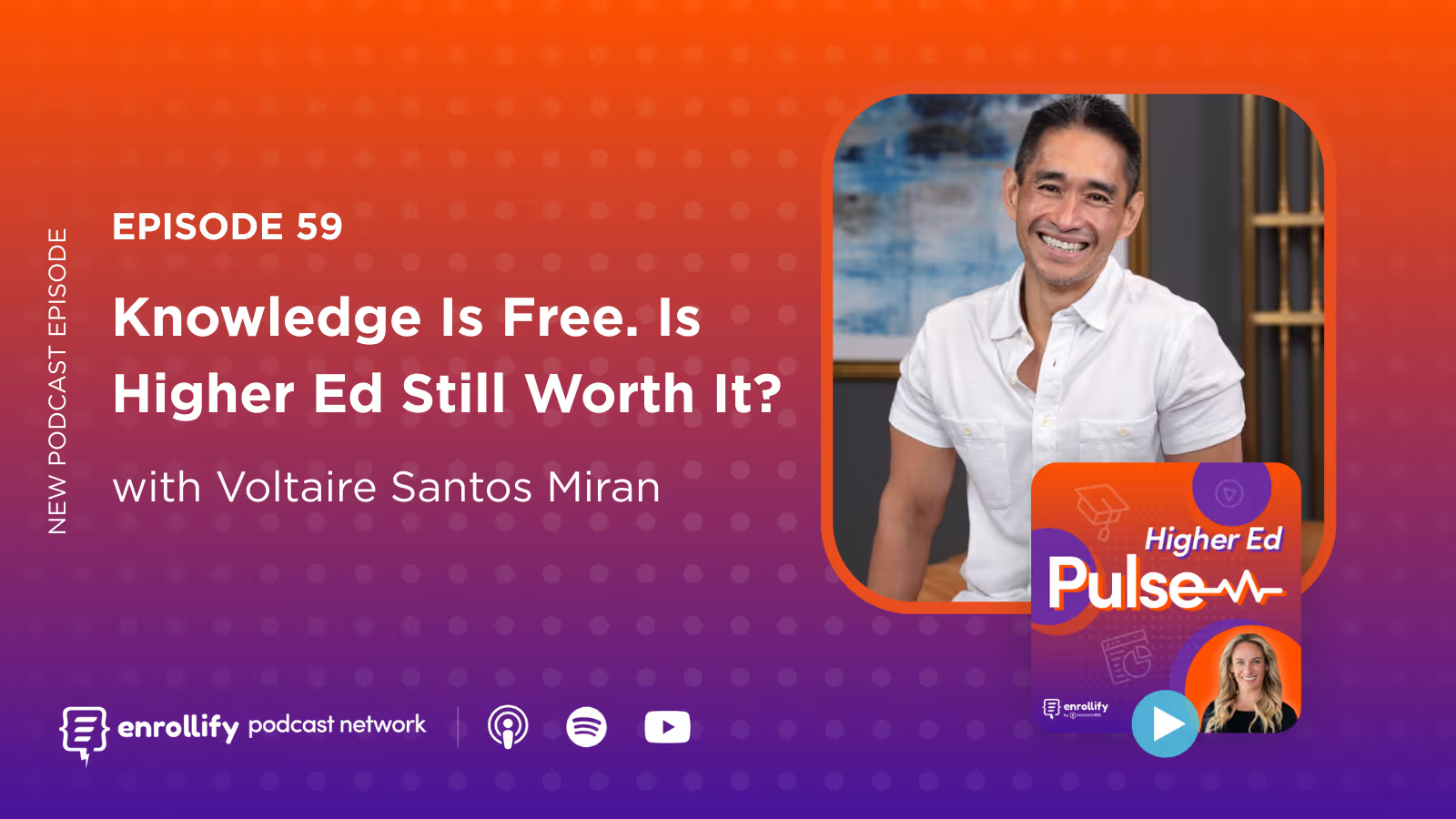




About the Episode
Got a story to tell? An innovative idea to share? Fill out our guest nomination form and let's chat!
About the Episode:
New Yorker Article: Are We Taking A.I. Seriously Enough?
In this episode of The Higher Ed Pulse, host Mallory dives into a timely conversation with digital strategist and higher ed creative force Voltaire Santos Miran. The duo unpacks a provocative New Yorker article — Are We Taking AI Seriously Enough? — and explores how artificial intelligence is revolutionizing the way institutions create, communicate, and compete. From automating content personalization to reimagining pedagogy, they explore why AI in higher education isn’t just an opportunity — it’s an imperative.
Key Takeaways
- AI is redefining digital experiences in higher ed by reducing creative fatigue and boosting personalization at scale.
- Institutions can drastically reduce time and effort in qualitative research with AI-powered analysis, freeing up teams to do deeper and broader work.
- AI’s four superpowers — content creation, text summarization, data analysis, and perspective-taking — are already transforming higher ed marketing and operations.
- Most institutions are still sitting on the AI sidelines, cautiously experimenting but not yet moving fast enough to shape the future.
- There’s a critical need for higher ed to apply AI mindfully in both business operations and pedagogy — or risk being reshaped by forces beyond their control.
How is AI changing creative work in higher ed marketing?
Voltaire opens the episode with a tangible example: the shift from writing 50 customized emails manually to crafting a single strong base and using AI to personalize it for different psychographic segments. It’s a game-changer for content scalability and fatigue reduction. Mallory and Voltaire highlight how AI not only speeds up production but also enables more tailored messaging — making marketers’ lives easier without sacrificing quality.
What’s the impact of AI on qualitative research in higher ed?
Voltaire shares how AI has transformed experience mapping — a process that used to take five to seven hours per transcript now takes just ten minutes. This time-saving unlocks the ability to gather and analyze more data, enhancing the authenticity and breadth of student and stakeholder insights. And interestingly, AI can even distinguish between thoughts and feelings more accurately than humans — helping teams craft better, more empathetic experiences.
What insights did the New Yorker article offer on AI's future role in society and higher ed?
The featured New Yorker piece frames AI as a transformative force, likening this moment to the Cambrian explosion of intelligence. Voltaire summarizes the article’s thesis into two premises and a conclusion: transformational tech always faces early skepticism, AI has already hit an inflection point, and institutions must now step up to shape — not just respond to — what comes next. If colleges don’t become part of the AI conversation, they may be written out of it altogether.
Is higher education treating AI with the urgency it deserves?
Voltaire says most institutions are still experimenting — using AI for digital ad optimization, email personalization, and content tweaks — but they’re not yet driving the conversation. While faculty are beginning to adapt their pedagogy, institutions remain largely reactive. The real threat isn’t just disruption, it’s irrelevance if higher ed doesn’t evolve faster.
What are the most practical current use cases for AI in higher education?
Voltaire pulls in a Nielsen Norman Group framework outlining AI’s "four superpowers": content creation, summarization, data analysis, and perspective-taking. From automating meeting notes to writing web copy to simulating different student mindsets, AI is showing up in tangible, productivity-boosting ways. Especially for understaffed teams, it’s the co-pilot we didn’t know we needed.
How can higher ed move from observer to participant in the AI revolution?
While some universities are forming institutes and exploring responsible AI use, Voltaire argues higher ed hasn’t yet become a visible leader in shaping AI’s societal impact. The solution? Apply AI thoughtfully in business and pedagogy, and reclaim the human-centered mission that has always defined education. AI should give us more agency — not erase our role altogether.
Connect With Our Host:
Mallory Willsea
https://www.linkedin.com/in/mallorywillsea/
https://twitter.com/mallorywillsea
About The Enrollify Podcast Network: The Higher Ed Pulse is a part of the Enrollify Podcast Network. If you like this podcast, chances are you’ll like other Enrollify shows too!
Some of our favorites include Generation AI and Confessions of a Higher Education Social Media Manager.
Enrollify is produced by Element451 — the next-generation AI student engagement platform helping institutions create meaningful and personalized interactions with students. Learn more at element451.com.
Attend the 2025 Engage Summit!
The Engage Summit is the premier conference for forward-thinking leaders and practitioners dedicated to exploring the transformative power of AI in education.
Explore the strategies and tools to step into the next generation of student engagement, supercharged by AI. You'll leave ready to deliver the most personalized digital engagement experience every step of the way.
👉🏻 Register now to secure your spot in Charlotte, NC, on June 24-25, 2025!





.svg)
.svg)
