






About the Episode
Got a story to tell? An innovative idea to share? Fill out our guest nomination form and let's chat!
About the Episode:
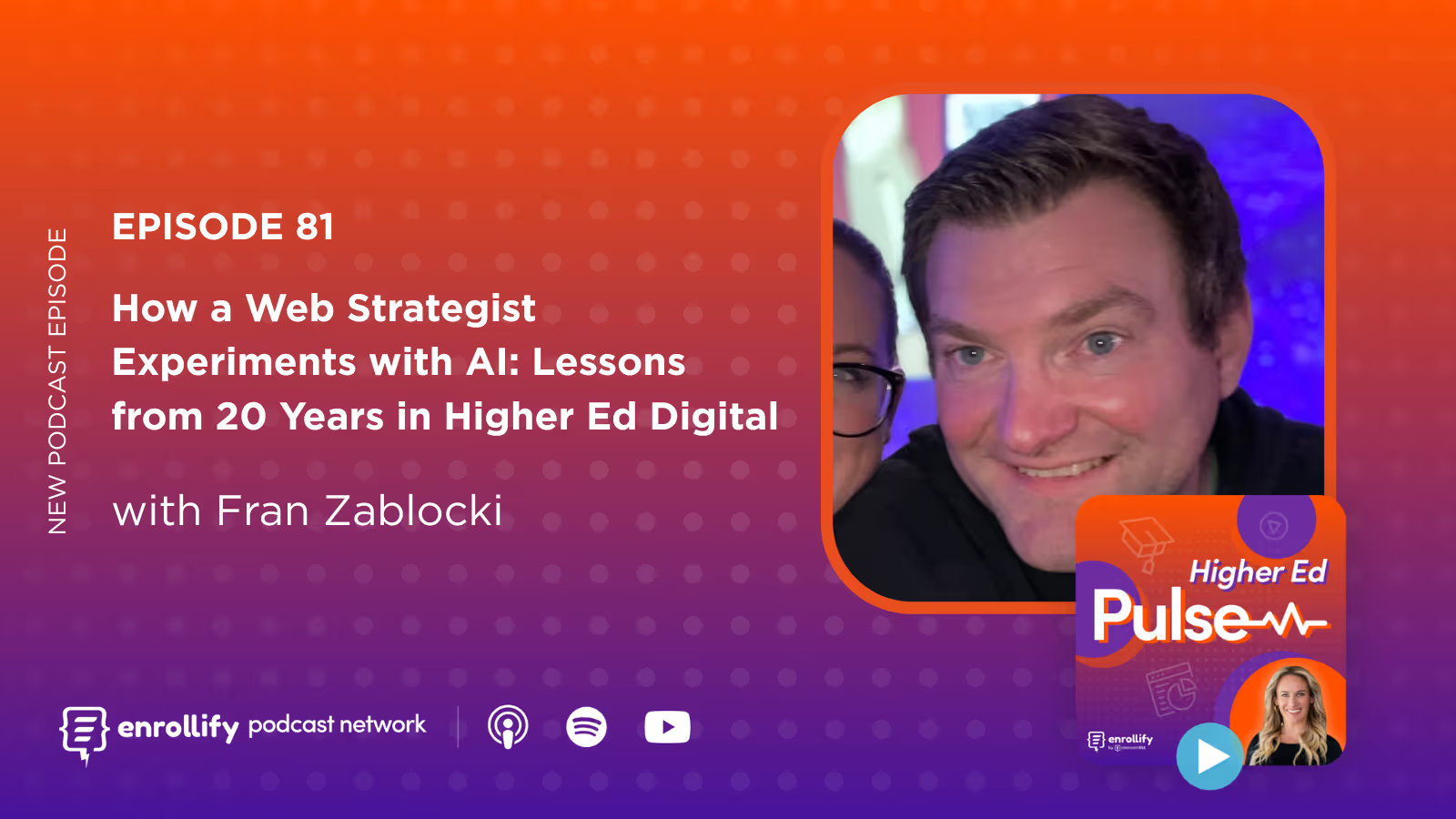
Mallory Willsea welcomes Fran Zablocki, Head of Strategy at Fastspot, to explore how artificial intelligence is transforming workflows—not by replacing human expertise, but by enhancing it. Drawing on two decades of experience in digital strategy, Fran shares how tools like Perplexity, Notion, and Claude are being integrated into agency workflows and what higher ed leaders can learn from past waves of technological disruption. If you're curious about practical AI adoption in higher education, this episode delivers fresh perspective grounded in strategy.
Key Takeaways
- AI isn’t a threat—it’s your new team of (unpaid) interns. When used intentionally, AI tools can accelerate research, reduce friction in collaboration, and improve decision-making.
- Tools like Perplexity and Claude are redefining research and prototyping. Fran shares how these AI applications speed up workflows and enhance clarity between content strategists and designers.
- AI helps, but doesn’t replace the fundamentals. Clarity, alignment with goals, and strategy still matter more than ever.
- Documentation chaos? Meet Notion AI. Fran highlights how AI-powered search transforms institutional knowledge management.
- Trust remains central. Students still value official sources more than AI summaries, making web strategy and content quality critical.
- AI experiments need boundaries. From setting internal policies to vetting outputs, AI use should be transparent, iterative, and human-guided.
Episode Summary
What makes AI feel different from past tech transformations in higher ed?
Fran makes a compelling case that AI’s breadth is what sets it apart. While previous innovations like CMS platforms or responsive design were laser-focused on improving specific parts of web infrastructure, AI spans a massive range of applications—search, content generation, coding, UX prototyping, and more. It’s not just one tool; it’s an ecosystem. That sheer scope can be overwhelming, and that’s why defining the use case is so important.
For higher ed leaders and marketers, the key is to think about how AI can serve as an extension of existing strategies—not a wholesale replacement. Fran emphasizes the importance of clarity, strategy, and aligning AI tools with specific institutional goals. In short: don’t get lost in the hype. Ground your experimentation in purpose.
How is Fastspot using Perplexity to reshape the research process?
Fran shares how Perplexity has become a go-to research assistant at Fastspot, especially when needing a high-level scan of an industry landscape or competitive set. Unlike traditional Google searches, Perplexity presents citations, conversation threading, and the ability to refine queries iteratively—making it feel more like a collaborative research session than a static search.
For enrollment marketers or comms teams who constantly perform audits or competitor research, Perplexity offers a more efficient and transparent way to gather intelligence. It’s a gateway tool—easy to test and highly relevant for everyday research workflows.
What role does AI play in managing documentation sprawl?
Let’s face it: outdated, buried documentation is a silent killer of productivity and continuity—especially in higher ed. Fastspot tackles this challenge using Notion and Notion AI to organize, search, and optimize internal documentation. With powerful search and prompt-based querying, team members can find what they need—faster.
This isn’t just helpful for onboarding new employees. It also gives existing staff better visibility into past projects and institutional knowledge. The AI-powered search functionality not only surfaces what’s useful but also helps identify what’s outdated or redundant. For campus teams with decades of docs scattered across systems, Notion AI offers a scalable path to clarity.
How does Claude support AI prototyping in agency workflows?
The jump from strategic idea to visual design has always been a bottleneck. Claude helps Fran bridge that gap. By using Claude for rough HTML or code-based prototypes, Fran can present visual ideas more clearly to design and development colleagues—skipping the need for lengthy verbal explanations or clunky sketches.
This kind of AI-enhanced prototyping doesn’t replace the design process. Rather, it acts as a fast-starting point, improving internal collaboration and saving valuable time. Whether you're reimagining a landing page or wireframing new interactions, Claude can help you get there faster—and with greater precision.
Why think of AI as a team of interns?
Fran’s favorite analogy? Treat AI tools like a team of eager interns. They have energy, potential, and can be incredibly helpful—but only with the right supervision and clear instructions. You wouldn’t hand a client deliverable to an intern without review, and the same principle applies to AI outputs.
This framing helps leaders adopt AI tools with the right balance of curiosity and caution. Try different tools. See what “intern” excels at what task. Keep the ones that truly extend your expertise—and ditch the ones that create more work than they save.
How should higher ed leaders approach AI with clients and teams?
Transparency is everything. Fran emphasizes the importance of being upfront about AI usage, especially in client work. Fastspot has implemented internal policies around AI privacy and tool usage to protect client data and ensure ethical practices. They're also encouraging experimentation, as long as it’s documented and guided by human oversight.
Fran also reminds us that higher ed teams should follow suit: establish an AI policy, test thoughtfully, and revisit often. We're all still in the trial phase, and pretending to be an AI “expert” is more dangerous than admitting you're still learning.
Where does AI actually improve the student web experience?
AI has massive potential to improve early-stage exploration for prospective students—especially in simplifying search. Think of zero-click answers, AI-generated summaries, or even chat-based exploration of programs and campus life. These tools cut through noise and help students discover relevant information faster.
That said, Fran cautions that AI summaries are only as good as their sources. And right now, Reddit, Wikipedia, and YouTube dominate the AI input stream—not official .edu sites. That means institutions need to actively manage their AI visibility. How? Monitor AI search results, optimize your digital presence on these platforms, and ensure your official website remains the source of truth.
Connect With Our Host:
Mallory Willsea
https://www.linkedin.com/in/mallorywillsea/
https://twitter.com/mallorywillsea
About The Enrollify Podcast Network: The Higher Ed Pulse is a part of the Enrollify Podcast Network. If you like this podcast, chances are you’ll like other Enrollify shows too!
Some of our favorites include Generation AI and Confessions of a Higher Education Social Media Manager.
Enrollify is produced by Element451 — the next-generation AI student engagement platform helping institutions create meaningful and personalized interactions with students. Learn more at element451.com.
Register for the AI Engage Summit — Oct 15–16, 2025
👉 Join us online from 12–4 PM ET each day for two afternoons of AI insights and training. Free to attend with on-demand access included. Register now.





.svg)
.svg)
