






About the Episode
Got a story to tell? An innovative idea to share? Fill out our guest nomination form and let's chat!
About the Episode:
Three Years In: Reflections and Considerations for the Next Chapter of AI in Higher Education
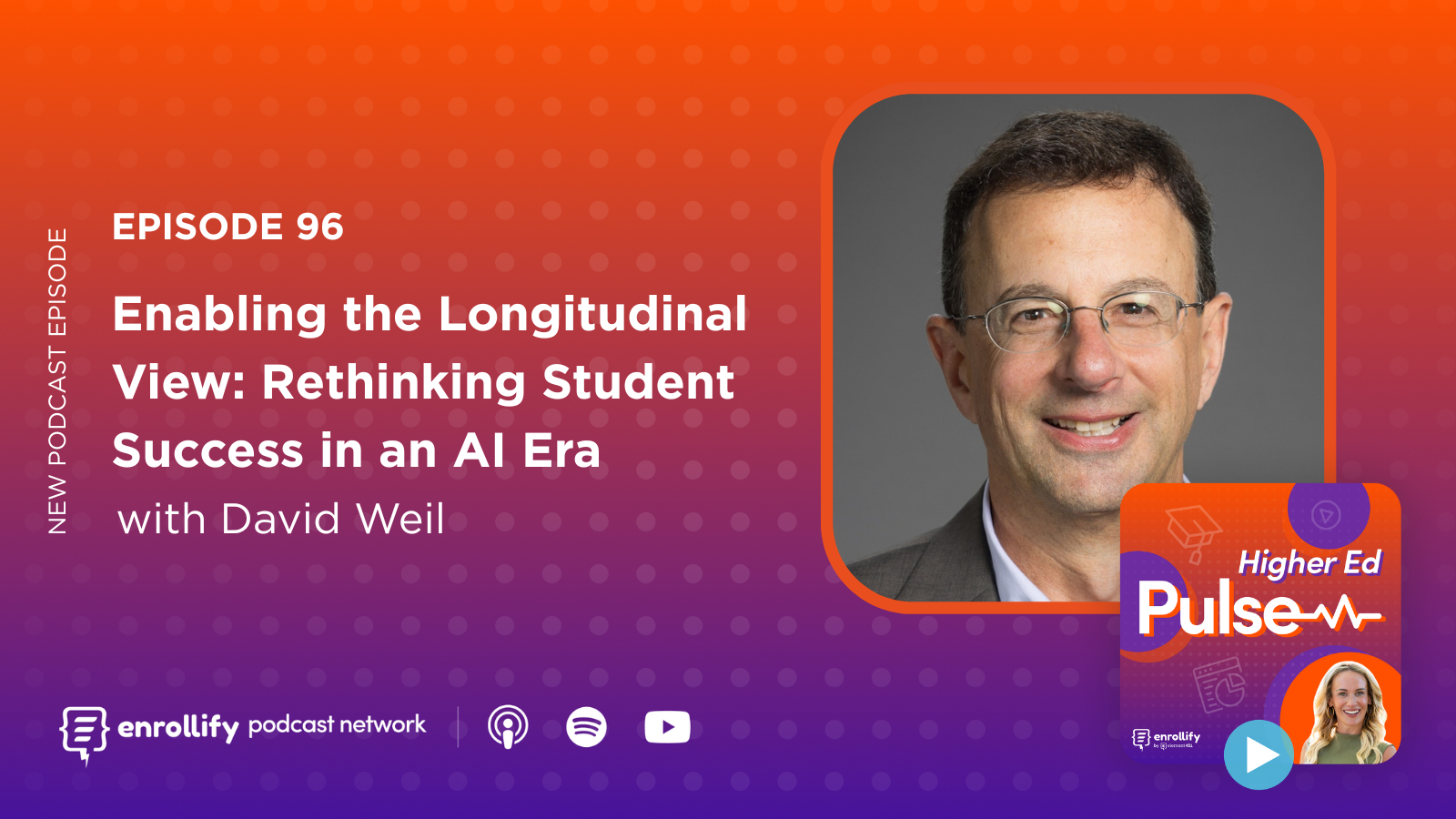
Mallory Willsea sits down with David Weil, SVP for Strategic Services and CIO at Ithaca College, to unpack a bold thesis from his recent EDUCAUSE article. The two dive deep into how AI’s most transformative potential in higher education isn’t found in flashy tools or automations — it’s in building a longitudinal view of the student experience. From data ethics and institutional silos to retention strategies and responsible design, this conversation challenges the status quo and outlines a human-first path forward for AI in higher ed.
Key Takeaways
- The future of AI in higher education is longitudinal — connecting data across academic, financial, and personal domains to create a holistic view of each student.
- Retention, not efficiency, is the true ROI metric for longitudinal AI applications in higher ed.
- Ethical design and transparency are non-negotiables — institutions must give students agency over their data and set clear boundaries.
- Institutions must rethink their architecture and governance to support integrated, student-centered data systems.
- Breaking down silos is essential — collaboration across IT, academics, student affairs, and enrollment is a must.
- AI is a tool to enhance, not replace, human-to-human interactions — counselors, advisors, and support staff remain central.
- Journey mapping is a key starting point for institutions serious about improving student experience through data and AI.
- The path to transformation is cultural as much as it is technical — leadership, trust, and institutional willpower matter just as much as the tools.
Episode Summary: Exploring AI's Role in the Longitudinal Student Experience
What does “longitudinal view” really mean in higher ed?
David Weil defines the longitudinal view as a shift away from transactional snapshots of student activity (like “Did they miss an advising appointment?”) to understanding the broader context and patterns that shape a student’s experience. Rather than reacting to isolated incidents, institutions can anticipate student needs through a continuous, connected lens — across academics, athletics, housing, and life circumstances. With AI, we finally have the technology to stitch together disparate signals and see the full journey of a student, not just fragments.
This is more than better dashboards; it’s about fundamentally reimagining how institutions support students. For example, if a student is underperforming in class, AI can now surface whether that might be related to recent travel for athletics, a roommate conflict, or something else entirely. The result? Earlier, more precise, and more personalized interventions. And this holistic approach can lead to better resource allocation, more equitable student experiences, and reduced friction throughout the student lifecycle.
But to make this vision real, higher ed must rethink its data systems, governance models, and perhaps most importantly — its culture. Institutions have to move beyond siloed, episodic support and invest in integrated, student-first approaches.
What are the biggest blockers to this kind of transformation?
According to Weil, the challenges fall into three big buckets: technical architecture, data governance, and institutional culture. Most institutions are still grappling with fragmented systems that don’t talk to each other. The result? Data silos that make it hard to build a full picture of a student’s journey.
At Ithaca College, a major step forward was merging the analytics and IT teams — a structural change that allowed for faster collaboration and aligned goals. But Weil is quick to point out that the tech alone isn’t enough. Shared governance is crucial. The people who understand the data must also be involved in determining how it’s used — and, importantly, how it’s not used.
Mallory also raises a key ethical concern: just because a system can predict something, doesn’t mean it should. Recalling the infamous Target case study — where predictive modeling revealed a teenage girl’s pregnancy before she’d even told her family — she pushes the conversation toward the human implications of powerful data models. For higher ed, this means setting clear policies on data use and ensuring students retain agency over their own narratives.
Who owns the data — and who decides how it's used?
It’s a loaded question, and one that many institutions haven’t answered. Weil offers a clear framework: data should only be accessible to those directly supporting the student — not broadly visible across the institution. For example, if an AI system identifies a student who may be struggling, that insight should only reach their assigned support team, not every employee on campus.
At Ithaca, students are even given the option to hide certain information from advisors (like whether they’re first-generation). This kind of transparency and control is essential. Weil emphasizes that students must have the right to say, “I don’t want you to use this data about me.” Respecting that boundary is key to building trust — and ensuring AI works in service of students, not systems.
There’s also a growing expectation from students that institutions do use data responsibly. If the college knows that a particular course load often leads to poor outcomes, shouldn’t it inform students before they enroll in those courses? Balancing proactive support with student agency is the delicate dance higher ed must learn.
How do institutions design these AI models responsibly and equitably?
Here’s the reality: if the data is biased, the models will be too. And when AI is used to “predict success,” there’s a real risk of codifying existing inequities — like tracking certain demographics into different academic paths or offering fewer opportunities based on flawed historical data.
Weil’s response? Keep humans in the loop — always. At Ithaca, AI is used to inform, not automate. Take the iCare program, for example: AI helps surface students who might benefit from outreach, but it’s trained counselors who meet with those students and decide on the best course of action. The human interpretation is non-negotiable. It’s not about removing people from the process — it’s about equipping them with smarter insights.
Weil also believes in building in opt-out options, designing ethical guardrails, and starting with transparency from day one. It’s about showing students how their data is being used and empowering them with choices — all while ensuring that the institution is still fulfilling its mission to support and retain students.
What’s the true ROI of this kind of student-centered AI?
Let’s be clear: while efficiency wins are great, the real return on investment for longitudinal AI strategies is retention. Weil makes this point unequivocally: every student retained is not just a financial win — it’s a life-changing outcome for that individual. It’s fewer dropouts with debt and no degree. It’s more students completing their journey.
At Ithaca, the proof is in the numbers. Their AI-informed iCare tool enabled 150 additional counselor meetings last academic year alone — and those meetings have a demonstrable impact on student persistence. This is the kind of ROI that resonates with presidents and boards: better support, higher retention, and ultimately, more students crossing the finish line.
And the impact doesn’t stop at graduation. Mallory notes that happier, better-supported students become more engaged alumni and donors — continuing the longitudinal journey beyond enrollment. That’s a full-circle value proposition for institutions ready to think long-term.
Connect With Our Host:
Mallory Willsea
https://www.linkedin.com/in/mallorywillsea/
https://twitter.com/mallorywillsea
About The Enrollify Podcast Network: The Higher Ed Pulse is a part of the Enrollify Podcast Network. If you like this podcast, chances are you’ll like other Enrollify shows too!
Some of our favorites include Generation AI and Confessions of a Higher Education Social Media Manager.
Enrollify is produced by Element451 — the next-generation AI student engagement platform helping institutions create meaningful and personalized interactions with students. Learn more at element451.com.




.svg)
.svg)
