






About the Episode
The AI Engage Summit is a free, virtual experience built to help higher ed leaders actually do something with AI. Over two afternoons, you’ll hear from peers, see practical demos, and walk away with ideas you can use immediately — no travel required, no cost to attend. If you’re ready to move AI from “interesting” to “impactful,” this is the place to be. Register now, don't miss out.
About The Episode:
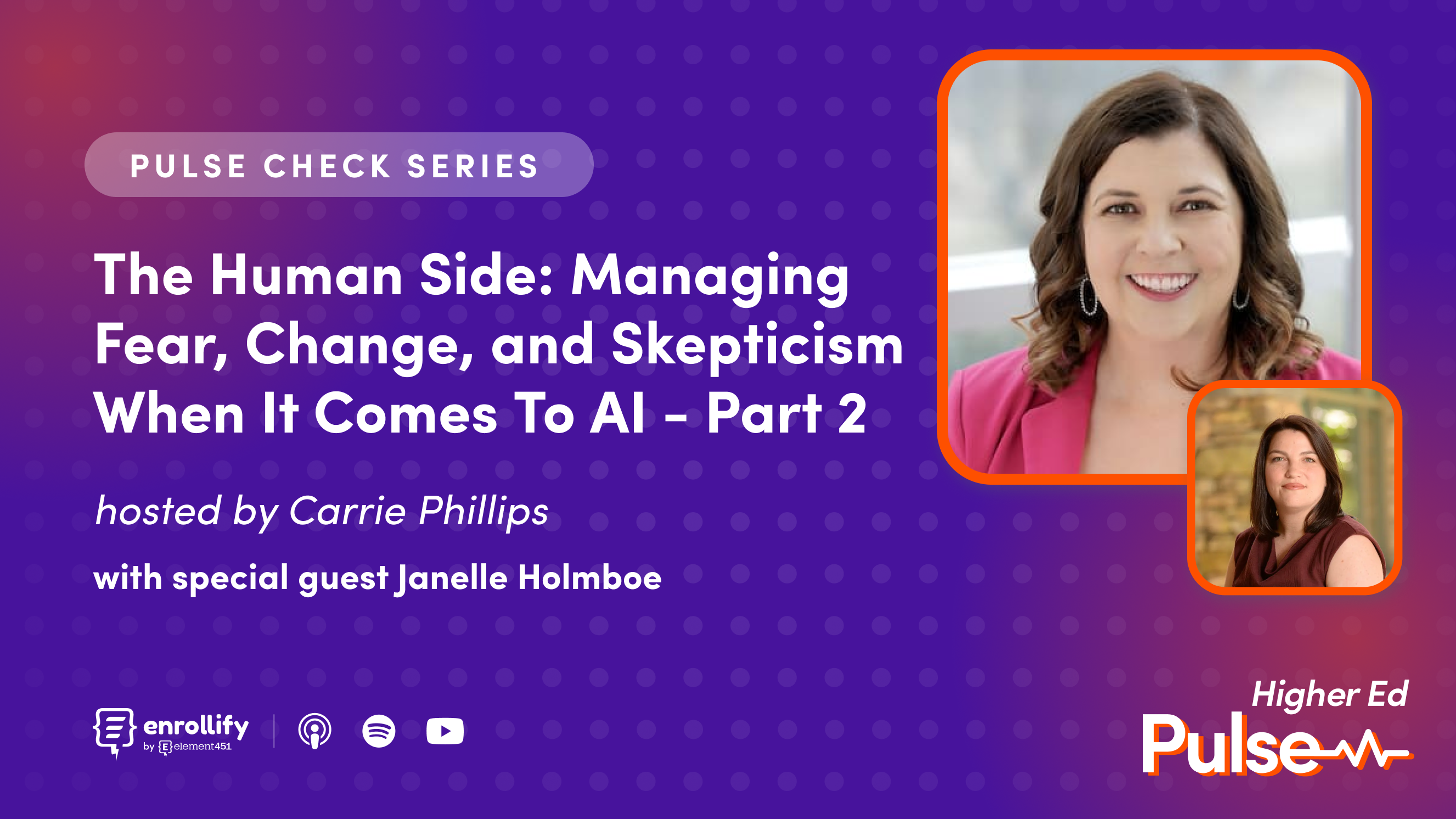
Carrie Phillips is joined by Janelle Holmboe, Chief Enrollment and Marketing Officer at McDaniel College, for a powerful conversation at the intersection of AI, innovation, and organizational leadership. This episode goes beyond the tools and tactics—it’s a masterclass in how to restructure teams, rethink priorities, and redefine innovation in higher ed. If you're a leader trying to manage change without burning out your people, this episode is essential listening.
Key Takeaways
- AI is not just about tech—it’s about leadership, structure, and change management.
- Innovation in higher ed means building systems that endure, not just chasing the next big idea.
- AI can reduce volume and friction, helping teams focus on high-impact, human-first work.
- McDaniel College’s integrated model combines enrollment, marketing, and advancement to build shared relationships and eliminate silos.
- Curiosity and fearlessness are essential values for bringing AI into your culture—and getting skeptics on board.
- A successful AI strategy starts small, with clear guardrails and low-stakes experiments that invite creativity.
- Innovation doesn’t mean adding more work—it means making space for what matters by letting go of outdated tasks.
- AI doesn’t replace human engagement—it protects it, by offloading repetitive tasks and freeing up staff capacity.
What does innovation look like in practice—not just theory?
At McDaniel College, innovation isn’t a buzzword—it’s a structural shift. As both CMO and Chief Enrollment Officer, Janelle Holmboe is leading an effort to integrate enrollment, marketing, and advancement teams into a shared model of constituent engagement. Instead of separating student recruitment from fundraising and alumni relations, McDaniel is creating a holistic relationship development model that reduces duplication, eliminates silos, and focuses on long-term connections. Janelle calls this innovation by design, not by accident. And with AI entering the conversation, this kind of structure makes it easier to share insights and leverage technology across functional areas.
But innovation at McDaniel isn’t just about reorgs—it’s also about resilience. In a time of turnover, enrollment pressure, and staff burnout, Janelle sees innovation as the act of building systems that can withstand stress, not rely on heroic individual efforts. That’s a fundamental mindset shift in higher ed leadership—and one many institutions would do well to emulate.
How does AI fit into an innovation culture without overwhelming people?
Rather than treating AI like a magic bullet or a disruptive threat, McDaniel is using AI to ask better questions and reduce workflow friction. Janelle explains that AI is helping her teams spot patterns, reduce volume, and prioritize human relationship-building over repetitive tasks. But perhaps more importantly, her team leads with curiosity and playfulness—two values that give people permission to experiment without fear.
Whether it’s testing AI chatbots with fake financial aid questions or generating fun prompts like “a rap about your division,” McDaniel is intentionally making space for exploration. Janelle compares it to the rise of the calculator in classrooms—once feared, now essential. AI doesn’t replace the work—it protects the work, by helping humans spend more time on what only humans can do.
To avoid overwhelming staff, Janelle recommends starting with very narrow, low-stakes experiments. Leaders should define the workflow to apply AI to, but leave the method open-ended. This lets teams dig deep, try different tools, and report out what they’ve learned—without it becoming “just another thing” on their plate. That mindset has helped even skeptics engage with AI meaningfully, rather than dismiss it outright.
What does responsible, sustainable innovation look like in higher ed leadership?
Janelle is refreshingly honest about the leadership balancing act—she loves new ideas but knows the importance of prioritization, communication, and permission to pause. That means asking: If we're going to start something new, what are we willing to stop? She points to examples like eliminating her team’s involvement in proofreading HR award programs—not because the work wasn’t important, but because it wasn’t strategic. And more importantly, it created unnecessary drain on a team that needed to focus on bigger priorities.
She also highlights something few higher ed leaders talk about: the emotional labor of “being collegial”. In a culture that values collaboration and service, it can feel uncomfortable to say no or to reprioritize. But Janelle makes a compelling case that strategic leadership sometimes means making the hard call—and doing it with empathy. That might mean walking away from long-held traditions, not because they’re bad, but because the context has changed.
And when it comes to AI, Janelle admits she was the skeptic at first. She didn’t want to lose the personal moments that matter in admissions—like the tactile experience of getting a physical acceptance letter. But through a culture rooted in curiosity and fearlessness, she’s come to see AI not as a threat to those moments, but as a way to protect and preserve them by clearing the noise that distracts from the human touch.
Enrollify is produced by Element451 — the next-generation AI student engagement platform helping institutions create meaningful and personalized interactions with students. Learn more at element451.com.






.svg)
.svg)
