






About the Episode
The AI Engage Summit is a free, virtual experience built to help higher ed leaders actually do something with AI. Over two afternoons, you’ll hear from peers, see practical demos, and walk away with ideas you can use immediately — no travel required, no cost to attend. If you’re ready to move AI from “interesting” to “impactful,” this is the place to be. Register now, don't miss out.
About the Episode:
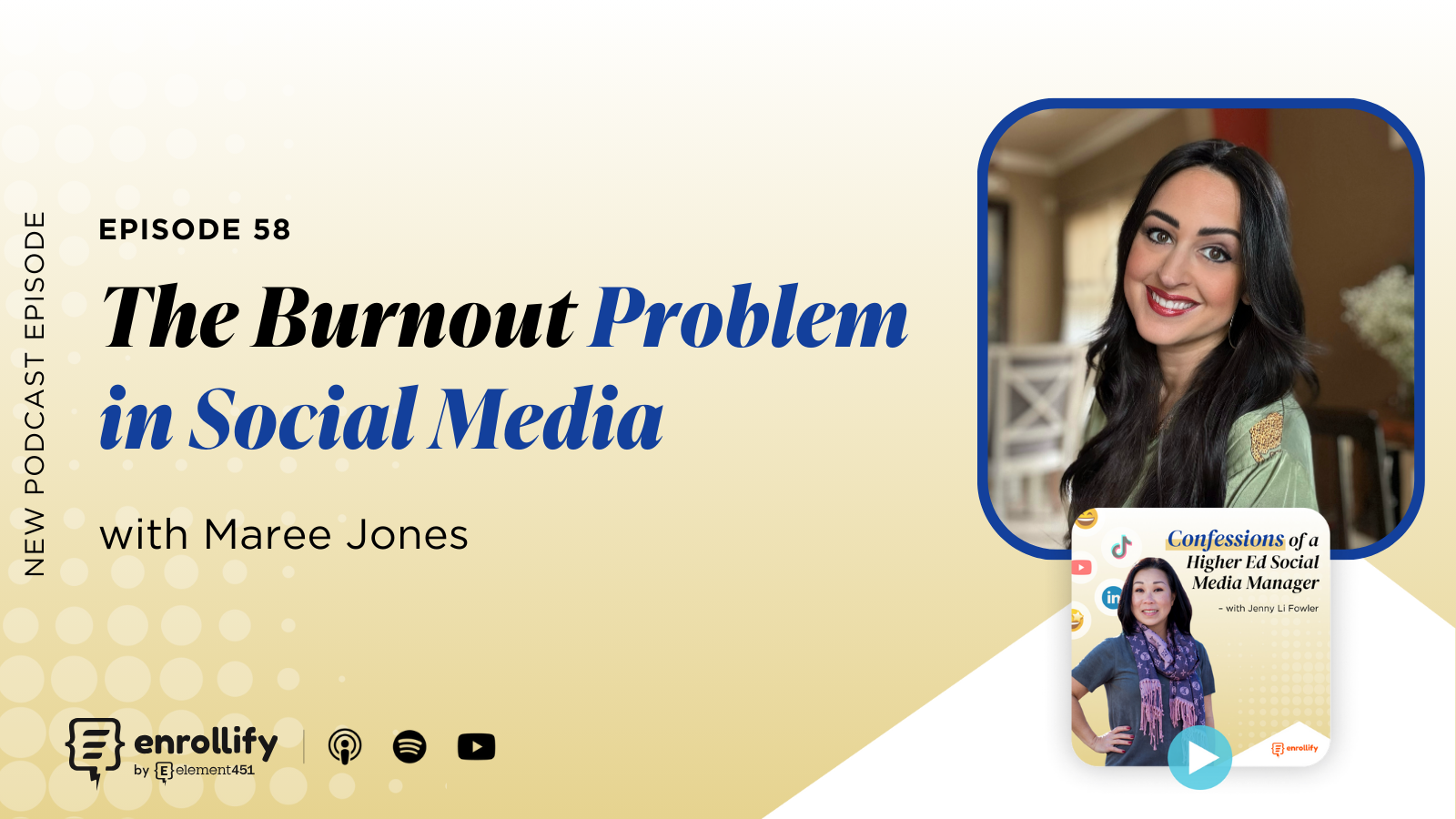
Jenny Li Fowler sits down with Maree Jones, Director of Social Media Strategy at the University of Alabama at Birmingham, to dive into a topic that's all too familiar for social pros — burnout. In this powerful conversation, Maree shares her personal experiences, how burnout manifests for social media professionals, and what institutions can do to foster healthier workplace cultures. If you’re managing digital engagement in higher ed, this is a must-listen episode that blends empathy with actionable advice.
Key Takeaways
- Burnout in social media is often invisible until it’s overwhelming — many professionals don't recognize it until it's affecting their personal lives or work performance.
- A "maker's schedule" vs. a "manager's schedule" is key to understanding how burnout creeps in — without dedicated time for creative or strategic work, burnout can thrive.
- Unchecked burnout impacts not only individuals, but institutional outcomes, from engagement metrics to overall community building and brand storytelling.
- Saying "no" is a skill — building boundaries, learning to communicate workloads, and resisting false urgency are essential survival tools for social media managers.
- Burnout isn’t solved with self-care alone — organizations need to support social teams with adequate resources, tools, and mental health benefits.
- Social media managers need more strategic recognition — the real work isn't "just the post" but the strategy, listening, and evaluation that goes around it.
- Peer support and professional communities offer much-needed empathy and validation in a high-pressure field.
- Real culture change is necessary to make higher ed communications more sustainable long term.
What does burnout look like for social media managers?
Burnout can be a tricky thing to spot — especially when your daily work is full of emotional content, high expectations, and relentless demands. For Maree Jones, burnout shows up when her schedule leaves no room for deep, creative thinking. It's when the to-do list dominates and creative energy disappears. Jenny and Maree reflect on how burnout can manifest emotionally — from irritability to detachment — and how easy it is to dismiss those feelings until they affect your well-being or relationships.
Social media pros, especially in higher ed, are constantly absorbing online negativity, processing crises, and navigating unrealistic content demands. Without recognizing the signs early — such as reduced creativity or persistent fatigue — burnout can spiral. The result? Lower quality engagement, decreased innovation, and even long-term mental health impacts.
What happens when burnout goes unrecognized?
Unchecked burnout doesn’t just hurt the person experiencing it — it also affects your institution’s online presence. As Maree notes, social media will take whatever you give it: time, energy, well-being. But the emotional drain ultimately impacts your ability to authentically connect with your community. That detachment can then hurt key metrics like engagement, audience growth, and storytelling effectiveness.
On a systemic level, this leads to a troubling pipeline issue — we’re not seeing enough social media managers rise into leadership roles, and burnout might be why. People leave the field before they have a chance to move up. Meanwhile, on a personal level, prolonged burnout can lead to serious health outcomes like depression and anxiety. The solution isn’t just more “self-care” — it’s workplace-level support.
How do you address burnout and build better boundaries?
According to Maree, the key first step is communication — and a workplace culture that allows for it. Open conversations with your manager about workload, priorities, and mental health can make a huge difference. Social media managers should also be trained and empowered to say “no” or “not right now” — something Maree had to learn the hard way. Jenny offers a useful script: “Happy to help — what should I deprioritize to make room for this?” It shifts the decision-making burden to supervisors while clarifying expectations.
Additionally, Maree and Jenny stress that burnout isn’t just about overwork — it's about the conditions of the work. Teams need better tools, reduced exposure to toxic online content, and strategic workflows that minimize last-minute requests. Maree even phased out UAB’s social media request queue in favor of collaborative conversations. By redefining how teams operate, institutions can foster healthier, more sustainable practices.
How can higher ed stop burnout from becoming the norm?
Ending burnout in higher ed social media isn’t about quick fixes or self-care trends — it requires a cultural shift. That means acknowledging the strategic nature of social media work, investing in proper tools, and reducing the expectation that social managers must always be “on.” As Maree puts it, “The post is the least interesting part of our job.” What matters is the thinking behind it, the listening after it, and the planning that makes content meaningful.
It also means recognizing the real-time mental and emotional labor involved in managing digital communities — and treating that labor with the respect and resources it deserves. Jenny and Maree both emphasize the value of peer networks and the broader higher ed social community. These spaces offer empathy, problem-solving, and crucial perspective: You’re not alone in this work.
Connect With Our Host:
https://twitter.com/TheJennyLi
Enrollify is produced by Element451 — the next-generation AI student engagement platform helping institutions create meaningful and personalized interactions with students. Learn more at element451.com.




.svg)
.svg)
