






About the Episode
The AI Engage Summit is a free, virtual experience built to help higher ed leaders actually do something with AI. Over two afternoons, you’ll hear from peers, see practical demos, and walk away with ideas you can use immediately — no travel required, no cost to attend. If you’re ready to move AI from “interesting” to “impactful,” this is the place to be. Register now, don't miss out.
About the Episode:
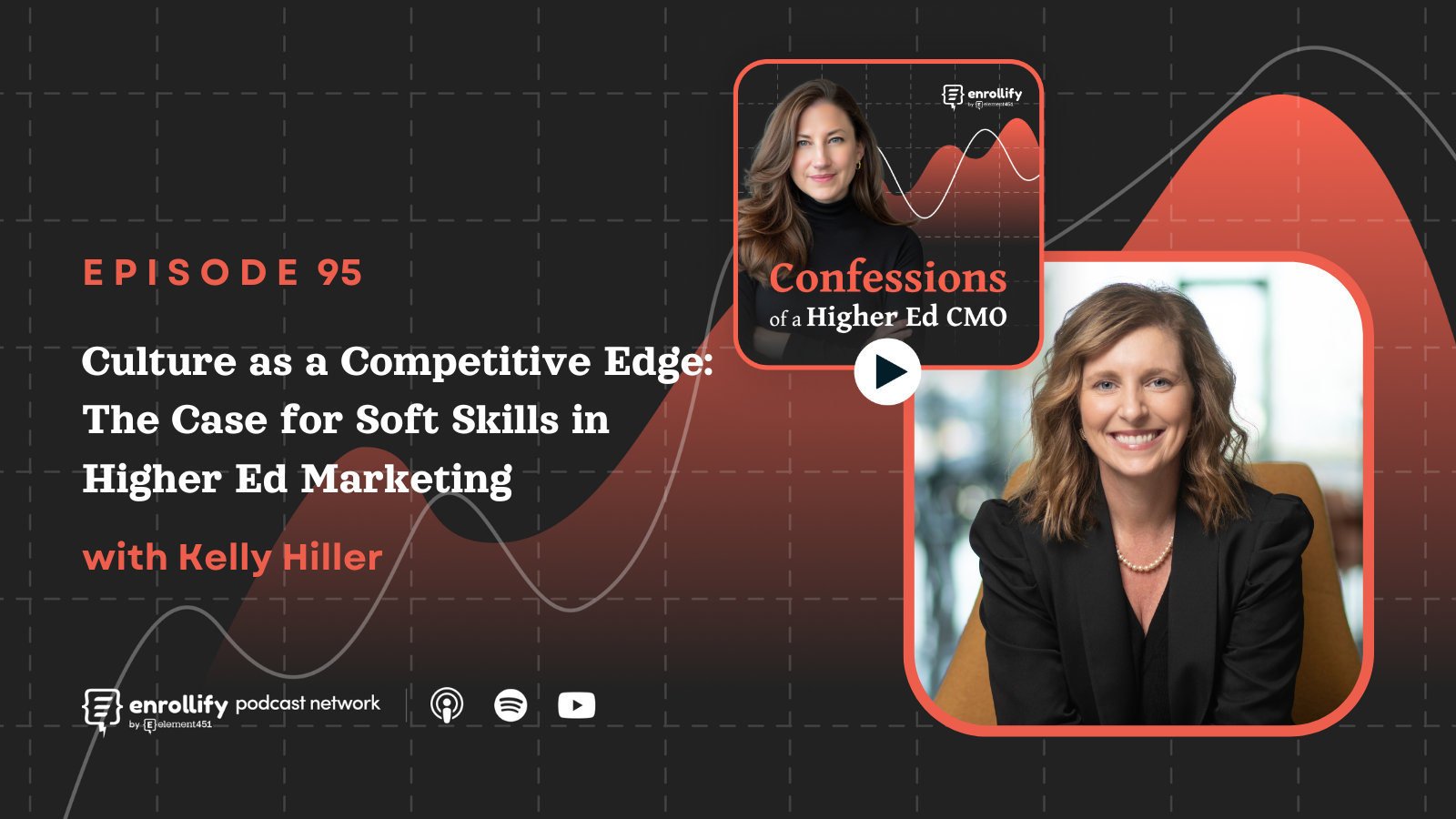
Jaime Hunt sits down with Kelly Hiller, Chief Marketing Officer at Purdue University, to explore a revolutionary idea: integrating soft skills into performance management. Hiller shares how Purdue's Brand Studio is not only delivering exceptional marketing but also cultivating a high-performing, emotionally intelligent team culture. This episode is a must-listen for higher ed marketers looking to future-proof their teams and foster stronger leadership pipelines.
Key Takeaways
- Embedding soft skills into performance planning can elevate both individual growth and team effectiveness.
- Developing emotional intelligence in higher education leads to better collaboration, creativity, and marketing outcomes.
- Soft skills like empathy, curiosity, communication, and adaptability are essential for career advancement in modern marketing teams.
- Clear expectations and accountability in leadership can—and should—coexist with kindness and empathy.
- Curiosity and self-awareness are critical in avoiding stagnation and enabling innovation in marketing strategy.
- Purdue's Brand Studio model showcases how culture-driven leadership enhances both internal team dynamics and external branding success.
Episode Summary: What You’ll Learn From This Conversation
Why are soft skills important in higher education marketing teams?
Kelly Hiller outlines that while technical or “hard” skills—like writing, design, and campaign execution—might launch a career, it’s soft skills that sustain and advance it. Emotional intelligence, the ability to collaborate, to give and receive feedback, to communicate effectively, and to adapt under pressure are the cornerstones of thriving teams. Especially in high-volume, high-pressure environments like Purdue’s Brand Studio, soft skills are no longer "nice to have"—they're essential.
How did Purdue make soft skills a formal part of performance management?
Hiller shares how Purdue implemented a system where each employee chooses a single soft skill to focus on and improve over the course of the performance cycle. This goal is evaluated alongside traditional objectives, ensuring that soft skill development is taken as seriously as task completion. Soft skill progress is tracked through ongoing one-on-ones, peer feedback, self-reflection, and supervisor assessments. Notably, this is distinct from technical upskilling, which has its own development path—reinforcing the unique value of emotional intelligence.
What motivated Purdue to formalize soft skill development?
Purdue’s marketing team experienced two major shifts: increased project volume and the integration of multiple new departments into the Brand Studio. Hiller recognized that these changes threatened the cohesion and performance of the existing team culture. To maintain excellence and psychological safety amidst rapid change, Purdue leaned into fostering soft skills like collaboration, communication, and feedback delivery. By formalizing soft skills in performance plans, they preserved team culture while welcoming new voices and ensuring alignment.
How do soft skills impact the quality of marketing?
Purdue's marketing isn't just technically strong—it’s emotionally resonant. Hiller emphasizes that human connection is at the heart of great marketing, and teams that have high emotional intelligence are better positioned to deliver work that genuinely resonates. The team frequently steps back to ask: “Why should someone care?” That question drives emotive storytelling, sharper copy, and better audience alignment—especially important when creating materials for prospective students and parents. Curiosity, empathy, and listening to feedback—hallmarks of soft skill development—are foundational to this process.
What tools and practices support the development of soft skills?
It’s not just about workshops and webinars. At Purdue, soft skill growth is supported through a variety of personalized tools—book recommendations, peer mentoring, presentation coaching, and more. Supervisors and team members engage in structured conversations to identify growth areas, co-create development plans, and revisit progress consistently. Managers are trained to lead with radical candor, balancing empathy with accountability to reinforce psychological safety without sacrificing standards.
How does soft skill development influence innovation and team creativity?
Better soft skills = fewer ego battles = more creative breakthroughs. As team members develop stronger interpersonal skills, brainstorming becomes more productive, team dynamics become more supportive, and risky ideas become safer to voice. Hiller observes that as empathy and collaboration have grown, the team has been able to rethink admissions materials, improve the customer journey on digital platforms, and shift how they speak to both students and parents—leading to better, more targeted marketing.
What advice does Hiller give to other higher ed leaders wanting to implement soft skill development?
Start by opening the conversation. Create a safe, candid space among leadership to identify the non-technical roadblocks that get in the way of great work. Be ready to listen—really listen. Don’t treat this as a check-the-box exercise. Hiller’s emphasis is clear: for soft skills to be meaningful, they must be supported with resources, integrated into day-to-day conversations, and modeled by leadership. Build in accountability, reward progress, and most importantly, be transparent about why it matters.
Connect With Our Host:
Jaime Hunt
https://twitter.com/JaimeHuntIMC
Enrollify is produced by Element451 — the next-generation AI student engagement platform helping institutions create meaningful and personalized interactions with students. Learn more at element451.com.




.svg)
.svg)
