






About the Episode
The AI Engage Summit is a free, virtual experience built to help higher ed leaders actually do something with AI. Over two afternoons, you’ll hear from peers, see practical demos, and walk away with ideas you can use immediately — no travel required, no cost to attend. If you’re ready to move AI from “interesting” to “impactful,” this is the place to be. Register now, don't miss out.
About the Episode:
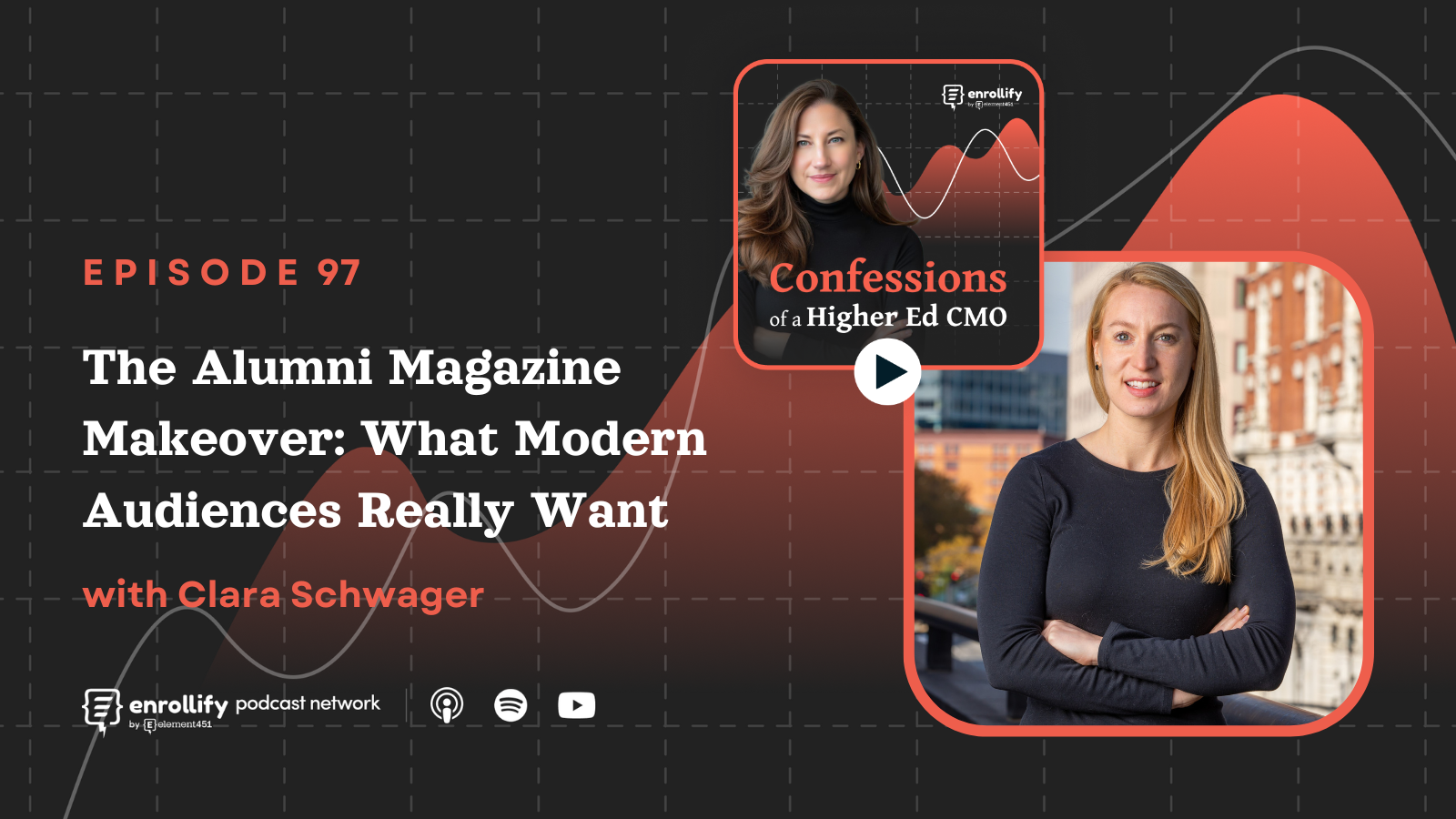
Jaime Hunt is joined by Clara Schwager, Director of Institutional and Advancement Marketing at Johnson & Wales University, for a much-needed conversation on the evolution of alumni magazines. Clara shares the behind-the-scenes story of a major redesign of JWU’s alumni magazine—one that transforms the publication from a static print piece into a dynamic, multi-channel storytelling engine. If you're still treating your alumni magazine like a mailbox-only moment, this is your wake-up call
Key Takeaways
- Alumni magazines are far from dead—but they must evolve. Print is powerful, but it’s only the beginning. Your alumni magazine should feed a full content ecosystem, from social to email to paid media.
- Strategic content repurposing drives engagement. Transforming longform print stories into blog posts, thought leadership, and social content maximizes impact while saving time and money.
- Print can support enrollment, development, and brand strategy. JWU is leveraging magazine content across fundraising, recruitment, and stakeholder engagement channels.
- Content format should follow storytelling strategy. The best marketing teams are preserving the power of storytelling while adapting to how people consume media in 2026.
- Don’t benchmark against other universities—look beyond. Inspiration should come from how Vogue, Time, and major media brands evolve storytelling, not just the school down the road.
- AI can enhance—not replace—human storytelling. From transcription to content repackaging, Clara shares how AI tools are helping her team streamline production while keeping editorial quality high.
- Institutional collaboration is key. Whether your magazine lives in advancement or marketing, success hinges on shared strategy, editorial alignment, and consistent storytelling.
Episode Summary
Why do alumni magazines still matter in higher education marketing?
Alumni magazines remain one of the few print assets in higher ed with real staying power. Clara Schwager believes they’re a unique storytelling tool that can reinforce institutional values, engage diverse audiences, and showcase the long-term outcomes of a university’s mission. But today, they must be more than just a printed piece—magazines should be a springboard for multi-channel content.
When done right, an alumni magazine can connect with alumni, parents, donors, and prospective students through digital extensions that build affinity and trust over time. In an industry that often struggles to differentiate itself, the alumni magazine remains an underleveraged—but powerful—brand asset.
What did the JWU alumni magazine redesign actually involve?
Clara led a full-scale overhaul of Johnson & Wales University’s alumni magazine—going beyond aesthetics into deep content strategy. The redesign included changes to editorial structure, format, page count, paper weight, and distribution model. But most importantly, it embraced a hub-and-spoke model for storytelling.
The print magazine became the central “hub” from which content spokes are created and distributed across digital platforms: website articles, thought leadership for paid placements, social posts, emails, even podcast vignettes. By optimizing content for various audiences and channels, the magazine became a living piece of media instead of a one-time drop.
Early results? A 30% increase in web traffic to the magazine site and nearly 20% growth in time on page, along with a 55%+ open rate for a new magazine-focused email to stakeholders outside of alumni. These early metrics are strong indicators that the content strategy shift is resonating.
How do you convince stakeholders to support a content strategy-driven redesign?
Surprisingly, Clara didn’t face much resistance—because the approach wasn’t radical, just overdue. She framed the shift not as a departure from tradition, but as an evolution of best practices already familiar to marketing teams. What helped was a strong focus on audience behavior, gleaned through focus groups that revealed how alumni consume media in 2026.
Rather than asking alums what they wanted from a magazine, Clara’s team asked broader questions about how they consumed media, what channels they preferred, and when and how they engage with content. The result? More digestible, flexible content formats and a shift away from traditional, static images toward vibrant, experience-centered visuals that reflect JWU’s values.
And if you’re leading a marketing team but don’t “own” the magazine? Clara recommends starting with common goals and shared outcomes—like enhancing storytelling reach and driving measurable engagement across advancement and enrollment.
How does the magazine now support advancement and admissions goals?
The redesigned magazine isn’t just a feel-good publication—it’s now a functional tool for multiple departments. For development officers, the team created custom bookmarks and envelopes so they can send personalized messages and magazine excerpts to alumni and donors. These messages are matched to the recipient’s interests—whether that’s experiential education, athletics, or entrepreneurship—based on stories within the issue.
For enrollment teams, the stories in the magazine offer proof points about alumni success, academic innovation, and career outcomes. This makes them great material for email drip campaigns, parent engagement, and prospective student nurture paths. According to Clara, the magazine is now used across the full student lifecycle—from recruitment to retention to fundraising.
What about managing stories from multiple campuses and online students?
Clara acknowledges the challenge of representing multiple campuses—and an ever-growing online student population—within a 32-page magazine produced only twice a year. The solution? Focus on shared institutional values rather than geography. The redesign intentionally centers stories around JWU’s core themes like experiential learning, industry alignment, and faculty expertise.
Instead of relying on static campus beauty shots, visuals are now grounded in active, engaging depictions of real learning experiences. And for online students, the team prioritizes inclusion by telling their stories in meaningful ways—whether that’s through remote interviews, social vignettes, or digital-only features. It’s not about showcasing every location, but about making every member of the community feel seen.
How is the team leveraging AI in the editorial process?
Clara’s team is integrating AI tools in smart, strategic ways. They're not using AI to write stories—but rather to transcribe interviews (Otter), convert text to audio (Speechify), and eventually produce a Spotify-style narrated playlist of magazine features. AI is also being used to repurpose long-form content into shorter formats for email, social, and paid channels.
As Clara explains, "AI is a fabulous tool for brainstorming and packaging." It’s helping the team streamline production and extend the reach of editorial work—without sacrificing authenticity or voice. And that’s the sweet spot for AI in higher ed content marketing: saving time on the repetitive tasks so human storytellers can focus on the nuance and emotion.
Connect With Our Host:
Jaime Hunt
https://twitter.com/JaimeHuntIMC
Enrollify is produced by Element451 — the next-generation AI student engagement platform helping institutions create meaningful and personalized interactions with students. Learn more at element451.com.


.svg)
.svg)
