


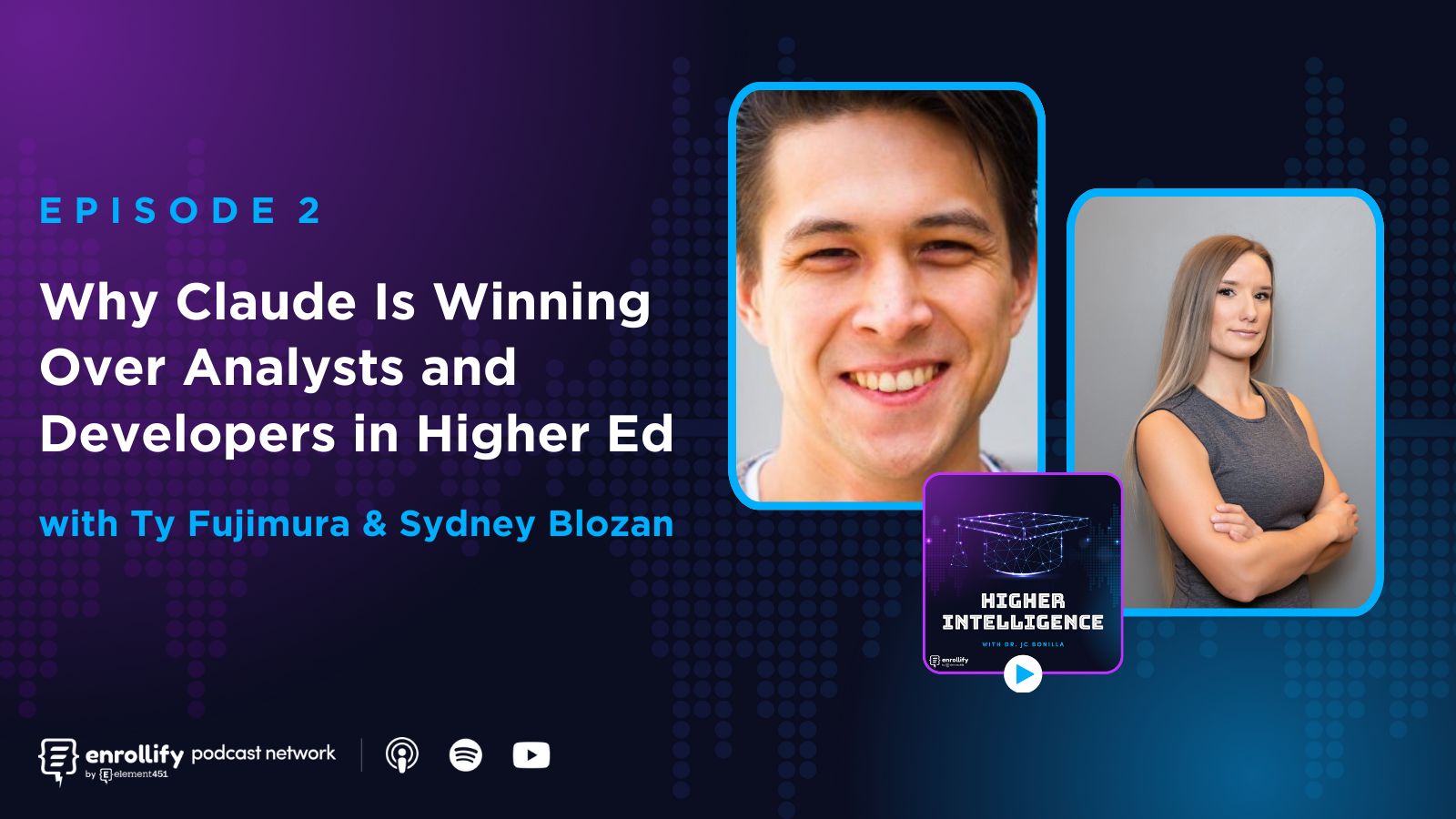




About the Episode
The AI Engage Summit is a free, virtual experience built to help higher ed leaders actually do something with AI. Over two afternoons, you’ll hear from peers, see practical demos, and walk away with ideas you can use immediately — no travel required, no cost to attend. If you’re ready to move AI from “interesting” to “impactful,” this is the place to be. Register now, don't miss out.
About the Episode:
JC Bonilla is joined by Ty Fujimura and Sydney Blozan of Element451 to unpack the recent leap in AI’s capabilities — from being just a tool to becoming a trusted teammate. Together, they explore viral AI agents like Mobo, the Claude vs. ChatGPT debate, and the real-world implications of these tools on workflows, strategy, and higher ed operations. This fast-paced, insight-packed conversation gives higher ed leaders and enrollment marketers a glimpse into the AI-powered future that’s already here.
Key Takeaways
- Claude is emerging as the preferred AI tool for deep work like data analysis, strategy, and product development — especially in higher ed contexts.
- AI agents are evolving from tools to teammates, capable of making autonomous decisions, managing workflows, and enhancing productivity across departments.
- Higher education institutions must shift from “using AI” to “being AI-native”, embedding AI into core operational processes.
- AI usage is already widespread among students (92%), while institutional adoption and governance still lags behind.
- Emerging technologies like AI wearables, hyper-personalized agents, and agentic computing are shaping the future of how campuses operate and serve students.
- The Claude vs. ChatGPT debate isn’t about loyalty — it’s about using the right tool for the right job.
What’s the Buzz About Claude vs. ChatGPT?
In 2026, many professionals — especially in higher ed — are reevaluating their go-to AI tools. While ChatGPT dominates in creativity, speed, and multimodal capabilities, Claude is winning over analysts, strategists, and product leaders with its deeper contextual understanding, longer memory, and human-like communication.
Ty Fujimura shares that Claude Opus is the first model that feels like a genuine creative partner — helping synthesize ideas, iterate product roadmaps, and even co-write talks. Sydney Blozan reveals how Claude acts like a trained analyst, capable of spotting anomalies in messy data and enhancing team performance with minimal prompting.
So what’s the verdict? Claude is taking the lead in real work, while ChatGPT holds ground in fast, creative tasks. The smart move? Use both strategically based on your goals.
What Is Mobo and Why Are AI Agents So Disruptive?
JC kicks things off by introducing Mobo, a viral open-source AI agent that lives in messaging apps like WhatsApp and Telegram. Unlike traditional chatbots, Mobo is proactive — it books reservations, sends reminders, and even makes calls on your behalf using voice agents. It has near-perfect memory and system-level access, raising both excitement and alarm across the tech and security communities.
Why does this matter to higher ed? Because agents like Mobo signal a future where AI isn't just responding to prompts — it's taking initiative. For colleges and universities, this means reimagining automation, FERPA compliance, and student data security at a whole new level.
How Should Higher Ed Leaders Think About AI Right Now?
Let’s be clear: 92% of students are already using AI tools. Yet, 39% of higher ed institutions don’t have any AI governance policies in place. The episode urges schools to move beyond “having a policy” or “using AI tools” — and toward building AI-native operations. That means embedding AI into workflows, processes, and decision-making at every level.
Ty recommends shifting the mindset from “adopting AI” to “solving problems with AI.” Sydney Blozan doubles down on the need to recognize that AI isn’t a bolt-on — it is the process now. From improving data hygiene and CRM analysis to enhancing internal reporting and enrollment outreach, the right AI can give teams superpowers — if they’re willing to adapt.
What Are the Most Exciting AI Trends on the Horizon?
The episode also touches on game-changing developments like:
- Personal AI agents powered by Google’s ecosystem
- AI-powered wearables from Apple
- Anthropic’s Claude Co-Work and Claude Code for collaborative workflows
- Solar-powered AI compute clusters via Elon Musk’s TerraWave
These aren’t science fiction — they’re fast-approaching realities. 2026, as the hosts suggest, may very well be the year AI becomes physical — integrated into devices we wear, use, and live with.
Connect With Our Host:
Enrollify is produced by Element451 — the next-generation AI student engagement platform helping institutions create meaningful and personalized interactions with students. Learn more at element451.com.



.svg)
.svg)
