


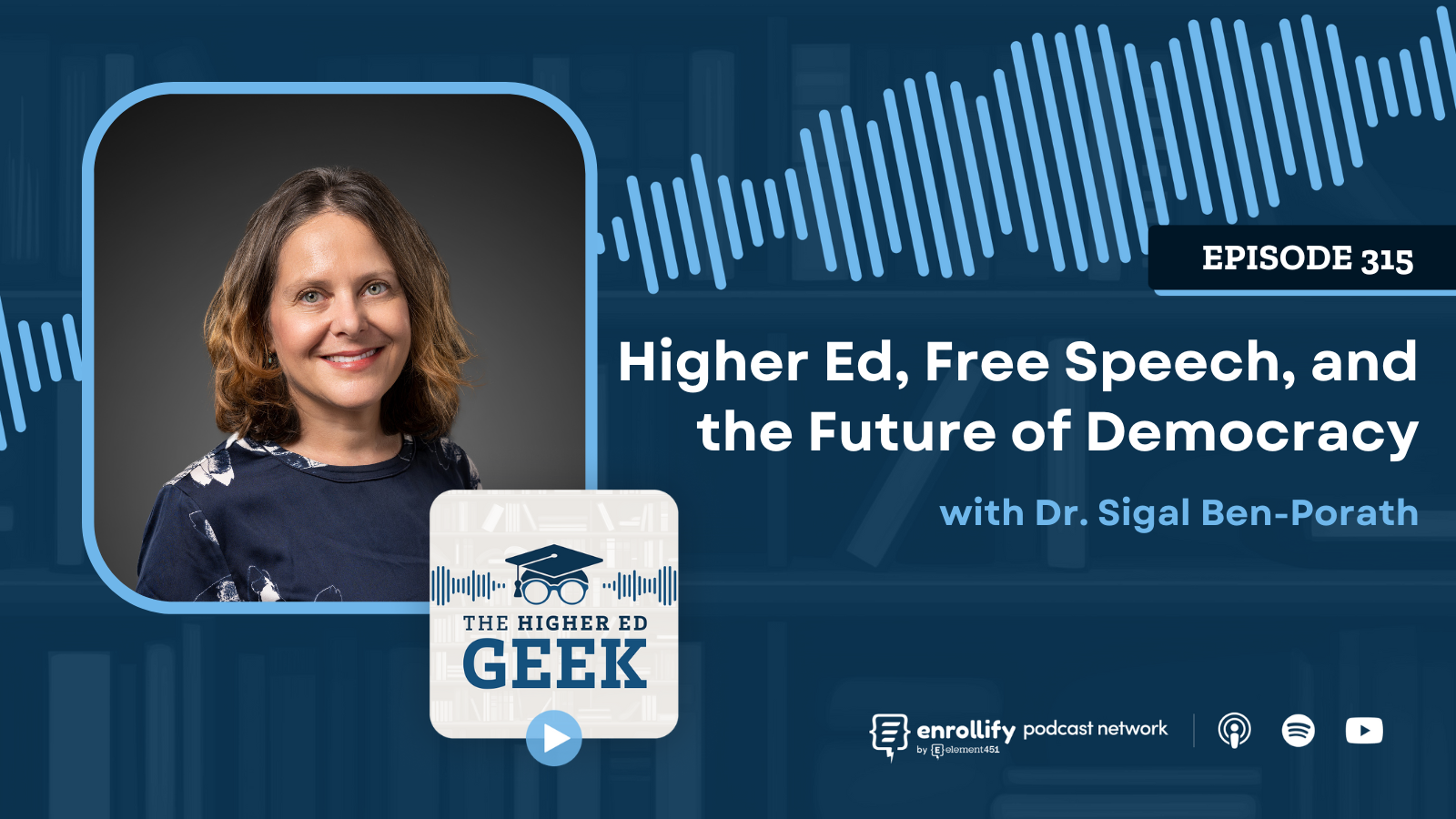




About the Episode
The AI Engage Summit is a free, virtual experience built to help higher ed leaders actually do something with AI. Over two afternoons, you’ll hear from peers, see practical demos, and walk away with ideas you can use immediately — no travel required, no cost to attend. If you’re ready to move AI from “interesting” to “impactful,” this is the place to be. Register now, don't miss out.
About the Episode:
In this thought-provoking episode, political philosopher and Penn GSE professor Dr. Sigal Ben-Porath joins host Dustin to unpack one of higher ed’s most pressing—and polarizing—topics: the future of free speech and academic freedom on campus. Drawing from her books Free Speech on Campus and Cancel Wars, Dr. Ben-Porath makes the case for a more inclusive vision of free expression in higher education, while warning against rising government overreach in curricula. She also highlights the important work happening on this topic at the SNF Paideia Program, where she is Faculty Director.
Together, they explore how colleges can stay true to their democratic mission even as they navigate growing political pressure and cultural division.
Key Takeaways
- Free speech on campus is evolving — Today’s students often advocate for inclusion and equity, challenging traditional boundaries of expression in learning environments.
- Political interference is increasing — State and federal policies are beginning to dictate what topics can or cannot be taught, threatening institutional autonomy and academic freedom.
- Higher education's democratic role is critical — Colleges and universities are one of the last civic spaces where students learn to engage in civil discourse and prepare for democratic participation.
- “Inclusive freedom” is the goal — Higher ed should balance open inquiry with a commitment to inclusion, ensuring all students feel heard and respected.
- Protests are part of the academic tradition — Student activism reflects the democratic mission of higher education and should be supported, not suppressed.
- Curricular censorship undermines knowledge development — Decisions about what to teach must rest with scholars, not politicians, to maintain educational integrity.
- Higher ed must lead the civic dialogue — Institutions have a responsibility to model civil discourse, foster critical thinking, and be transparent about their role in public life.
Episode Summary
What is the current state of free speech on college campuses?
According to Dr. Sigal Ben-Porath, the state of free speech on college campuses is at a critical inflection point. While student protests and civic organizing remain integral to campus life, the real pressure now comes from legislative actions that aim to restrict what educators can teach—especially in areas like history, race, gender, and reproductive health. These interventions threaten the foundational principles of open inquiry and academic autonomy, shifting campuses from places of exploration to sites of political control. Dr. Ben-Porath advocates for a model she calls “inclusive freedom,” where free speech and inclusivity coexist to foster a more just and informed educational environment.
What are the major political pressures facing higher ed institutions?
Political pressures are coming from both state and federal levels, often in the form of "divisive topics" legislation that dictates what subjects can be covered in the classroom. Topics like systemic racism, LGBTQ+ rights, reproductive justice, and even the teaching of the Holocaust are being scrutinized or restricted. Beyond content, public funding is being leveraged as a tool to reshape curricula and silence dissent. Dr. Ben-Porath emphasizes that while accountability is essential, substituting expert judgment with political agendas erodes the integrity and purpose of higher education.
Why is institutional autonomy essential to democratic resilience?
The ability of colleges and universities to self-govern is not just an internal policy issue—it’s a democratic necessity. As Ben-Porath explains, campuses are unique spaces where students from diverse backgrounds learn to live, study, and engage with differing viewpoints. Removing this autonomy in favor of partisan control jeopardizes the sector’s ability to cultivate critical thinking, shared understanding, and informed decision-making. Higher education isn't just about job preparation; it's about preparing citizens for meaningful participation in democracy.
How do campus protests and student activism fit into the conversation?
Historically and today, student protests serve as a vital expression of civic engagement on campus. From the Vietnam War era to today’s movements for racial and social justice, student activism is a form of public pedagogy. These actions are not disruptions but reflections of higher education’s democratic purpose. Dr. Ben-Porath encourages institutions to view protests as opportunities to model dialogue and strengthen community, rather than as threats to order or reputation.
What is “inclusive freedom” and how can institutions practice it?
“Inclusive freedom,” as outlined in Ben-Porath’s book Free Speech on Campus, is a framework that promotes both intellectual openness and inclusive learning environments. This model rejects the idea that free speech and inclusion are at odds. Instead, it challenges institutions to foster a climate where a wide range of ideas can be explored while ensuring all students feel safe and empowered to participate. Implementing inclusive freedom requires intentional dialogue, empathetic listening, and a deep respect for diverse perspectives in both curricular and co-curricular settings.
How should higher ed leaders respond to this political moment?
Dr. Ben-Porath offers a clear call to action: Higher ed leaders must reaffirm their commitment to their democratic mission. This means speaking publicly about the value of academic freedom, supporting faculty and students under political pressure, and engaging local and national communities in conversations about higher ed’s public purpose. Institutions should be proactive in showing how their work contributes to democratic resilience—not just through research and instruction, but by modeling how to engage across difference.
About the Show: The Higher Ed Geek Podcast explores the impact of edtech on the student experience by speaking with diverse leaders from institutions, companies, and nonprofit organizations. Each week we aim to provide an engaging, fun, and relevant dose of professional development that honors the wide range of work happening all across the higher ed ecosystem. Come geek out with us! The Higher Ed Geek Podcast is hosted by Dustin Ramsdell and is a proud member of the Enrollify Podcast Network.
Connect With Our Host:
Dustin Ramsdell
Enrollify is produced by Element451 — the next-generation AI student engagement platform helping institutions create meaningful and personalized interactions with students. Learn more at element451.com.



.svg)
.svg)
