






About the Episode
The AI Engage Summit is a free, virtual experience built to help higher ed leaders actually do something with AI. Over two afternoons, you’ll hear from peers, see practical demos, and walk away with ideas you can use immediately — no travel required, no cost to attend. If you’re ready to move AI from “interesting” to “impactful,” this is the place to be. Register now, don't miss out.
About the Episode:
How Will AI Actually Show Up in Higher Ed in 2026?
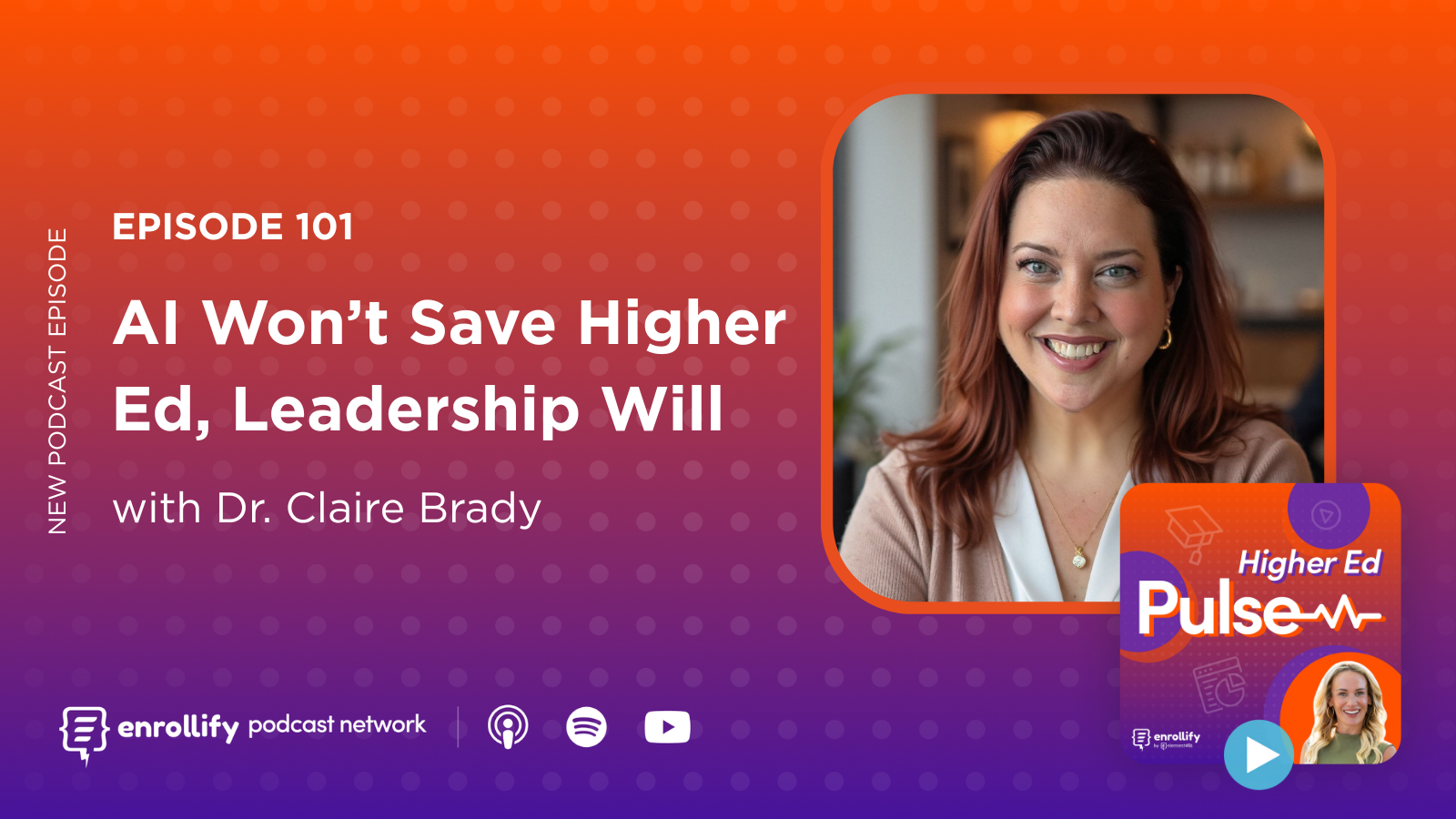
Mallory Willsea sits down with Dr. Claire Brady, President of Glass Half-Full Consulting and author of the upcoming book AI with Intention: The Leadership Guide for Higher Education. Together, they unpack how artificial intelligence is quietly but rapidly becoming default infrastructure across college campuses — not through flashy rollouts, but through everyday, often invisible workflows. If you’re tired of AI hype and wondering whether you’re already behind, this episode is your wake-up call. Learn how the institutions that treat AI as a strategic lever — not a pressure valve — will come out ahead in 2026 and beyond.
Key Takeaways
- AI is showing up through default behaviors, not polished rollouts
Leaders often think of AI in terms of pilots and task forces, but staff are already integrating AI tools like ChatGPT to manage daily workloads — often without oversight or support. - The biggest risk isn’t rogue usage — it’s misaligned systems
When institutions layer AI over broken workflows (especially in advising or financial aid), they risk fossilizing dysfunction instead of fixing it. - AI governance must go beyond the task force
Successful institutions are implementing lightweight, principle-driven governance models that clarify guardrails while empowering distributed decision-making. - Using AI with intention means building trust through transparency
By 2027, the differentiator won’t be how sophisticated your AI is — it will be how clearly and ethically your institution used it to support, not replace, human care. - AI can create capacity — but only with leadership and integration
Generative AI can help alleviate burnout and optimize operations, but only when paired with thoughtful implementation and cross-system interoperability.
Episode Summary: How Is AI Really Being Used in Higher Ed?
Why is the way higher ed talks about AI already outdated?
Claire Brady breaks it down: leadership is still talking about AI as if it's a future initiative — something that needs planning, approval, and oversight before it’s introduced. But on the ground, AI has already arrived. Staff, faculty, and students are using generative tools on their own, often with personal devices and out-of-pocket subscriptions. It’s a bottom-up transformation happening in real time.
Leaders who imagine they can control when and how AI enters their institutions are missing the real challenge: it’s already here. AI is being used to summarize meetings, draft emails, manage workloads, and translate complex institutional language for students. But because this shift is happening quietly, it risks creating a shadow infrastructure — where decisions are made without alignment, oversight, or shared norms.
The real disconnect? While leadership prepares for a rollout, the real rollout is already happening without them.
Where is AI already becoming the default on campus?
AI is becoming default infrastructure in the least glamorous parts of the institution — what Claire calls "low visibility, high volume work." Think: student email communications, meeting notes, scheduling, and translating enrollment instructions. These uses aren’t headline-worthy, but they’re deeply influential in how students and staff interact with the institution.
For students, AI tools are now acting like informal support systems — organizing tasks, simplifying complex information, and acting as study partners. But if institutions ignore these shifts, they risk falling behind in areas that directly impact access, persistence, and student success.
The danger isn’t that students or staff are using AI. The danger is that leadership isn’t noticing or designing for the reality that they are.
What happens when AI is layered on broken systems?
One of the most vivid examples Claire shares is about AI chatbots — particularly in high-impact areas like financial aid or academic advising. When chatbots are deployed without rethinking the system beneath them, they can actually scale confusion, not reduce it. Students may get quicker responses, but not necessarily better ones.
Claire tells the story of a school whose chatbot was scoring well overall, but failed to meet the needs of first-gen students. Once the institution disaggregated the feedback, it realized the tool assumed a level of knowledge those students didn’t have — and kept delivering the wrong answers. The institution hit pause, invited students and frontline staff into the redesign process, and redeployed a more thoughtful tool. That’s what intentional AI looks like.
The takeaway? Automating a flawed process only locks in the flaws. Don’t mistake speed for progress.
What does using AI to create capacity actually look like?
Many teams adopt AI tools hoping to reduce burnout — but that only works if the technology is matched with real workflow changes. Claire points out that without integration across platforms (CRMs, LMSs, SISs), AI just becomes another tool staff don’t have time to use.
Leaders who successfully use AI to create capacity first understand the human work it’s meant to support. Claire shares a common scenario: administrators spending half their day scheduling meetings because systems and expectations aren’t aligned. The tech is available, but human behaviors and boundaries prevent its adoption. The result? Burnout continues.
The institutions making real progress are slowing down just enough to watch how work actually gets done — and then redesigning systems, not just speeding them up with tech.
How are smart institutions handling AI governance?
According to Claire, the most effective governance models aren’t the ones with the biggest task forces — they’re the ones that lead with values and distribute authority. These models define the why and how of AI use at a high level (ethical guardrails, transparency, risk thresholds), but leave room for departments to make decisions aligned to their unique contexts.
Governance isn’t about micromanagement — it’s about cultural clarity. When people know the boundaries, they don’t need to wait for permission. They act with confidence.
Claire encourages institutions to move away from “compliance theater” and toward models that empower teams while maintaining institutional trust. And yes — governance can help institutions move faster, not slower, when done right.
What are successful AI leaders doing differently?
Claire’s favorite leaders share one key trait: humility. They approach AI not as experts, but as intentional explorers. They’re not trying to control everything or pretend they have all the answers. Instead, they’re modeling curiosity and encouraging teams to build AI literacy and fluency — knowing when to use it, how to use it, and when not to.
They’re also transparent. Claire shares how leaders talk openly about where AI helps (board reports) and where it doesn’t (academic research), building trust through honesty. The institutions that will win in 2027 won’t just be fast — they’ll be trusted.
And that trust will stem from clear communication, shared accountability, and a demonstrated commitment to putting students and staff first.
Connect With Our Host:
Mallory Willsea
https://www.linkedin.com/in/mallorywillsea/
https://twitter.com/mallorywillsea
Enrollify is produced by Element451 — the next-generation AI student engagement platform helping institutions create meaningful and personalized interactions with students. Learn more at element451.com.




.svg)
.svg)
