






About the Episode
The AI Engage Summit is a free, virtual experience built to help higher ed leaders actually do something with AI. Over two afternoons, you’ll hear from peers, see practical demos, and walk away with ideas you can use immediately — no travel required, no cost to attend. If you’re ready to move AI from “interesting” to “impactful,” this is the place to be. Register now, don't miss out.
About the Episode:
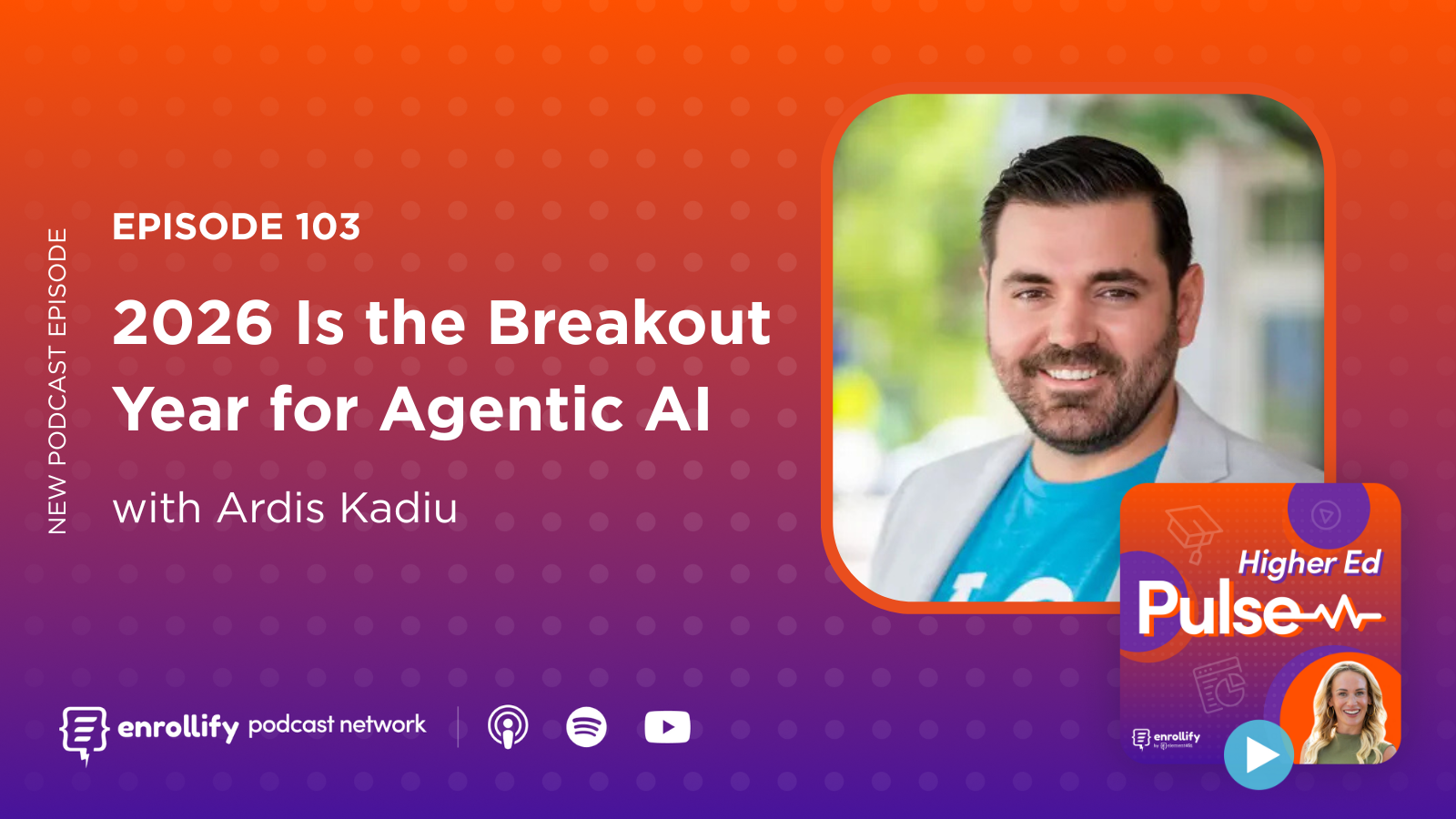
Mallory Willsea sits down with Ardis Kadiu, co-founder of AI Idea Lab and former CEO of Element451, to explore why 2026 is poised to be the breakout year for agentic AI in higher education. Unlike traditional AI tools that assist with tasks, agentic AI can now plan, execute, and deliver outcomes autonomously. They unpack how this shift will impact student communication, operational workflows, and the very structure of work across campuses. Tune in to hear real-world applications, insights into Ardis’s new venture Andy.AI, and how enrollment leaders can start leveraging these tools today.
Key Takeaways from “When AI Stops Helping and Starts Owning Outcomes” on Higher Ed Pulse
- Agentic AI marks a fundamental shift in AI's role — moving from simple assistance to full ownership of complex workflows and measurable outcomes.
- 2026 is the inflection point — due to smarter models, better infrastructure, and dramatically lower costs for running agents.
- Agentic AI tools are accessible now — platforms like Claude, GPT-4, and Replit allow marketers to build and deploy AI workflows without writing code.
- Higher ed teams can start with simple use cases — such as automating student inquiries, email management, and content generation.
- The ROI conversation has replaced the productivity pitch — with agentic AI being evaluated by tangible outcomes like conversion rates and time saved.
- Small teams can benefit the most — especially those running lean departments or managing multiple responsibilities across campus.
- Measurement matters — teams should evaluate AI by activity metrics, efficiency metrics, and outcome metrics to ensure real value.
- Don’t wait for perfect conditions — early adopters have paved the way, and now is the time for more institutions to start scaling with AI.
What is agentic AI and how is it different from traditional AI tools?
Agentic AI doesn’t just assist with tasks — it owns them. Unlike previous AI models that acted more like interns (e.g., generating content or drafting emails), agentic systems can independently plan, execute, and complete complex workflows. They can make decisions, interact with tools, track progress, and produce real outcomes with minimal human supervision. This is a major evolution in AI’s role across higher education marketing, operations, and student success.
Why is 2026 considered the breakout year for agentic AI?
Ardis explains that three forces are converging to make 2026 a pivotal moment:
- The models have matured — Newer models like GPT-5.2, Claude Opus, and Kimi 2.5 are designed for long-horizon planning and persistent memory.
- The infrastructure is ready — Sophisticated orchestration layers and “harnesses” allow agents to persistently call tools, access data, and remember tasks over time.
- The economics have flipped — What once cost $50 to run can now be done for under $1, making high-powered automation affordable for even small teams.
How are these tools already being used in real life?
Ardis shares how he uses agentic AI tools like Claude and Cursor for product development, deep research, and even coding. Mallory adds her own example: using AI to dramatically improve and accelerate buyer persona research — replacing weeks of manual effort with a streamlined, automated workflow.
Other solved use cases include:
- Email triage and drafting
- Meeting recordings and intelligent note-taking
- Research and document analysis
- Automated messaging and student communications
Do I need technical skills or a developer to use agentic AI?
Not anymore. With tools like Claude Co-Work, Replit, and ChatGPT’s agent integrations, anyone can describe a task and have an AI agent complete it — no coding required. The key is learning how to describe the workflow clearly and trusting the system to handle the execution. Ardis emphasizes that it’s more about experimenting and learning by doing than it is about technical expertise.
Where should small higher ed teams start with agentic AI?
Ardis recommends starting with the “3 Rs” to identify what to automate:
- Repetitive tasks — anything done more than 3x per week
- Rule-based decisions — tasks that follow predictable logic
- Record-heavy workflows — tasks requiring frequent data retrieval or updates
Student inquiries, content repurposing, and automated communications are prime places to begin — especially for lean teams looking to free up time for high-impact work.
How should we measure whether agentic AI is working?
Ardis offers a three-tiered framework for measurement:
- Activity Metrics – How many tasks were completed? How often did it need human help?
- Efficiency Metrics – What’s the cost or time saved per task compared to humans?
- Outcome Metrics – Are conversion rates better? Is engagement improving? Is student response time decreasing?
The real test? If you’d be upset to lose the tool, it's no longer just a “cool” feature — it’s delivering ROI.
What did we get wrong in the early days of AI in higher ed?
Looking back, Ardis admits they underestimated the complexity of change management. The technology worked, but trust, workflows, and governance were the real barriers. Early pilots often stalled because institutions weren’t ready to scale or lacked internal alignment. But today, more schools have governance in place, internal champions are winning buy-in, and infrastructure is maturing — making this the year AI can finally scale meaningfully.
Connect With Our Host:
Mallory Willsea
https://www.linkedin.com/in/mallorywillsea/
https://twitter.com/mallorywillsea
Enrollify is produced by Element451 — the next-generation AI student engagement platform helping institutions create meaningful and personalized interactions with students. Learn more at element451.com.




.svg)
.svg)
