






About the Episode
About the Episode:
SimpsonScarborough’s Higher Ed CMO Study
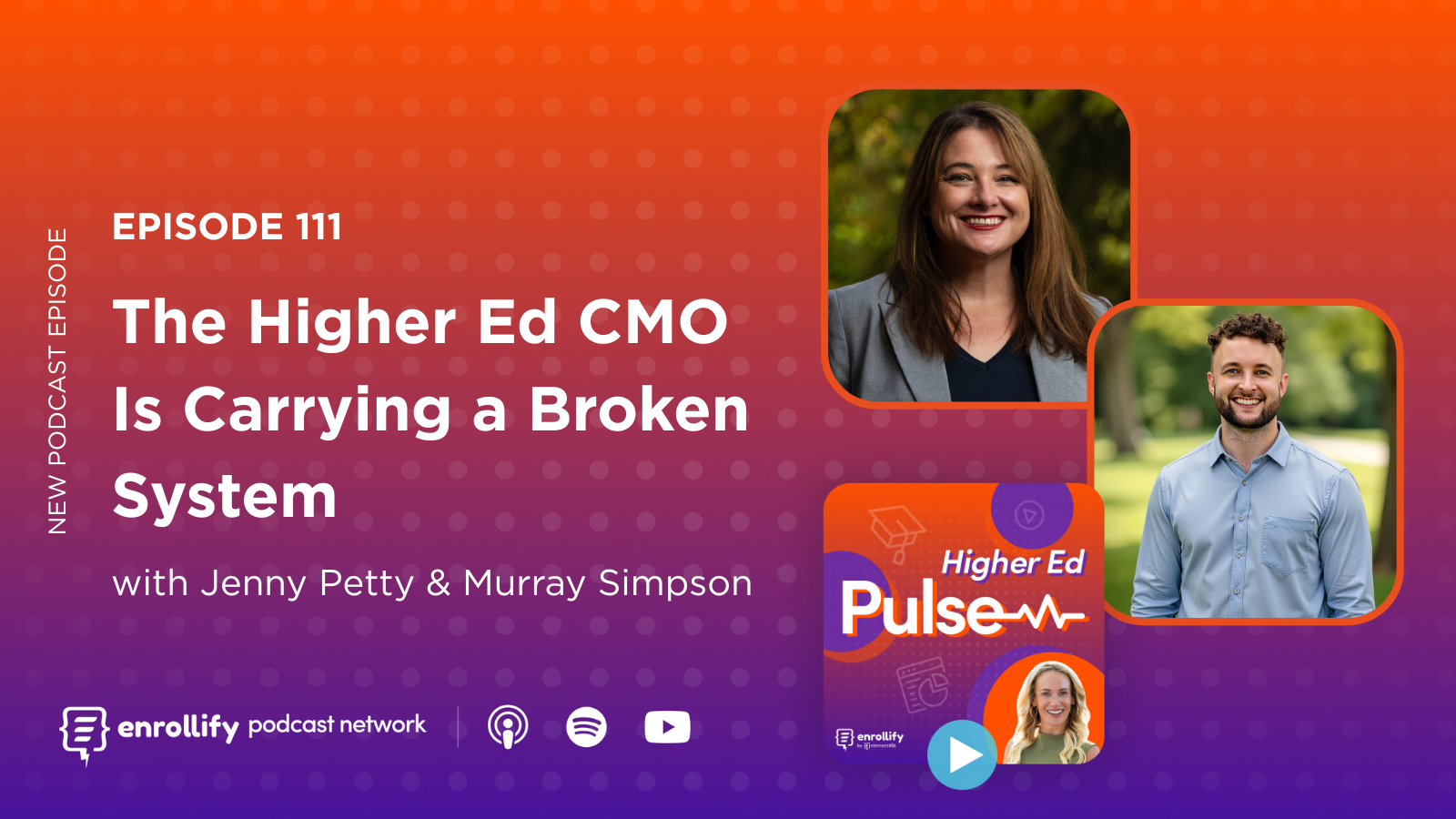
Mallory Willsea sits down with Murray Simpson and Jenny Petty to unpack findings from the latest SimpsonScarborough CMO Study. The conversation dives into the evolving expectations placed on CMOs, the structural challenges holding them back, and the growing pressure to prove impact on enrollment and institutional growth.
This episode is a candid, insight-rich exploration of enrollment marketing leadership in a fragmented system—and what must change for CMOs to truly drive results.
Key Takeaways
- The CMO role is elevated—but still constrained: More CMOs have cabinet-level influence, yet lack control over budgets, systems, and decision-making structures.
- Silos remain the biggest barrier to growth: Despite “good relationships,” poor content sharing and lack of governance undermine collaboration.
- Fear of blame is limiting marketing impact: CMOs often avoid tying marketing directly to enrollment outcomes, weakening their case for investment.
- Brand awareness ≠ reputation: Institutions must move beyond visibility and focus on shaping perception through strategic storytelling.
- Growth needs redefining: Enrollment isn’t the only metric—net revenue, program mix, and institutional positioning matter just as much.
- Not every institution should prioritize growth: Strategic contraction and repositioning may be the smarter path in a shrinking market.
- Advancement is an underleveraged growth driver: Alumni engagement and giving should be more tightly aligned with marketing strategy.
- Measurement is the next frontier: CMOs must build better systems to track reputation and demonstrate marketing’s full impact.
Episode Summary
What Does the Modern Higher Ed CMO Role Really Look Like?
The modern CMO sits closer to institutional power than ever before, with nearly 70% holding cabinet-level roles and many reporting directly to presidents. But this elevation comes with a catch: expectations have scaled faster than institutional structures. CMOs are now tasked with driving growth while operating within decentralized, fragmented systems that dilute their authority.
Murray Simpson frames this tension clearly—there’s a critical difference between accountability and responsibility. CMOs are increasingly accountable for outcomes like enrollment, but they don’t fully control the levers that drive those results. This disconnect creates a leadership paradox that defines the role today.
Jenny Petty reinforces that ambiguity, noting that marketing is often poorly defined on campuses. When everything becomes “marketing,” it also becomes the default scapegoat when things go wrong—especially in enrollment-driven environments.
Why Is Enrollment Marketing Still Stuck in Silos?
Despite strong interpersonal relationships across departments, operational alignment is still breaking down. The study reveals that while 87% of marketers report good cross-campus relationships, over a third say content sharing is ineffective. That gap signals a deeper issue: governance failure.
Jenny challenges the long-standing centralized vs. decentralized debate, arguing that most institutions now operate in hybrid models—and need governance systems that reflect that reality. Without clear decision rights, shared measurement frameworks, and coordinated content strategies, even well-intentioned teams duplicate efforts and dilute impact.
This is where higher education content marketing and operational discipline must intersect. Institutions can’t rely on goodwill alone—they need structured systems that enable collaboration at scale.
Are CMOs Letting Fear Undermine Their Impact?
One of the most provocative themes in the episode is fear—specifically, the fear of blame. Many CMOs hesitate to tie marketing directly to enrollment metrics, worried about being held responsible for outcomes beyond their control.
But Murray argues this hesitation is counterproductive. If marketing leaders want increased investment and influence, they must demonstrate impact—even if it means embracing risk. Avoiding accountability ultimately weakens marketing’s credibility in the cabinet room.
Jenny adds that this fear often stems from a lack of psychological safety. Leaders can’t “say the thing” or push bold strategies if they fear job loss or political backlash. Building a culture that supports candid, data-driven decision-making is essential for progress.
What Are Institutions Getting Wrong About Brand and Reputation?
Higher ed leaders consistently rank brand awareness as a top priority—but often treat it as optional in practice. The result? Over-reliance on performance marketing tactics that drive short-term inquiries but fail to build long-term reputation.
Murray highlights a critical distinction: awareness alone isn’t enough. Institutions must focus on meaningful visibility—shaping how prospective students perceive them before they even begin their search. This requires investing in storytelling, audience insights, and early-stage engagement.
From a marketing strategy for student recruitment perspective, the takeaway is clear: brand and performance must work together. Over-indexing on performance marketing can actually reduce ROI, while strong brand positioning enhances every downstream metric.
Should Every Institution Be Chasing Growth?
Jenny delivers one of the episode’s boldest takes: not every institution should be trying to grow. In a contracting market, chasing enrollment increases without strategic alignment can do more harm than good.
Instead, institutions need to rethink what growth actually means. It might involve program cuts, mergers, or even intentional downsizing to ensure long-term sustainability. Murray adds that net revenue—not just headcount—should be the primary lens for evaluating success.
This reframing challenges one of higher ed’s most entrenched assumptions and calls for more courageous leadership at the cabinet level.
Why Is Advancement Still Sidelined in Growth Conversations?
Despite being a major revenue driver, advancement remains disconnected from broader growth strategies. The study shows fundraising ranks far below enrollment as a priority—but that may be a missed opportunity.
Murray points out that alumni giving is one of the strongest indicators of institutional health. If graduates are willing to give back, it signals a positive student experience and strong brand affinity. Yet advancement and marketing often operate in silos, limiting their collective impact.
Bringing these teams together could unlock powerful long-term engagement strategies—especially when paired with data analytics in higher education to track donor journeys over time.
How Can CMOs Better Measure What Matters?
Measurement is the next big challenge—and opportunity—for higher ed marketers. Reputation is one of the most important metrics for presidents, yet also one of the hardest to quantify.
Jenny emphasizes that this isn’t an unsolvable problem. Other industries regularly conduct brand studies and perception research, and higher ed can adopt similar approaches. The key is building a measurement ecosystem that aligns with institutional goals, even in decentralized environments.
For CMOs, mastering this space is essential to proving value and securing long-term investment.
Connect With Our Host:
Mallory Willsea
https://www.linkedin.com/in/mallorywillsea/
https://twitter.com/mallorywillsea
Enrollify is produced by Element451 — the next-generation AI student engagement platform helping institutions create meaningful and personalized interactions with students. Learn more at element451.com.





.svg)
.svg)
