






About the Episode
The AI Engage Summit is a free, virtual experience built to help higher ed leaders actually do something with AI. Over two afternoons, you’ll hear from peers, see practical demos, and walk away with ideas you can use immediately — no travel required, no cost to attend. If you’re ready to move AI from “interesting” to “impactful,” this is the place to be. Register now, don't miss out.
About the Episode:
Storytelling is having a moment.
But most brands are still telling stories that sound exactly the same.
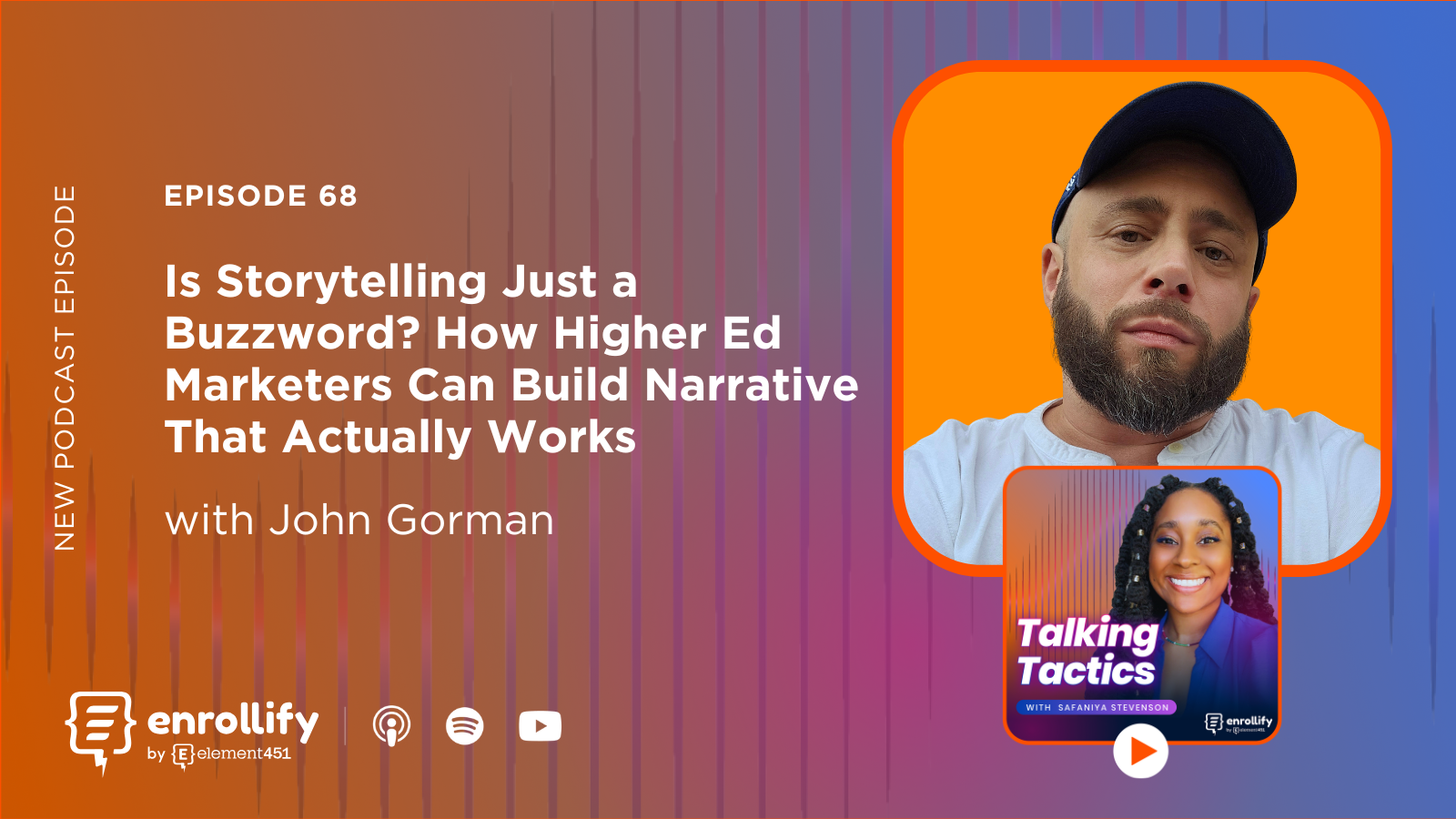
On this episode of Talking Tactics, Safy sits down with John Gorman, founder of Saint Orange, to unpack why “storytelling” has become marketing’s favorite buzzword and how it lost its edge along the way.
They get into what actually separates storytelling from narrative and copywriting, why higher ed marketing has been sanded down to beige, and how playing it safe is quietly killing differentiation. From building lore without blowing up your institution to measuring whether a story is doing its job, this conversation is equal parts strategic, cultural, and refreshingly honest.
If you’re a marketer who wants fewer buzzwords, better stories, and permission to take smarter creative risks, press play.
Key Takeaways
- Storytelling is the marketing skill of the future: According to Forbes and The Wall Street Journal, storytelling is becoming the most in-demand skill for CMOs and brand teams, and higher ed must keep up.
- Not all stories are created equal: Storytelling, narrative, and copywriting are not interchangeable. Each has its own function and role in brand communication.
- Higher ed stories sound the same—and that's a problem: The risk isn’t just in being bold; it’s now in being boring. Institutions that don’t differentiate through story will be drowned out in a sea of sameness.
- Constraints spark creativity: Small teams with limited resources can still tell powerful stories. Words, visuals, and existing institutional lore are valuable (and free) storytelling assets.
- Storytelling can be measured: Good storytelling builds attention, awareness, authority, affinity, and action—the five A’s that guide measurable storytelling outcomes.
- Institutional lore is untapped gold: Every campus has a rich story reservoir, from standout alumni to unique challenges. Use these to shape compelling narratives that feel true and urgent.
- Audit before action: The first step to better storytelling is assessing what stories already exist, how they’re perceived, and where the gaps are.
What makes someone a great storyteller in higher education marketing?
According to John Gorman, a great storyteller maximizes for reach, relevance, and resonance. They don’t just “write well”—they create emotional, insightful, and actionable experiences across mediums like words, visuals, and design. Unlike copywriting, which is typically word-focused, and narrative, which builds an overarching arc, storytelling is about impact in the moment and beyond. Higher ed marketers need to focus on making people feel something, not just filling brochures or social posts with polished language.
What’s the difference between narrative, copywriting, and storytelling?
John breaks it down:
- Narrative is a continuation function—it’s the broader arc, the shared meaning across multiple stories.
- Storytelling is the craft of drawing people into an emotional or intellectual transformation. It doesn’t always serve a narrative, but it should serve the audience.
- Copywriting is the tactical use of words, often supporting both narrative and storytelling, but not always rising to the level of either.
In higher education, this distinction matters. When job titles like “Chief Narrative Officer” pop up, it's crucial to understand what these roles actually entail—and why storytelling is foundational to all of them.
Why do all higher ed stories sound the same?
The answer is twofold: risk aversion and scale. As institutions grow, they play it safer. With big budgets and even bigger reputations to protect, many schools lean into sanitized messaging that avoids offending anyone. The result? Every 30-second spot during bowl season starts to blur together. As John notes, “If you didn’t see the logo or colors, you’d never know which school is which.”
Ironically, this risk-averse approach is now the risk. In 2026, the greater threat isn’t standing out—it’s disappearing into the noise. Differentiation isn’t just a branding exercise anymore; it’s survival.
How can small or under-resourced marketing teams tell better stories?
Great news: storytelling isn’t reserved for schools with massive marketing budgets. As John says, “Words are free. Pictures are free.” The real question is how you use them. Start by auditing what you already have—alumni wins, geographic uniqueness, cultural moments, and even your school’s struggles are all ripe storytelling material. From there, assess the talent on your team and work within your constraints.
The key is to tell your story with intentionality and clarity. You don’t need a full brand studio to be bold; you just need a strategy and the courage to use your voice differently than your competitors.
How can storytelling be measured in higher ed marketing?
John introduces a brilliant framework: the 5 A’s of storytelling purpose. Each story should aim to generate one or more of the following:
- Attention – Are people noticing it?
- Awareness – Do people recall your message?
- Authority – Are people quoting, sharing, or referencing it?
- Affinity – Are you building emotional connection and community?
- Ask – Are you driving action (leads, applications, donations)?
By tying stories to these outcomes, higher ed marketers can confidently make the case to leadership that storytelling isn’t fluff—it’s a performance indicator.
What should marketers do when leadership is afraid to take creative risks?
Creative storytelling often feels risky in higher ed, especially when going through multiple layers of approval. But not all risk is bad. John suggests evaluating risk across four dimensions:
- Intellectual: Have we done this before?
- Emotional: How does it make people feel?
- Financial: What are the cost implications?
- Cultural: Are we venturing into new territory or speaking to new audiences?
The best marketers balance upside and downside. They frame storytelling not as reckless, but as a smart and calculated opportunity to break through the sameness and stand out in a crowded market.
Where should a higher ed marketer start if they want to improve their institutional storytelling?
Start with a story audit. Look at what’s out there already—your videos, your emails, your social posts, your homepage copy. Then compare it to how your institution is actually perceived. Find the gaps between your internal “essence” and external “image.” Only once you understand your position can you start crafting a stronger path forward.
John puts it perfectly: “Find the gap, then tell the story.”
Connect With Our Host:
Enrollify is produced by Element451 — the next-generation AI student engagement platform helping institutions create meaningful and personalized interactions with students. Learn more at element451.com.




.svg)
.svg)
