






About the Episode
The AI Engage Summit is a free, virtual experience built to help higher ed leaders actually do something with AI. Over two afternoons, you’ll hear from peers, see practical demos, and walk away with ideas you can use immediately — no travel required, no cost to attend. If you’re ready to move AI from “interesting” to “impactful,” this is the place to be. Register now, don't miss out.
About the Episode:
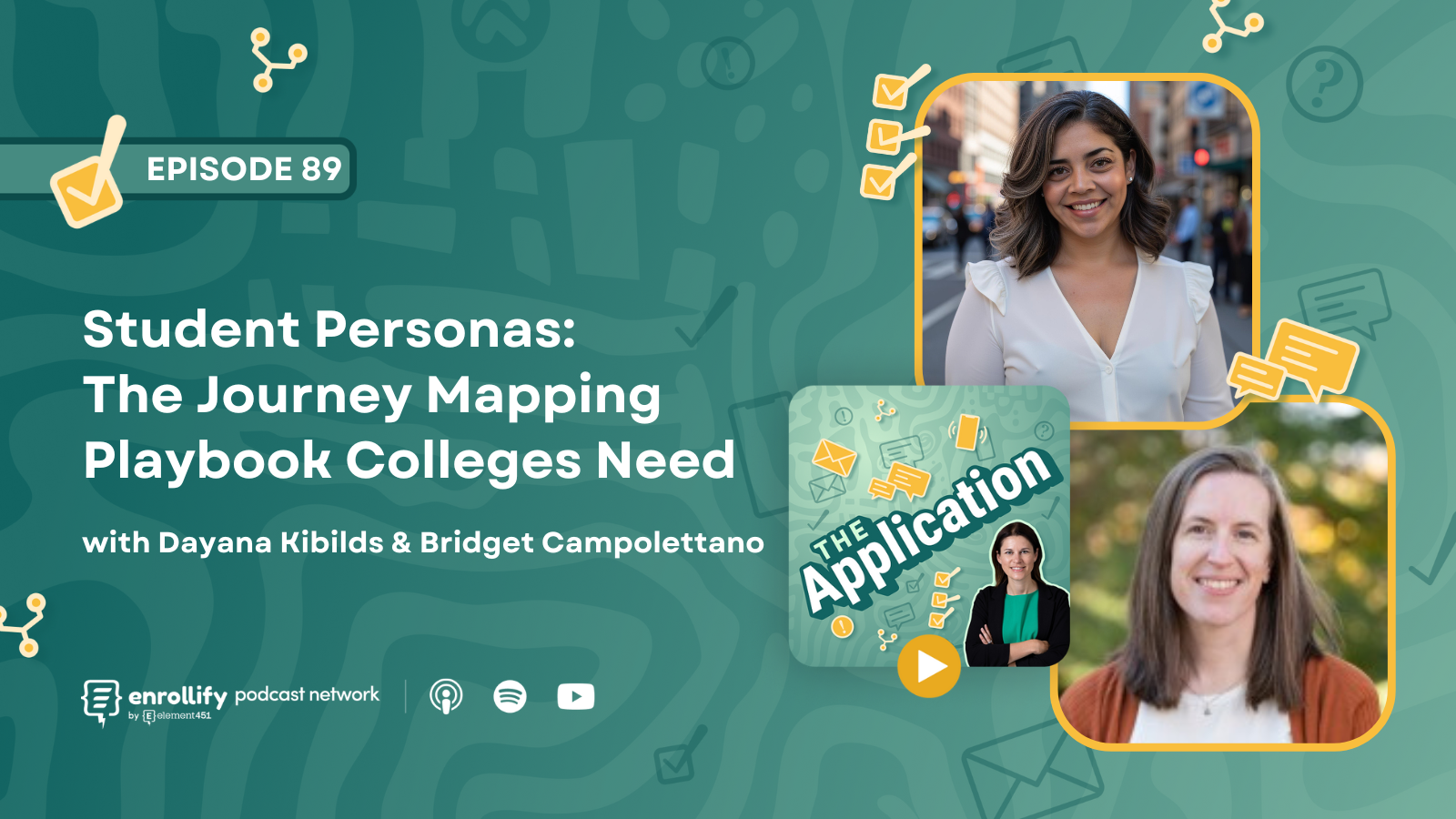
In this episode, Allison talks with Day Kibilds, VP of Strategy at Ologie, and Bridget Campolettano, Executive Director of Communications - Arts and Sciences at Dartmouth College, about the bold journey mapping project that transformed how Amherst College thinks about access, communication, and enrollment strategy. Day and Bridget break down how they uncovered four personas that reveal the emotional and informational barriers students face, and how those insights reshaped real conversations and real materials. They also share the early impact, including record numbers of first generation and rural admits, and offer practical advice for any institution ready to rethink its approach from the student perspective.
Join us as we discuss:
- [2:00] How journey mapping uncovered what traditional research missed
- [11:52] The pain points that most students want schools to solve
- [19:14] How admissions counselors use the personas in real conversations
To hear this interview and many more like it, subscribe on Apple Podcasts, Spotify, or our website, or search for “The Application with Allison Turcio” in your favorite podcast player.
Why Did Amherst and Ologie Launch a Journey Mapping Project?
The project was born out of the realization that Amherst’s recruitment materials were outdated—unchanged since 2014, the same year the Apple Watch debuted. But more than just modernizing content, Bridget and her team aimed to tackle a much deeper challenge: making Amherst visible and accessible to students who didn’t even know schools like it existed. Their goal wasn’t more applications—it was more awareness from underrepresented audiences.
With that mission in mind, Amherst and Ologie embarked on a journey mapping exercise to visualize how different students experienced the college admissions process. Their north star? Find out where students fall off the journey—and intervene before they do.
What Is Journey Mapping, and Why Did It Matter?
Day explains that traditional research often tells you who succeeds at your school, but not why others never apply. Journey mapping uncovers those missing stories. By breaking the enrollment process into five phases—from initial search to deposit—the team gathered anonymous insights from current students about what almost stopped them at each stage.
They also turned to Reddit and other online spaces to capture raw, unfiltered reflections from students going through the process. Combined, this qualitative research allowed them to identify emotional and informational pain points that were previously hidden.
Who Are the Four Student Personas Amherst Discovered?
Bridget and Day describe a student matrix built on two axes: knowledge of Amherst and interest in Amherst. From there, they defined four personas:
- The Guided – High knowledge and high interest. These are Amherst’s “core” applicants with strong support systems. Their barrier: choosing Amherst over Ivy peers.
- The Skeptic – High knowledge, low initial interest. Often cross-applicants with research universities. Their barrier: belonging—do I fit in at a liberal arts school?
- The Seeker – Low knowledge, high interest. Motivated but unclear on what liberal arts means. Their barrier: connecting college choice to future outcomes.
- The Dreamer – Low knowledge and low access. First-gen or low-income students who don't know Amherst exists. Their barrier: awareness—they're not even in the funnel yet.
This framework didn’t just drive understanding—it helped humanize outreach. It allowed the team to craft messaging that would resonate with everyone while specifically meeting each persona at their moment of doubt.
How Did Amherst Apply the Research to Their Enrollment Marketing?
Amherst didn’t just research; they built things with the findings. Each persona informed a key moment in the enrollment journey, and every touchpoint—from emails to viewbooks—was re-engineered to reflect the emotional and informational needs of these students.
- Guided students received intellectually validating materials in their admit packet, helping them see that Amherst was just as rigorous and fulfilling as its Ivy peers.
- Skeptics were met with messaging that showcased campus dialogue, critical thinking, and parental approval stories—delivered through a reimagined viewbook.
- Seekers got practical content focused on outcomes, connecting their interests to real-world careers via a redesigned travel piece.
- Dreamers—who weren’t even aware Amherst was a fit—received a new household guide, mailed to homes, explaining both liberal arts and the financial feasibility of attending Amherst.
Crucially, all students received the same baseline materials, but with flavors of messaging designed to resonate based on where they were emotionally and intellectually. This wasn’t segmentation—it was strategic storytelling.
What Were the Results?
Bridget shares a range of outcomes that highlight how deeply effective this approach was:
- 25% of admitted students for the Class of 2029 were first-gen—a record for Amherst.
- 21% of the enrolling class were first-gen students, proving that yield held strong.
- A 37% increase in students from rural areas—thanks in part to Amherst’s new participation in the STARS Network and persona-driven outreach.
- Fewer repetitive questions from prospects and families—evidence that communications were clearer, more accessible, and more helpful.
- Increased QuestBridge enrollments, demonstrating stronger resonance with high-achieving, low-income students.
Even better? Admission deans and counselors found the personas helpful as a conversation tool, giving them the language to respond to each student’s unspoken fears in one-on-one settings.
How Can Other Schools Start Journey Mapping?
Day and Bridget’s advice is clear: start small and use what you already have. You don’t need a massive study. Begin by identifying one student group you want to understand better. Dive into counselor emails, Reddit threads, and internal conversations. Use those insights to ask new questions: What almost stops this student from applying? What do they wish they knew?
Then, use those learnings to train your teams, rewrite your emails, or redesign one key piece. This work is iterative, human, and most of all—possible with the resources you have today.
Connect With Our Host:
Allison Turcio
https://www.linkedin.com/in/allisonturcio/
https://twitter.com/allisonturcio
Enrollify is made possible by Element451 — the next-generation AI student engagement platform helping institutions create meaningful and personalized interactions with students. Learn more at element451.com.


.svg)
.svg)
