






About the Episode
The AI Engage Summit is a free, virtual experience built to help higher ed leaders actually do something with AI. Over two afternoons, you’ll hear from peers, see practical demos, and walk away with ideas you can use immediately — no travel required, no cost to attend. If you’re ready to move AI from “interesting” to “impactful,” this is the place to be. Register now, don't miss out.
About the Episode:
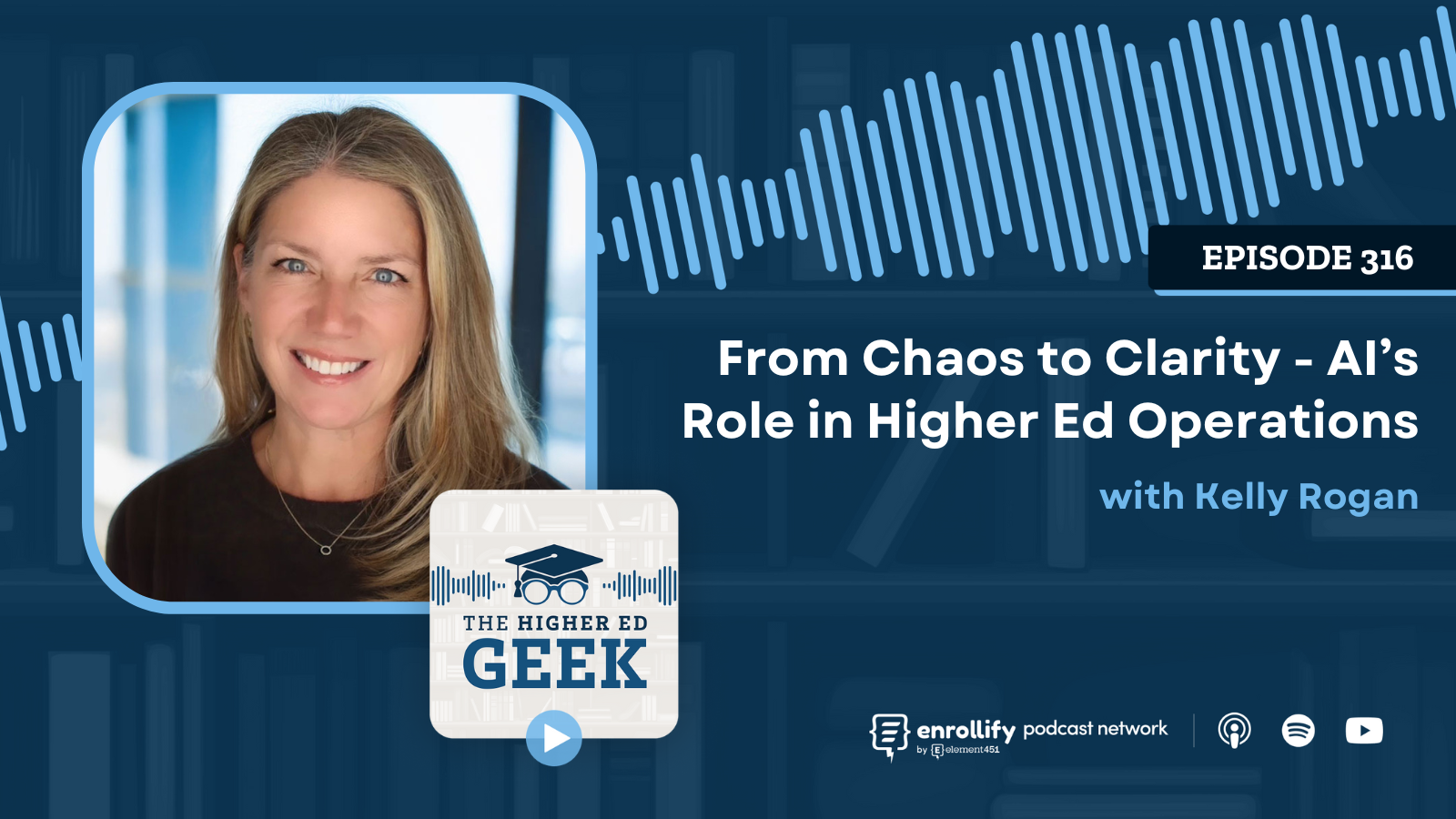
What if the path to transforming higher ed isn't about radical reinvention—but about finally using the tools we already have? In this episode, Dustin chats with Kelly Rogan, COO of Ellucian, about how AI and data can revolutionize student experiences, institutional operations, and leadership decisions—if we’re brave enough to modernize. Drawing from her background at Microsoft and her deep dive into higher ed, Kelly unpacks how institutions can move from resistance to action, without losing the human touch.
Key Takeaways
- Institutions must prioritize data governance to unlock meaningful AI use cases in student success and operational efficiency.
- AI in higher education is moving beyond theory—2026 marks the year of institutional adoption and scaled implementation.
- Strategic partnerships with trusted EdTech providers like Ellucian can accelerate modernization and digital transformation.
- AI tools are most impactful when they enhance student services, enabling advisors to focus on meaningful, high-touch interventions.
- Institutions can drive future-proof enrollment strategies by leveraging data insights for program planning, financial health, and retention.
Who is Kelly Rogan and what does she do at Ellucian?
Kelly Rogan is the Chief Operating Officer at Ellucian, bringing over 30 years of tech experience—including 15 years at Microsoft—to the higher education space. At Ellucian, she leads customer success, professional services, and support, helping institutions modernize operations and integrate emerging technologies like AI. Her role centers around improving student and staff outcomes through strategic tech enablement.
How is AI transforming operations and student experiences in higher ed?
AI is rapidly evolving from an experimental tool into a powerful engine for institutional transformation. According to Rogan, early applications focused on teaching and learning, but now, the focus is shifting toward process optimization and advising. AI can synthesize data across departments, identify at-risk students, and empower self-service planning tools—freeing up human advisors for deeper student engagement.
What are the biggest challenges institutions face in adopting AI?
The main hurdles include legacy systems, a lack of data governance, and the need for cultural change. Many institutions are sitting on decades of siloed data, making it difficult to generate insights or automate tasks. There’s also a gap between students’ tech-savviness and institutional readiness. Building trust in AI-generated outcomes requires institutions to standardize data, define governance protocols, and create cross-functional AI councils to guide adoption responsibly.
How should institutions approach modernization in 2026?
Rogan stresses that “it’s not if, but when” institutions must modernize. She encourages leaders to see 2026 as a pivotal year to embrace AI as a foundational tool—not just for automation, but for unlocking new, student-centric experiences. From enrollment planning to academic advising to transfer credit evaluations, the opportunities to streamline and improve outcomes are real, immediate, and measurable.
What role does data governance play in successful AI implementation?
Data governance is the backbone of trustworthy AI adoption. Without clean, centralized, and well-managed data, AI outputs risk being inaccurate or unhelpful. Rogan highlights that many student pain points—like unclear transfer credit pathways or delayed advising—can be solved by simply connecting existing data sets in a more intelligent way. Governance ensures that these tools deliver consistent, equitable, and secure experiences.
What are some real-world examples of AI creating value for students and staff?
One key example Rogan shares is using AI to unlock reverse transfer credentials—awarding degrees to students who unknowingly meet requirements after transferring. Another is personalized degree planning powered by real-time course availability, enabling students to make timely, cost-effective decisions. AI also powers executive dashboards for leadership to track enrollment, retention, and program performance without manual data requests.
How can institutions future-proof their digital strategies?
Rogan advises institutions to adopt modern, standardized platforms that offer flexibility but reduce complexity. The goal isn’t to chase every new AI trend but to thoughtfully implement tools that align with institutional goals and student needs. She also stresses the importance of choosing the right partners—like Ellucian—that understand higher ed’s unique challenges and can guide responsible transformation.
About the Show: The Higher Ed Geek Podcast explores the impact of edtech on the student experience by speaking with diverse leaders from institutions, companies, and nonprofit organizations. Each week we aim to provide an engaging, fun, and relevant dose of professional development that honors the wide range of work happening all across the higher ed ecosystem. Come geek out with us! The Higher Ed Geek Podcast is hosted by Dustin Ramsdell and is a proud member of the Enrollify Podcast Network.
Connect With Our Host:
Dustin Ramsdell
Enrollify is produced by Element451 — the next-generation AI student engagement platform helping institutions create meaningful and personalized interactions with students. Learn more at element451.com.



.svg)
.svg)
