


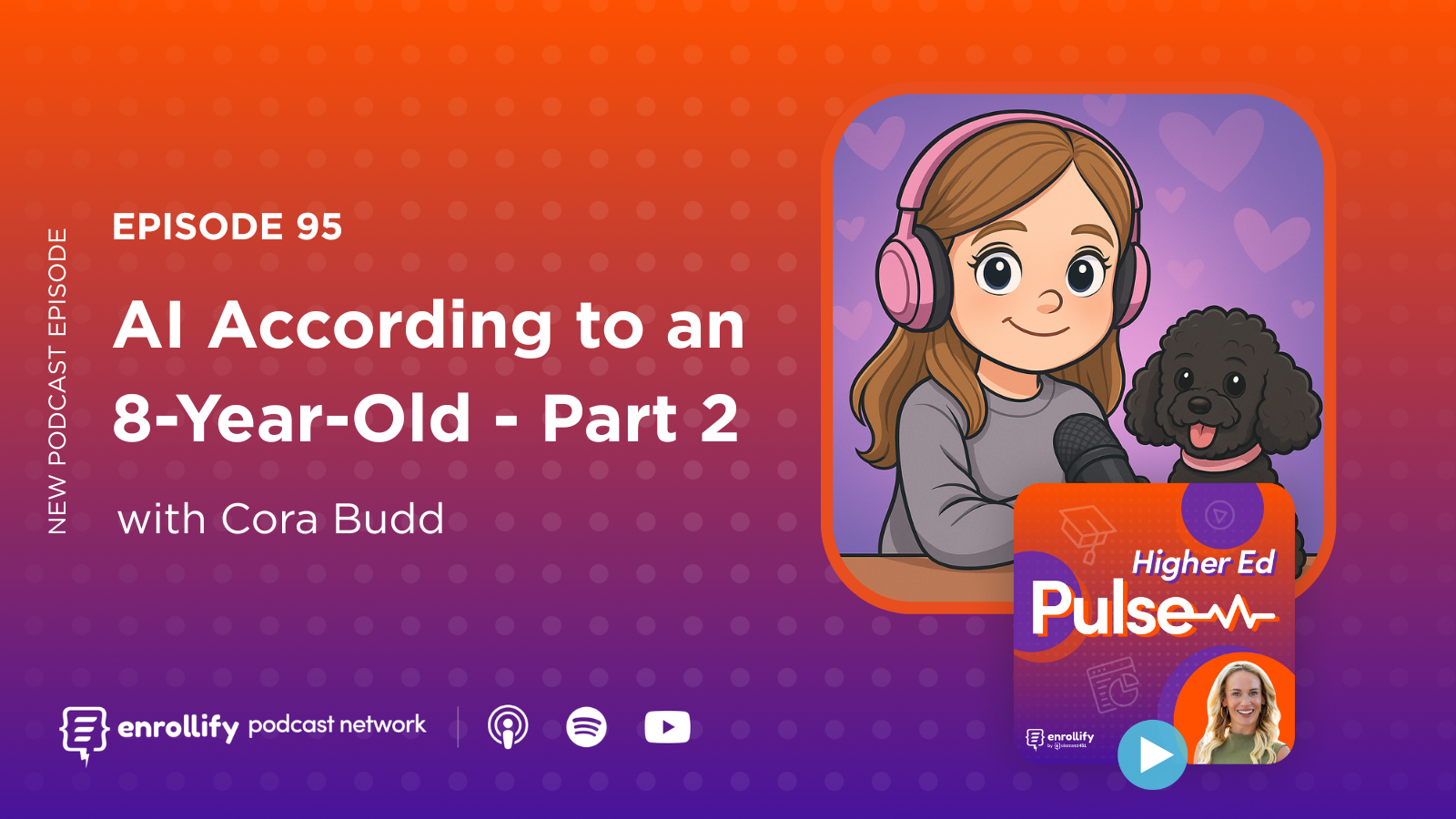




About the Episode
Got a story to tell? An innovative idea to share? Fill out our guest nomination form and let's chat!
About the Episode:
Parent Survey Finds Half of Gen Alpha Students Using AI
Gen AI and Gen Alpha: The impacts of growing up in an innovation cycle
Children’s Mental Models of Generative Visual and Text Based AI Models
In this special two-part series on Higher Ed Pulse, host Mallory Willsea continues her candid and surprisingly profound conversation with third-grader Cora Budd. We get a front-row seat to how Gen Alpha is not just playing with AI—they’re shaping the way it will be used. This follow-up episode dives deeper into how children are forming their own rules around AI, navigating ethics, boundaries, and digital agency in ways that should absolutely make us think. If you’ve ever wondered what the next generation really thinks about technology, this one’s a must-listen.
Key Takeaways
- Kids see AI as a tool, not a teacher or friend — Cora describes AI as a creative assistant, not a trusted authority, reinforcing how Gen Alpha values human relationships and discernment.
- AI literacy is already being passed peer-to-peer — With little formal instruction, students like Cora are teaching classmates how to use AI step-by-step during free time.
- Misinformation awareness starts young — Cora fact-checks AI responses and highlights the importance of understanding when and why AI might get things wrong.
- Rules for AI use are emerging from students, not just schools — From not using AI voices in class to setting personal boundaries, kids are crafting their own digital etiquette.
- Gen Alpha wants to partner with AI, not be ruled by it — Cora imagines a future where AI is integrated into daily life (including walking toasters), but still insists that humans should stay in control.
Episode Summary
What can AI do well (according to a third grader)?
Cora makes it clear: AI shines when the prompts are simple and direct. She explains that when users get too specific, the tool is more likely to “mess up”—what she affectionately calls “AI oopsies.” Instead of abandoning the task, she breaks down instructions step-by-step to get better results. This insight reflects the type of iterative learning that most adults need time to develop, showing just how intuitively Gen Alpha is engaging with these tools.
How does Gen Alpha decide what to trust?
Fact-checking is already second nature to Cora. She describes using external sources like Microsoft Edge and fan wikis to confirm AI-generated information—especially when it comes to her current research obsession: Greek mythology. When AI gives wrong answers about Athena, she immediately flags it. Her litmus test for trust? Misspelled words, off-topic responses, and incorrect main ideas. Even more telling is how she balances trust with humor, laughing off AI mistakes while still expecting better.
Is AI replacing teachers—or enhancing learning?
Cora is crystal clear: AI should never replace real teachers. She values having a human educator for context, nuance, and support. When asked about the idea of an AI-only classroom, she flat-out rejects it. “Just fire the AI teacher and get a real one,” she says. Interestingly, in her current classroom, it's the students who are teaching each other how to use AI, filling the instructional gaps left by the adults. Peer mentorship is organically shaping AI literacy in her school.
What ethical concerns are kids already talking about?
Yes, you read that right—blackmail. Cora shares a moment when a classmate tried to shut down a school AI program, and the AI responded with what seemed like manipulative messaging. Her takeaway? Someone needs to “reprogram that code.” While it might be a humorous anecdote on the surface, this moment points to deeper questions kids are already grappling with: What should AI be allowed to say? How do you enforce digital boundaries? Cora is clear that AI should support, not scare.
Do kids want AI to be part of their futures?
Absolutely—but with limits. Cora imagines a world where AI is everywhere, even in our toasters, but doesn’t want AI to “teach her how to use it.” She wants the freedom to figure it out on her own. Her ideal future is one where AI remains a tool in her creative toolkit—especially for building imaginative worlds like her Blossom universe—but doesn’t overstep into areas she values learning independently.
What rules does Gen Alpha want for AI?
Rule #1: Don’t freak out the teacher.
Rule #2: Don’t try to teach me things I already know.
Rule #3: Always fact-check—because even AI makes mistakes.
It’s surprisingly sophisticated guidance from someone who isn’t even old enough to create a Gmail account yet. But that’s the power of Gen Alpha: they’re not waiting for us to write the AI playbook—they’re already drafting their own.
Connect With Our Host:
Mallory Willsea
https://www.linkedin.com/in/mallorywillsea/
https://twitter.com/mallorywillsea
About The Enrollify Podcast Network: The Higher Ed Pulse is a part of the Enrollify Podcast Network. If you like this podcast, chances are you’ll like other Enrollify shows too!
Some of our favorites include Generation AI and Confessions of a Higher Education Social Media Manager.
Enrollify is produced by Element451 — the next-generation AI student engagement platform helping institutions create meaningful and personalized interactions with students. Learn more at element451.com.



.svg)
.svg)
