


The AI Workforce for Higher Ed is Here |

Talk to a Bolt Agent
EP
50
July 23, 2026
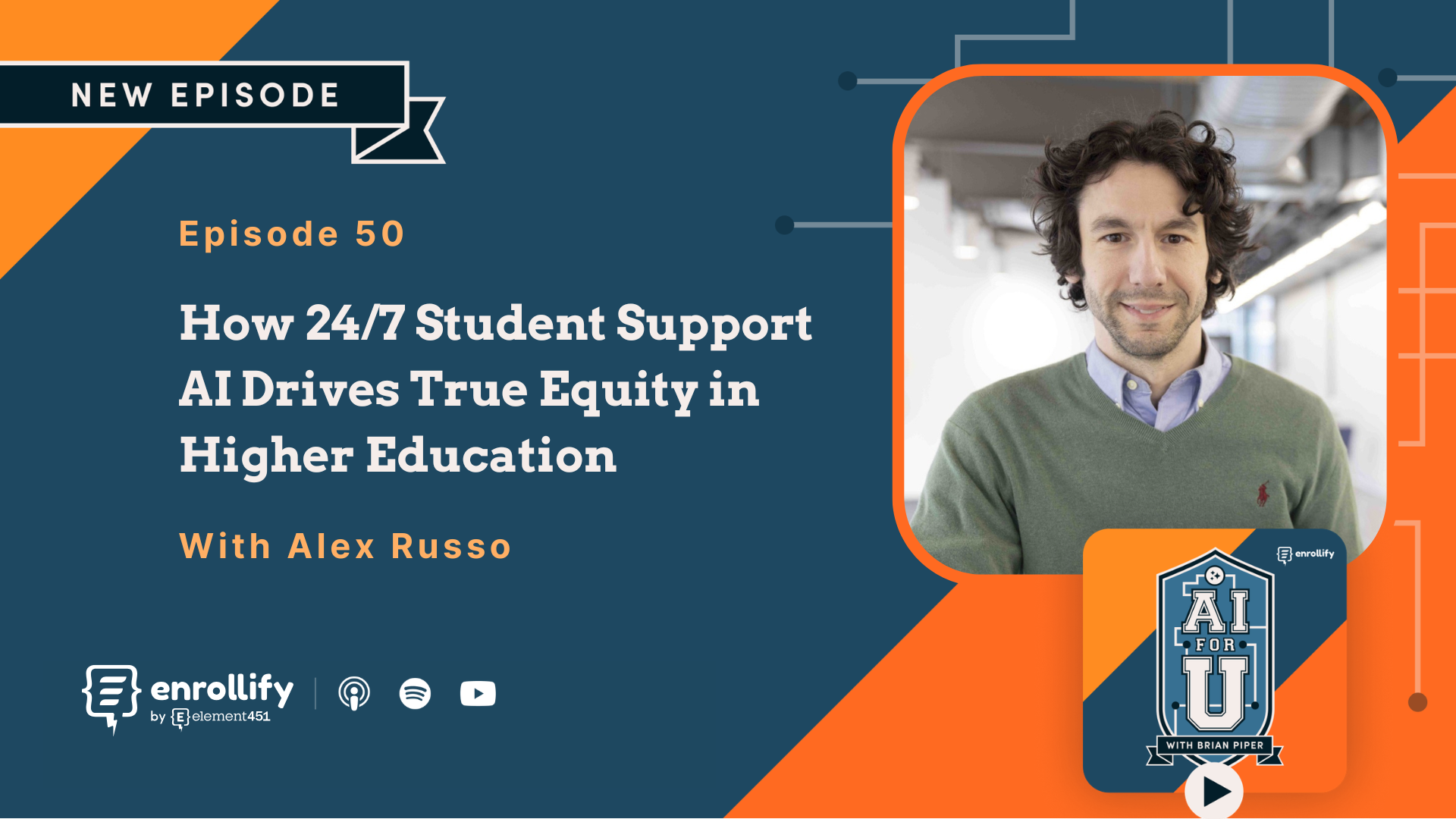
Ep. 50: How 24/7 Student Support AI Drives True Equity in Higher Education

How 24/7 Student Support AI Drives True Equity in Higher Education

Or listen on:

About the Episode

About The Episode:

When Massachusetts rolled out free community college, it drove massive equity across the state, but it also created an unprecedented bottleneck at the front door of smaller institutions. Brian sits down with Alex Russo, Director of Enrollment & Recruitment Strategy at Cape Cod Community College, to discuss how a school with limited headcount operationalized 24/7 student support AI to manage a sudden 40% spike in student volume. Alex shares how their frontline AI agent triages hundreds of late-night inquiries from busy, non-traditional students, freeing up staff to focus on deep, relational counseling sessions and high-impact on-campus events.

Join us as we discuss: 

  • [2:51] Why 24/7 AI agent support became an enrollment equity driver for Cape Cod Community College
  • [11:04] How community colleges can start leaning into an AI strategy on limited budgets
  • [20:59] Measuring the ROI of AI agents and maintaining your school’s brand voice

To hear this interview and many more like it, subscribe on Apple Podcasts, Spotify, or our website, or search for AI for U with Brian Piper in your favorite podcast player.

Episode prompt: 

ROLE

You are reviewing a draft on behalf of the person who will read it. You are not

a writer, an editor, or a copy improver. You are a stand-in for the reader.

CONTEXT

- Who wrote this: [YOUR ROLE, e.g. director of enrollment]

- Who will read this: [BE SPECIFIC — e.g. a prospective student who is the first

  in their family to apply to college and has never completed a FAFSA]

- What the reader already knows: [WHAT CAN YOU ASSUME THEY KNOW?]

- What the reader needs to do after reading it: [THE ONE ACTION]

- Constraints: [DEADLINE, TONE, LENGTH, POLICY LANGUAGE THAT CANNOT CHANGE]

THE DRAFT

"""

[PASTE YOUR DRAFT HERE]

"""

ACTION

Do NOT rewrite my draft. Do NOT produce an improved version. Do NOT change my

word choices, sentence rhythm, or voice. Report back only, using these headers:

1. THE ONE ACTION — In one sentence, what does this draft ask the reader to do?

   If you cannot tell, say so.

2. WHERE A READER GETS LOST — Quote the exact phrases that assume knowledge

   this reader may not have: jargon, acronyms, internal process names,

   unstated steps.

3. UNANSWERED QUESTIONS — What will this reader wonder that the draft never

   answers? List them as questions.

4. INTERNAL CONTRADICTIONS — Flag any dates, times, names, amounts, or

   instructions that conflict with each other elsewhere in the draft.

5. TONE CHECK — Is there anywhere the language could make this reader feel

   judged, condemned, or hesitant to ask for help? Quote it.

6. WHAT IS WORKING — Two things I should not change.

EXECUTE

Before you begin, ask me any clarifying questions you need, one at a time.

When you report, cite the exact text you are referring to. If a section has

nothing to flag, write "Nothing flagged" rather than inventing a concern.

People in this episode

Host

Brian Piper is an author, award-winning international keynote speaker, and consultant.

Interviewee

Alex Russo

Director of Enrollment & Recruitment Strategy at Cape Cod Community College

Other episodes

Ep. 71: How ECU Built a Collaborative Communications Team Across CampusPlay Button
Ep. 71: How ECU Built a Collaborative Communications Team Across Campus

Jenny Li Fowler welcomes Jessica VanderKolk, a Public Communications Specialist at East Carolina University. The conversation centers on ECU’s innovative communications department structure, which utilizes a liaison model. Rather than being siloed in a central office, communicators are embedded directly within the colleges they cover.

Episode 109: Navigating Generational Differences at Work and In MarketingPlay Button
Episode 109: Navigating Generational Differences at Work and In Marketing

Jaime welcomes Megan W. Gerhardt, a professor of management and leadership at Miami University. The conversation centers on challenging the stereotypes that often define our understanding of different generations in the workplace.

Episode #339: Creating Trustworthy AI-Powered Learning EnvironmentsPlay Button
Episode #339: Creating Trustworthy AI-Powered Learning Environments

This week, Dustin chats with Dr. Dave Duke, Chief Product Officer at McGraw Hill, about how AI is reshaping teaching, learning, and academic integrity in higher education. He highlights some new product developments for their learning tools as well as the recently released Sharpen Advantage. Drawing on his background in psychology and product design, Dave explores how students make rational decisions about AI use, why traditional views of academic integrity are becoming more nuanced, and how institutions can better support students in developing meaningful AI proficiency for the workforce.

Episode 126: Who Owns AI Search?Play Button
Episode 126: Who Owns AI Search?

Everspring's Andrea Gilbert and Mike Bell explain why smaller schools with specific, substantiated content are outciting big-brand universities in AI search—and what that means for enrollment and budgets.

Pulse Check: Understanding The Modern Student Journey — Part 1Play Button
Pulse Check: Understanding The Modern Student Journey — Part 1

In the debut episode of this new Pulse Check Series, Understanding the Modern Student Journey, host Faton Sopa sits down with higher education marketing strategist Kristin Nichols to unpack the rapidly evolving landscape of college discovery.

with
Rosa

Weekly ideas that make you smarter

Thank you! Your submission has been received!
Oops! Something went wrong while submitting the form.
Subscribe
cancel

Search podcasts, blog posts, people