



About the Episode
Got a story to tell? An innovative idea to share? Fill out our guest nomination form and let's chat!
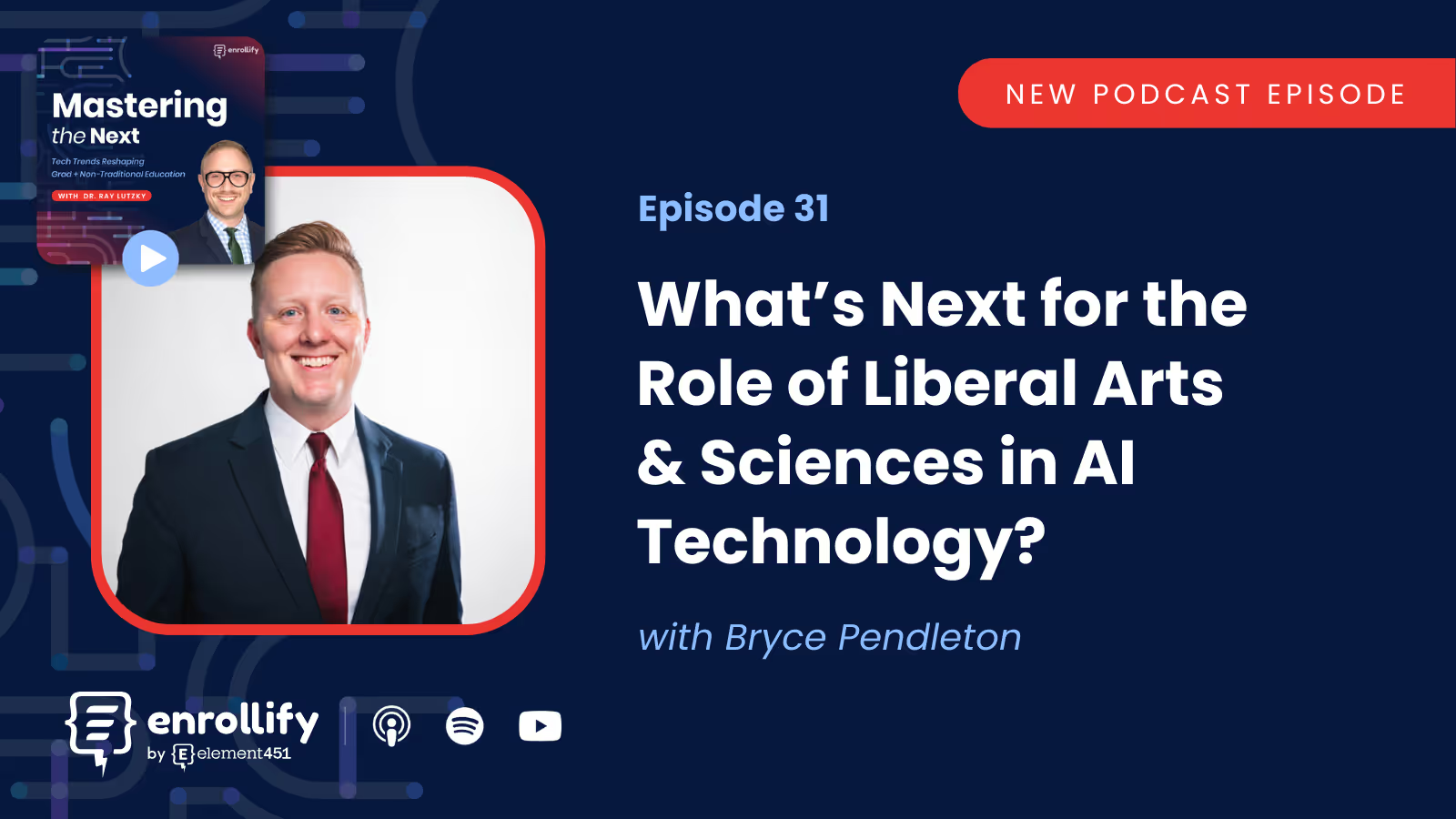
About the Episode: This episode covers one of Ray’s favorite topics – the liberal arts and sciences. As colleges and universities are pressured to demonstrate the return on investment for their cost of attendance, many have prioritized science, technology and engineering fields with higher employability and starting salaries. This has shifted focus from the liberal arts at a time when AI technology is becoming more central to higher education. Bryce Pendleton, Vice President of Brand & Technology at Southern Virginia University joins the podcast to explore the future of liberal arts education in the context of AI technology.
Key Takeaways
- Liberal arts disciplines like philosophy and ethics play a vital role in shaping AI's ethical use and societal impact.
- AI tools, when used responsibly, can enhance learning in liberal arts education rather than replace traditional methods.
- The liberal arts provide critical frameworks for understanding humanity, fostering creativity, and ensuring technology serves human flourishing.
- Institutions need to adapt their teaching methodologies to integrate AI as a tool while preserving foundational liberal arts principles.
- Liberal arts colleges can use AI to demonstrate their relevance and value in today’s technology-driven world.
Episode Summary
What’s Next for Liberal Arts and AI?
Pendleton highlights the necessity of bridging liberal arts and STEM fields in a collaborative approach rather than treating them as opposing forces. He recalls the philosophical differences between tech visionaries Bill Gates and Steve Jobs, noting that innovation thrives at the intersection of technology and the humanities. As AI becomes central to higher education, the liberal arts’ role in fostering critical thinking, ethics, and creativity is more crucial than ever. Pendleton advocates for integrating AI into liberal arts education to enhance students' learning experiences.
How Can Liberal Arts Disciplines Influence AI Development?
Liberal arts fields like philosophy, ethics, and sociology contribute more than just guardrails for AI—they shape our understanding of its purpose and impact. Pendleton argues that a liberal arts education equips individuals to evaluate AI outputs through a lens of beauty, virtue, and human flourishing. He emphasizes the importance of educating the whole person to ensure that technological advancements align with humanity's ethical and cultural values.
Why Has the Focus Shifted Away From Liberal Arts?
The decline in liberal arts enrollment can be traced to societal emphasis on immediate employability and financial outcomes. Pendleton references a Georgetown University study that highlights the long-term earning potential of liberal arts graduates, arguing that while the ROI may take longer to manifest, its value is substantial. He also identifies a cultural drift toward instant gratification as a challenge to the liberal arts, which require patience and deep engagement.
How Can AI Revitalize Liberal Arts Education?
Pendleton envisions AI as a tool to rejuvenate the liberal arts, offering examples such as analyzing literary patterns in Shakespeare's works using AI. He recounts Southern Virginia University's adoption of Apple technology, underscoring the potential of morally neutral tools to advance education when used responsibly. AI, he suggests, can help liberal arts colleges demonstrate their relevance by blending traditional humanities with cutting-edge technology.
What Does the Future Hold for AI and Liberal Arts?
Looking ahead, Pendleton predicts that AI will become as ubiquitous as Google, transforming but not eliminating the liberal arts. Institutions must evolve their teaching methods to incorporate AI without compromising the critical thinking and creativity at the heart of a liberal arts education. By embracing AI as a complement rather than a threat, liberal arts colleges can remain vital contributors to a well-rounded education.
Connect With Our Host:
About The Enrollify Podcast Network: Mastering the Next is a part of the Enrollify Podcast Network. If you like this podcast, chances are you’ll like other Enrollify shows too!
Some of our favorites include The EduData Podcast and Generation AI.
Enrollify is produced by Element451 — the next-generation AI student engagement platform helping institutions create meaningful and personalized interactions with students. Learn more at element451.com.
Attend the 2025 Engage Summit!
The Engage Summit is the premier conference for forward-thinking leaders and practitioners dedicated to exploring the transformative power of AI in education.
Explore the strategies and tools to step into the next generation of student engagement, supercharged by AI. You'll leave ready to deliver the most personalized digital engagement experience every step of the way.
👉🏻 Register now to secure your spot in Charlotte, NC, on June 24-25, 2025! Early bird registration ends February 1st.