






About the Episode
About the Episode:
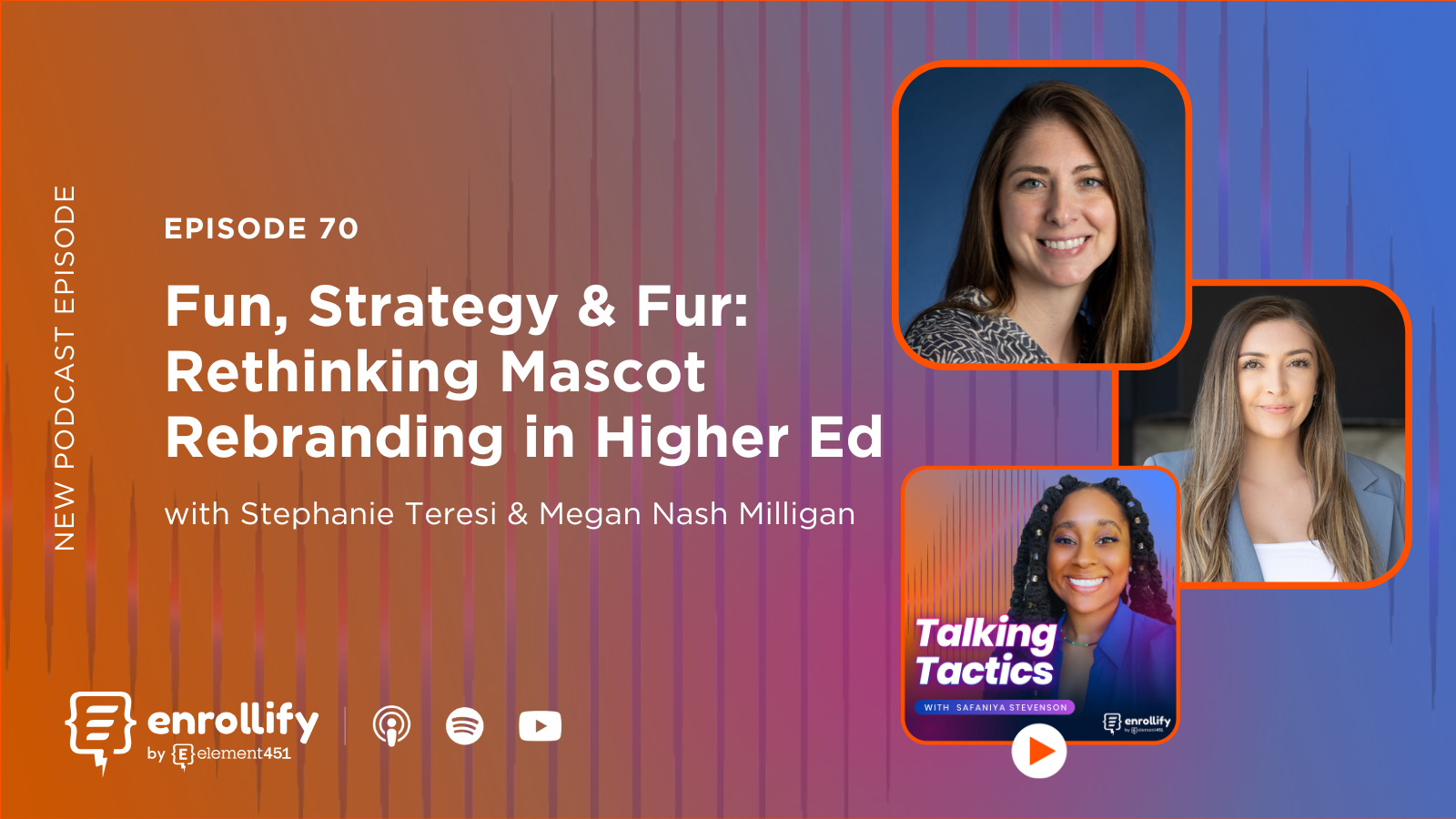
In this energizing episode of Talking Tactics, host Safaniya Stevenson sits down with Megan Nash Milligan, Brand Marketing Strategist, and Stephanie Teresi, Associate Director of Trademarks, Licensing and Promotional Assets at Loyola Marymount University (LMU). Together, they unpack the strategic mascot rebrand that transformed “Iggy” from an under-managed costume into a campus-wide brand powerhouse.
What sounds like a story about fun and fur is actually a masterclass in enrollment marketing, brand governance, and higher education content marketing. From building a three-year phased rollout plan to leveraging licensing strategy and ESPN-level exposure, LMU’s mascot glow-up proves that tradition doesn’t just happen — it’s built.
If you’ve ever underestimated the power of a mascot, this episode will challenge that assumption in the best way.
Key Takeaways
- A successful mascot rebrand requires infrastructure, governance, and long-term planning — not just a new costume.
- Cross-functional collaboration between athletics and central marketing strengthens institutional brand alignment.
- Mascots can play a powerful role in enrollment marketing and student engagement beyond athletics.
- Trademark protection and licensing strategy are critical for brand control and revenue generation.
- Strategic retail launches and experiential activations drive measurable ROI.
- A phased, multi-year rollout sustains momentum and builds campus traditions.
- A centralized mascot website supports higher education content marketing, media visibility, and brand consistency.
- Mascot programs require leadership buy-in, student involvement, and operational structure to scale effectively.
Episode Summary
How Do You Turn a Mascot Into an Enrollment Marketing Asset?
At LMU, Iggy didn’t just get a facelift — he got a strategy.
When Megan and Stephanie arrived, the mascot lived primarily in athletics with little centralized oversight. Requests were informal, governance was minimal, and there was no long-term brand vision. Recognizing the opportunity, the MarCom team repositioned Iggy as a university-wide brand ambassador, not just an athletics accessory.
This shift reflects a broader trend in enrollment marketing: institutions must engage students where they actually are. At LMU, many students don’t attend games — they’re drawn by film, creativity, and Los Angeles culture. So Iggy began appearing at Wellness Wednesdays, campus coffee shops, and student life events, embedding himself into everyday campus culture.
The lesson? Mascots aren’t just spirit symbols. They can be storytelling vehicles that strengthen student connection, build affinity, and reinforce brand identity across the student lifecycle.
What Infrastructure Is Required for a Successful Mascot Rebrand?
Before the new costume debuted, LMU built the foundation.
Stephanie emphasizes auditing your infrastructure first: Who owns the mascot? Who protects the intellectual property? Who manages performers? How will licensing and monetization work? Without answers to these questions, even the most exciting reveal will fade quickly.
LMU created an Iggy handbook, appearance criteria, and a dedicated website. They trademarked a full suite of mascot marks and established licensing controls to protect the brand internally and externally. This level of governance prevents misuse and ensures the mascot aligns with institutional standards.
In higher education content marketing, consistency is currency. By structuring the program before the spotlight moment, LMU ensured that excitement could convert into sustained brand equity.
Why Take a Three-Year Phased Approach?
Here’s where LMU courageously questioned the status quo: they didn’t treat the rebrand as a one-time reveal.
Instead, they implemented a three-year phased rollout plan. Year one focused on unveiling Iggy’s refreshed look at a high-energy basketball game. Year two introduced “Iggy’s Birthday” — a large-scale activation featuring professional mascots from the LA Rams, LA Galaxy, UCLA, and USC.
This phased strategy allowed the team to build traditions intentionally. LMU doesn’t have deep-rooted, decades-old rituals — so they’re creating them. Each activation builds anticipation for the next, reinforcing emotional attachment over time.
Momentum isn’t accidental. It’s operationalized.
How Does Licensing and Retail Strategy Drive ROI?
Mascots are emotional — but they’re also intellectual property.
Stephanie worked with a collegiate design firm to develop a protected suite of Iggy marks. These were trademarked and tightly controlled under LMU’s licensing program. The goal? Prevent brand dilution while strategically expanding retail offerings.
The results speak for themselves. During Parents Weekend, LMU launched Iggy merchandise alongside a “Meet the Mane Man” activation. A photo booth, exclusive drops, and limited availability drove over $20K in a single day, with continued sell-through and nearly $10K in ongoing Iggy merch sales.
This is where enrollment marketing intersects with revenue strategy. When brand affinity is high and access is controlled, desirability increases. The mascot becomes both a cultural symbol and a retail driver.
What Role Does Content Play in Mascot Strategy?
The Iggy website was originally built as a simple information hub — a place to document his history and house appearance requests.
Then ESPN found it.
Without pitching directly, ESPN pulled historical images and rebrand information from the site for a nationally aired segment. The reason? LMU had already done the foundational work. The assets were centralized, organized, and accessible.
This moment underscores the compound value of strong higher education content marketing. When your brand storytelling is structured and searchable, opportunities can find you.
Sometimes the ROI of infrastructure shows up when you least expect it.
How Do You Balance Mascot Energy With Institutional Identity?
One risk of a high-performing mascot program is overshadowing the institutional brand.
LMU approached this thoughtfully. Their university rebrand in 2019 tightened visual identity standards, and Iggy was introduced as an extension — not a replacement — of that system. His use is strategic, not ubiquitous.
Appearance criteria, request approvals, and internal controls ensure Iggy remains special. He doesn’t attend everything. He doesn’t stay for three hours. Scarcity preserves excitement.
In brand strategy, discipline builds desirability.
What Should Schools Do Before Launching a Big Mascot Moment?
According to Megan and Stephanie: audit your infrastructure first.
Establish ownership. Secure leadership buy-in. Protect your marks. Define licensing strategy. Create clear appearance guidelines. Build cross-campus relationships. And ensure you have enough operational support to manage growth.
Mascot programs are no longer one-person side projects. Like social media in higher ed, they’ve evolved into multi-faceted brand platforms requiring coordination and strategy.
And when done right? They build joy, tradition, revenue, and long-term brand equity.
If this episode sparked ideas about how your mascot could elevate your enrollment marketing strategy or strengthen your higher education content marketing efforts, don’t stop here. Listen to the full episode of Talking Tactics with Safaniya Stevenson to hear the full story behind Iggy’s transformation — and explore more conversations across the Enrollify Podcast Network designed to help you question the status quo and market smarter.
Connect With Our Host:
Enrollify is produced by Element451 — the next-generation AI student engagement platform helping institutions create meaningful and personalized interactions with students. Learn more at element451.com.




.svg)
.svg)
