






About the Episode
About the Episode:
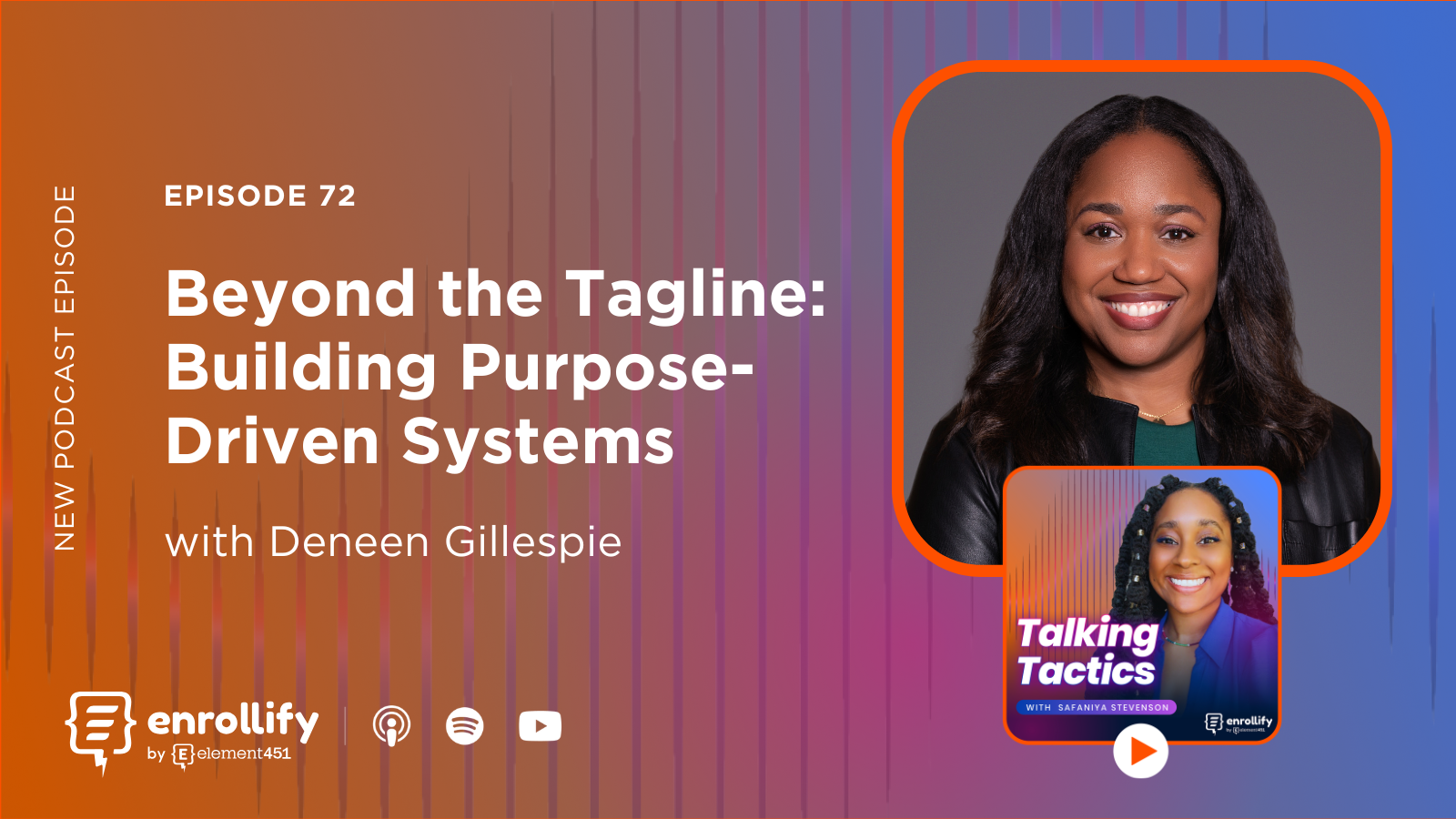
What happens when the brand is not the lead but the work is? In this episode of Talking Tactics, Safy sits down with Deneen Gillespie to unpack a bold shift from traditional branding to purpose-driven systems thinking. From navigating system-level marketing to redefining what “brand” actually means, this conversation challenges everything you thought you knew about building influence. You will hear how focusing on collective impact, not just creative, can unlock real results across institutions. If you have ever questioned whether your brand is actually doing its job, this one is for you.
Key Takeaways
- Purpose > Brand: A clear, shared purpose drives stronger results than a top-down brand strategy.
- System-Level Marketing Requires Trust: Collaboration across campuses hinges on relationship-building, not authority.
- “Brandless” Doesn’t Mean Identity-Free: It means prioritizing what actually needs branding—and what doesn’t.
- Unified Campaigns Drive Enrollment Impact: Coordinated messaging around affordability and access can significantly boost inquiries and applications.
- Community-Centered Storytelling Wins: Hyper-local, human-centered campaigns outperform generic institutional messaging.
- Data + Transparency Build Buy-In: Demonstrating real results is key to aligning stakeholders across institutions.
- Modern სტუდენტ Expectations Are Changing: Today’s students demand clarity, affordability, and real human connection—beyond what AI or static content can provide.
Episode Summary
What Does It Mean to Take a “Brandless” Approach in Higher Education Marketing?
The idea of going “brandless” might sound like heresy in a field obsessed with positioning and perception—but Deneen reframes it in a compelling way. It’s not about abandoning brand altogether; it’s about being intentional with what actually deserves branding. At the system level, this means shifting focus away from promoting a centralized identity and instead amplifying the collective strength of individual institutions.
Rather than forcing a unifying brand across campuses, the University of Illinois System chose to highlight relationships—between universities, communities, and the state. This approach allowed each campus to maintain its unique voice while benefiting from shared infrastructure and storytelling frameworks. The system becomes the stage, not the star.
This is a critical evolution in higher education content marketing. Instead of creating top-down narratives, marketers are curating ecosystems of stories that reflect real impact. And in doing so, they’re building something far more credible than a tagline: trust.
How Do You Align Multiple Institutions Around a Shared Marketing Strategy?
System-level marketing introduces a unique challenge: how do you unite institutions that may also be competing for the same students? Deneen emphasizes that the answer isn’t control—it’s collaboration. Her role required a mindset shift from being a “creator” to becoming a “connector,” prioritizing trust over authority.
This trust is built through consistent communication and intentional relationship-building. Regular meetings with campus communicators, one-on-one conversations, and shared planning sessions create space for alignment without forcing conformity. It’s פחות about dictating strategy and more about co-creating it.
For enrollment marketers, this is a powerful reminder: your internal audience matters just as much as your external one. Without buy-in from stakeholders, even the most sophisticated marketing strategy for student recruitment will fall flat. Alignment isn’t a deliverable—it’s a discipline.
What Tactics Actually Drive Enrollment Results Across a System?
One standout example from the episode is the system-wide access and affordability campaign, which led to a surge in website traffic, inquiries, and applications. The results were so dramatic that campuses initially questioned whether the data was accurate.
So what worked? First, the campaign focused on real financial transparency—breaking down actual costs rather than relying on vague promises of affordability. Second, it featured diverse, relatable storytelling that reflected the lived experiences of prospective students. Third, it extended beyond digital channels into communities, equipping local leaders with toolkits to act as ambassadors.
This is enrollment marketing done right: clear, actionable messaging delivered through trusted channels. It’s also a masterclass in how data analytics in higher education can validate bold strategies and drive stakeholder confidence.
How Do You Bridge the Gap Between Brand Promise and Reality?
One of the most provocative moments in the episode centers on diagnosing the disconnect between what institutions say and what they actually do. Deneen challenges the conventional approach, suggesting that the real issue isn’t brand execution—it’s misalignment between brand and purpose.
She poses a critical question: Why does a university system need a brand at all? Without a clear answer, branding becomes what she calls “decorating a question mark.” It might look polished, but it lacks substance.
For marketers, this is a wake-up call. Before investing in rebrands or campaigns, institutions need to define their unique value proposition at a systemic level. Only then can brand language authentically reflect the work being done. This is where education market research and internal discovery become essential.
What Role Does Human Connection Play in Modern Student Recruitment?
In an era where AI tools are increasingly used to शोध college options, this campaign doubled down on something التكنولوجيا can’t replicate: real human connection. By making it easy for students and families to speak with actual ადამიანები, the system addressed one of the most frustrating aspects of the college search process—navigating complexity.
This approach acknowledges a key shift in student behavior. Today’s prospects are more cost-conscious, more skeptical, and more eager for clarity. While AI can فراہم information, it often lacks nuance—especially when comparing institutions within a system.
By prioritizing accessibility and responsiveness, the campaign didn’t just inform students—it empowered them. And that’s a cornerstone of effective student success strategies: meeting learners where they are with the support they actually need.
How Can Marketers Apply These Insights Today?
Deneen offers two actionable perspectives—one for system leaders and one for campus marketers. For system-level professionals, the advice is simple but challenging: resist assumptions. Instead, lean into curiosity, ask better questions, and take the time to define your true purpose before building a brand around it.
For campus marketers, the call is to be a willing partner. Collaboration requires openness, transparency, and a shared commitment to outcomes. It also requires clarity—because, as Deneen puts it, “clarity is the highest form of respect.”
These insights are հատկապես relevant as institutions navigate evolving trends in higher education marketing. The future belongs to those who can balance independence with interdependence—who can tell their own story while contributing to a larger narrative.
Connect With Our Host:
Enrollify is produced by Element451 — the next-generation AI student engagement platform helping institutions create meaningful and personalized interactions with students. Learn more at element451.com.




.svg)
.svg)
