






About the Episode
Got a story to tell? An innovative idea to share? Fill out our guest nomination form and let's chat!
About the Episode:
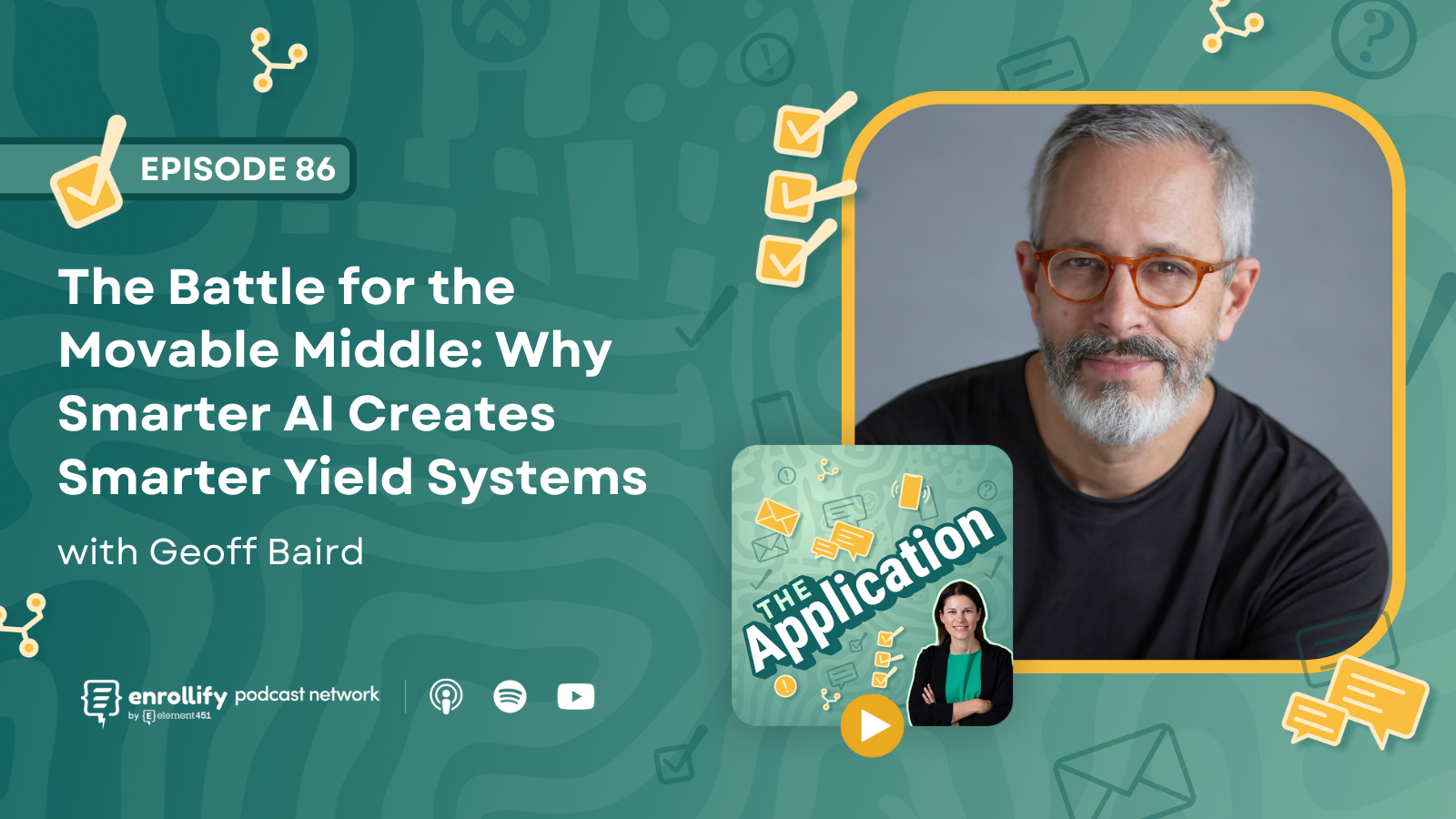
Are you still trying to out-volume your enrollment problems? More apps, more emails, more FAFSAs? What if the real solution isn’t more noise, but sharper signals? In this episode, Geoff Baird, Founder and CEO of Enroll ML, joins Allison to pull back the curtain on higher ed’s “Category 5 collision” and explains why the old playbook of chasing volume is broken. You’ll hear how application surges can actually hide intent, why the movable middle is where enrollment is won or lost, and how AI is changing the game by revealing hidden behavioral patterns.
Join us as we discuss:
- [2:38] The category five storm of forces that’s reshaping higher ed
- [8:06] How to analyze patterns of behavior to understand student intent
- [16:13] Unpacking the student decision process and smart AI vs. vanity AI
Check out these resources we mentioned during the podcast:
To hear this interview and many more like it, subscribe on Apple Podcasts, Spotify, or our website, or search for “The Application with Allison Turcio” in your favorite podcast player.
What is the “Category 5 Collision” in higher ed enrollment?
Geoff Baird opens the episode with a bold metaphor: higher ed is in the middle of a Category 5 storm—and it’s not just one challenge, but a collision of five major disruptions. First, there’s the well-documented demographic decline. Then comes the application surge, which has distorted key metrics. Add to that the growing interest in alternative pathways, increasing scrutiny on ROI and cost, and the “TikTok Effect”—students expecting hyper-personalized digital experiences. While institutions might be able to manage one or two of these forces, the real challenge is that they’re all happening simultaneously.
What’s the result? Traditional enrollment strategies are no longer sufficient. Schools can’t simply “out-volume” their problems with more outreach, more applications, and more email. They need to rethink their entire approach.
Why is the surge in applications misleading enrollment teams?
According to Baird, the de-frictioning of applications (thanks to tools like the Common App and easier FAFSA processes) has created what he calls expensive noise. More applications no longer mean more yield. In fact, they often hide the truth about student interest. As Baird explains, many institutions are still operating under the outdated assumption that filling the top of the funnel will naturally fill the bottom.
But in today’s market, that’s no longer true. Enrollment teams are swamped with “activity” that doesn’t translate into intent. The real challenge is identifying the small percentage of students—what Geoff calls the “movable middle”—who are genuinely persuadable but not actively raising their hands. That’s where the opportunity lies.
What signals are actually meaningful when measuring student intent?
Forget visit registrations and application timestamps—Baird argues that behavioral patterns are the real goldmine. With the help of machine learning, his team at Enroll ML is uncovering hundreds of behavioral signals that indicate real student interest. These include how a student engages with communications in key time windows (like the 30 days before and after submitting an application), how often they visit the website, and how they interact with personalized content.
The big insight? The same action—like visiting campus—can mean totally different things depending on the student. One might be deeply interested; the other might be just tagging along with a parent. AI allows teams to look beyond grouped segments and understand student behavior on an individual level, unlocking yield potential that traditional models miss.
How can enrollment teams act on these deeper signals?
Knowing a student is interested is only half the battle. The next step is taking action based on where they are in their decision-making journey. Baird introduces the “OSO” model—Objective, Subjective, Objective—as a simplified framework for how students make decisions. The middle “subjective” phase is where emotion, connection, and storytelling matter most.
If your marketing automation is delivering the wrong message for the wrong phase, you could be pushing students away. For example, triggering a decision deadline email before a student is emotionally ready might not help them commit—it might cause them to withdraw. By using AI to pinpoint where students are on their journey, enrollment teams can deliver the right message at the right time, with empathy and precision.
What does it mean to treat yield as a system, not a season?
Baird and Turcio both push back against the idea of “yield season” as a two-month sprint before May 1. Yield, they argue, starts from the moment a student first interacts with your brand. And in a world where attention is fractured and signals are diluted, every touchpoint counts. The institutions seeing the best results are the ones building systems that personalize outreach year-round—not just cranking up the pressure in the spring.
More importantly, these systems require collaboration across departments. Marketing, enrollment, student support, and even faculty need to be aligned around a shared understanding of student signals. That’s what enables a truly responsive and human-centered enrollment experience.
How can teams distinguish smart AI from “shiny AI”?
Let’s face it: there’s a lot of noise in the edtech space right now. As Geoff puts it, we’re still in the pre-game warm-up of AI in higher ed, but it already feels like the grand finale of a fireworks show. To avoid falling into the trap of “vanity AI,” leaders should ask two questions:
- What signals is the tool creating or processing?
- Does fixing this process lead to real enrollment outcomes?
True AI-driven value comes from tools that improve critical decision-making, not just flash new features. Baird recommends starting small—find a broken or leaky process, apply the right tool, and prove the impact before scaling. It’s not about having an “AI plan” for your board. It’s about solving real problems in meaningful ways.
Connect With Our Host:
Allison Turcio
https://www.linkedin.com/in/allisonturcio/
https://twitter.com/allisonturcio
About The Enrollify Podcast Network: The Application with Allison Turcio is a part of the Enrollify Podcast Network. If you like this podcast, chances are you’ll like other Enrollify shows, too!
Some of our favorites include Mission Admissions and Visionary Voices: The College President’s Playbook.
Enrollify is made possible by Element451 — the next-generation AI student engagement platform helping institutions create meaningful and personalized interactions with students. Learn more at element451.com.



.svg)
.svg)
