






About the Episode
About the Episode:
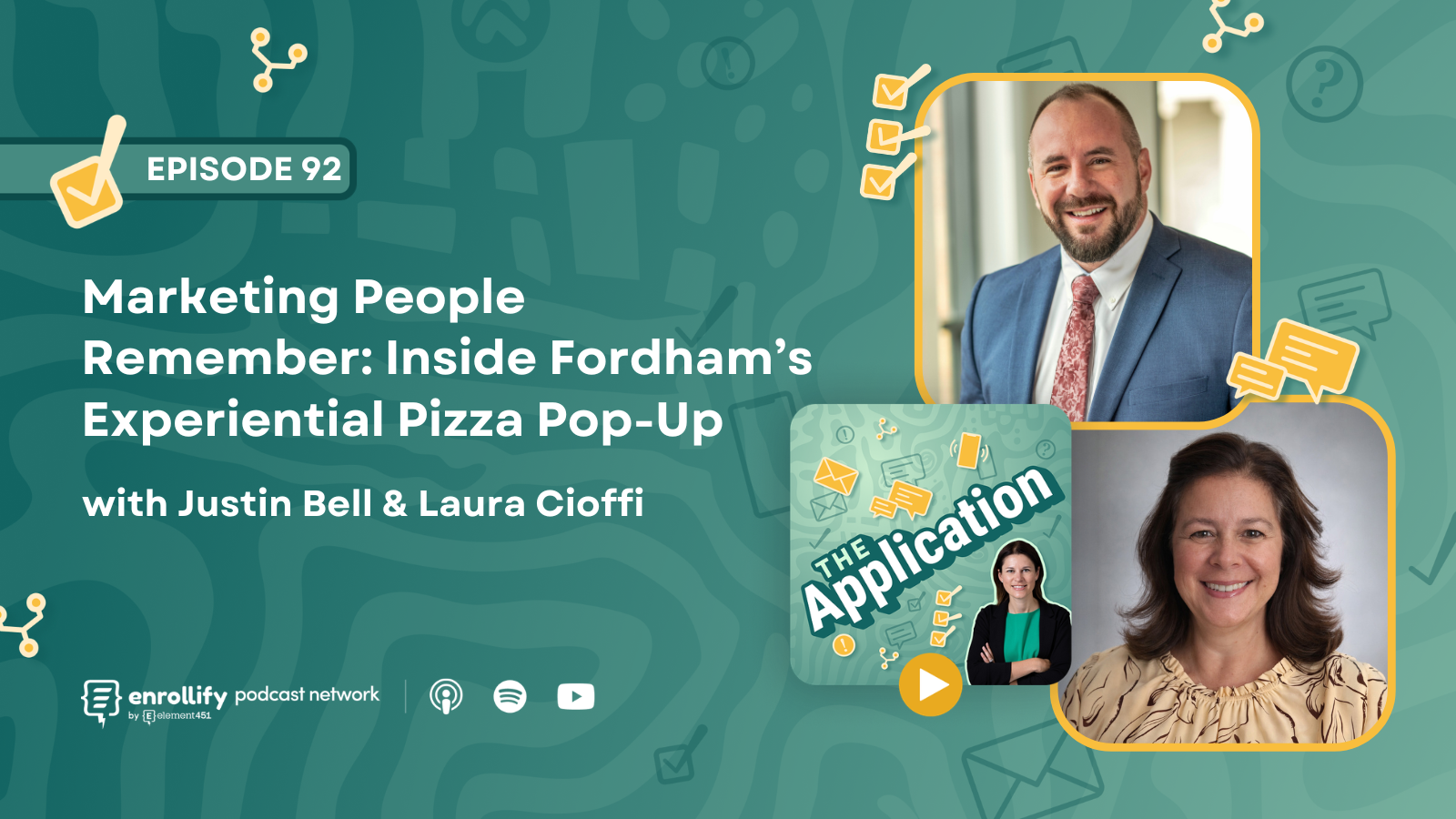
Higher ed marketing teams are competing in one of the noisiest environments we’ve ever seen, and traditional tactics often get lost in a “sea of sameness.” So Fordham University tried something different. At the NACAC conference, the team transformed a pizza shop across the street into a fully branded Fordham pop-up experience. With New York style pizza, music, and Fordham branding everywhere, the activation drew nearly 1,000 attendees in a single day. In this episode, Allison talks with Justin Bell and Laura Cioffi about how the idea came together, what they learned from launching the pop-up, and why experiential marketing works best when it’s amplified by traditional campaigns.
Join us as we discuss:
- [2:25] How Fordham brought a piece of New York to Columbus
- [11:17] What success and ROI look like in experiential marketing
- [17:50] Why experiential marketing needs amplification with traditional marketing
Check out these resources we mentioned during the podcast:
To hear this interview and many more like it, subscribe on Apple Podcasts, Spotify, or our website, or search for “The Application with Allison Turcio” in your favorite podcast player.
Episode Summary
Why does experiential marketing matter so much in higher education right now?
Higher ed marketers are operating in an environment where nearly every institution is fighting for the same sliver of attention. As Justin Bell puts it, many colleges and universities are stuck in a “sea of sameness,” where even strong programs and solid value propositions can blur together. That is exactly why experiential marketing is showing up as one of the most compelling trends in higher education marketing today.
In this episode, the Fordham team argues that experiential marketing works because it creates a personal, emotional connection in ways static advertising often cannot. Rather than simply telling people who Fordham is, the university gave NACAC attendees something tangible to feel, remember, and talk about. That shift from message delivery to memory creation is what made the activation so sticky.
The conversation also makes clear that this is not experiential marketing for the sake of being flashy. It is a strategic extension of enrollment marketing that helps institutions stand out with intention. For schools trying to sharpen their marketing strategy for student recruitment, the big takeaway is simple: relevance and resonance matter just as much as reach.
How did Fordham turn a pizza shop into a high-impact brand experience?
Fordham’s activation started with a big idea and a very short runway. Roughly 45 days before NACAC, the team began exploring how to bring an authentic New York experience to Columbus, Ohio, and quickly landed on pizza as the most natural expression of Fordham’s location and identity. From there, the concept evolved from food truck brainstorming into a full restaurant takeover directly across from the convention center.
What made the pop-up so effective was the depth of the execution. The pizza shop was fully transformed with Fordham branding, from logo-woven tablecloths and signage to menus, photo booth elements, boxes, and framed visuals throughout the space. It was not a sponsorship slapped onto a lunch break; it was a carefully built environment that invited people to experience Fordham’s brand story through hospitality, atmosphere, and fun.
That brand story mattered. Fordham had recently launched a refreshed institutional brand centered on its New York identity, so the pizza shop became a live-action expression of that positioning. Justin and Laura explain that the goal was not only to showcase Fordham as a university in New York, but to create the same feeling of welcome, belonging, and community that students experience on campus.
What can enrollment marketers learn from Fordham’s results and strategy?
One of the strongest parts of this episode is how honestly the guests talk about measurement. They acknowledge that experiential marketing does not always fit neatly into the click-driven dashboards many higher ed teams rely on, but that does not mean it lacks accountability. Instead, Fordham defined success through a mix of attendance, social buzz, relationship-building, and downstream recruitment impact.
The numbers are hard to ignore. Fordham expected roughly 300 to 400 visitors and saw about 950 people come through the activation in a single day. The team also captured counselor information through QR codes, built a follow-up strategy around those relationships, and later saw early lifts in applications, including a reported 49% increase from Ohio and a 47% rise from high schools connected to counselors who engaged with the experience.
For marketers thinking about trying something similar, Justin and Laura offer practical advice that applies well beyond a pizza pop-up. Start earlier than you think you need to, build around a real audience need, and amplify the experience with other channels like email, retargeting, and out-of-home media. Most importantly, define the feeling you want people to have, because the emotional outcome is not fluff; it is the strategy.
How can colleges and universities start smaller with experiential enrollment marketing?
Not every institution has the budget, team, or appetite to launch a conference takeover on the first try. Laura makes an important point in the episode: experiential marketing is not all-or-nothing. Schools can begin with smaller, more manageable activations that still create meaningful connection and brand differentiation.
That could look like rethinking the campus visit experience, inviting a select group of students into a tradition-rich event, or building an academic hands-on moment that reflects institutional strengths. The goal is not necessarily scale on day one. The goal is to create a branded experience that feels intentional, memorable, and human.
This is especially relevant for teams trying to modernize their higher education content marketing and in-person recruitment strategies at the same time. The smartest institutions are not choosing between digital and physical touchpoints; they are building ecosystems where each channel reinforces the other. Fordham’s story is a reminder that bold ideas often work best when they are supported by smart promotion and a crystal-clear sense of brand.
Connect With Our Host:
Allison Turcio
https://www.linkedin.com/in/allisonturcio/
https://twitter.com/allisonturcio
Enrollify is made possible by Element451 — the next-generation AI student engagement platform helping institutions create meaningful and personalized interactions with students. Learn more at element451.com.






.svg)
.svg)
